
Mesh WiFi vs WiFi 7 Router: Which Is Right?
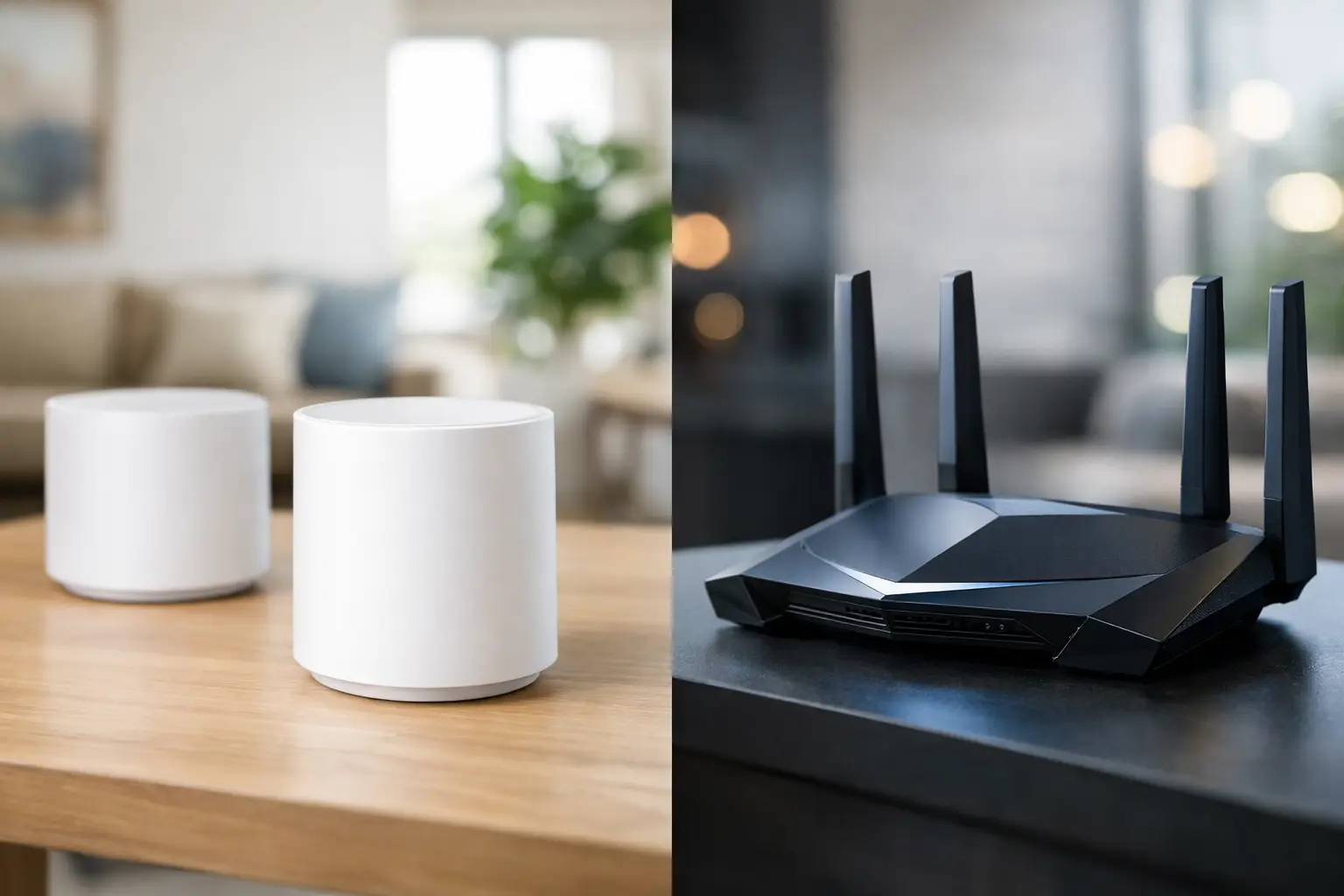
A beautiful home can be full of smart conveniences and still feel frustratingly disconnected. The projector buffers just as guests arrive, a video call drops in the upstairs office, or a new patio camera struggles to stay online. The mesh WiFi vs WiFi 7 router decision matters because it shapes how reliably every connected detail of your home performs.
The first distinction is easy to miss: mesh WiFi and WiFi 7 describe different things. Mesh is a network design built around multiple access points working together across a larger space. WiFi 7 is a newer wireless standard designed for higher speeds, lower latency, and better handling of many demanding devices. You can choose a mesh system with WiFi 7, a single WiFi 7 router, or an older mesh setup that may be a better fit for a smaller home.
For shoppers creating a high-end haven, the right answer is less about chasing a specification and more about matching coverage, construction, internet service, and connected lifestyle to the space you actually use.
Mesh WiFi vs WiFi 7 Router: The Essential Difference
A traditional router is one central device, usually placed near the modem. It broadcasts WiFi outward from that location. A WiFi 7 router follows this familiar design but brings a more advanced wireless platform, including access to the 6 GHz band on compatible models, wider channels, and technology that can send and receive data more efficiently.
A mesh system uses a main router plus one or more satellite nodes. Rather than expecting one device to reach every corner, each node extends the network into another part of the home. Ideally, your phone, laptop, smart TV, and other devices move between nodes without requiring you to switch networks manually.
That means a WiFi 7 router may deliver exceptional performance close to its location, while a mesh system is designed to make performance more consistent across floors, rooms, and outdoor living areas. Neither label automatically guarantees a better experience.
A single WiFi 7 router can be the elegant, high-performance choice for a compact apartment, a loft with an open floor plan, or a modest single-story home where the router can sit near the center. A mesh system tends to earn its place in larger homes, layouts with multiple levels, properties built with brick or concrete, and homes where the connection needs to reach a detached office, garage, or patio.
What WiFi 7 Changes in Daily Use
WiFi 7 is engineered for homes where several high-bandwidth activities happen at once. Think 4K streaming in the living room, competitive gaming in a media space, a work call in the study, cloud backups from multiple phones, and security cameras recording in the background. Its upgrades are intended to reduce congestion and improve responsiveness when the network is busy.
One standout feature is Multi-Link Operation. Compatible devices can use more than one wireless band at the same time, helping data find a cleaner route instead of waiting on a crowded channel. WiFi 7 also supports wider 320 MHz channels in the 6 GHz band, which can increase potential speeds when both the router and device support them.
There is an important qualification: WiFi 7 does not transform every device overnight. An older laptop, television, smart speaker, or thermostat can still connect, but it will use the WiFi generation it supports. The biggest gains arrive with newer phones, computers, gaming hardware, and WiFi 7-ready streaming devices.
Your internet plan matters too. If your service is 300 Mbps, a premium WiFi 7 router may improve local responsiveness and device management, but it cannot turn that plan into multi-gigabit internet. If you already have gigabit or multi-gig service and frequently transfer large files, stream high-resolution content, or rely on a serious home office, WiFi 7 becomes much more compelling.
When Mesh Is the Better Upgrade
Coverage problems are not always speed problems. A fast router in one room cannot overcome the physical realities of a long hallway, a dense floor, metal-framed walls, radiant heating, stone finishes, or a distant outdoor entertaining area. In those cases, buying a more powerful single router may improve one zone while leaving another unreliable.
Mesh distributes the signal closer to where it is needed. A node in the upstairs hall can support bedrooms and a home office. Another near a rear door can improve coverage for outdoor speakers, landscape lighting controls, and cameras around a deck or pool area. The result is not merely a stronger signal indicator. It is a home where smart features feel considered rather than temperamental.
Mesh systems are also appealing because management is usually straightforward. Many offer app-based setup, device prioritization, guest networks, parental controls, and security options. That simplicity can be especially valuable when guests, family members, and an expanding collection of connected products share the same network.
Still, placement is everything. A mesh node cannot create speed from a weak connection. Each satellite needs a strong link to the main router or another node. Tucking one inside a cabinet, placing it behind a television, or spacing nodes too far apart undermines the benefit. For the cleanest installation, place nodes on open furniture at mid-height, away from large metal objects and dense electronics.
The Best Option for Different Home Layouts
For a refined apartment or smaller home under roughly 1,500 square feet, a single WiFi 7 router is often the smarter purchase. Position it centrally and in the open, and it can provide impressive speed without adding extra equipment to your decor. This route is especially attractive if your priority is a new laptop, console, or home theater setup that can take advantage of WiFi 7 performance.
For a larger single-story home, the choice depends on the floor plan and materials. An open, airy layout may still work beautifully with one WiFi 7 router. A sprawling ranch home with bedrooms at one end and a media room at the other is usually better served by mesh.
For two-story homes, townhomes, and properties above 2,000 square feet, mesh becomes the more reliable starting point. Floors and structural elements create natural signal barriers. A two- or three-node arrangement can preserve quality upstairs without placing the main router in an awkward compromise location.
For a smart home with many cameras, locks, sensors, speakers, appliances, and displays, prioritize a system with strong device capacity and a dedicated IoT network option. Many smart-home products still use 2.4 GHz, which travels farther but can become crowded. Separating those devices from laptops, phones, and entertainment gear can make the network easier to manage.
The Premium Choice: WiFi 7 Mesh
For many larger, technology-rich homes, WiFi 7 mesh is the most complete answer. It combines the reach of multiple nodes with the capacity and low-latency potential of the latest standard. This is the configuration worth considering when the home includes a serious entertainment space, multiple remote workers, fast internet service, or a growing ecosystem of premium connected products.
It is also the most expensive path, and not every household will see a proportional return immediately. A WiFi 6 or WiFi 6E mesh system can still be an excellent choice when internet speeds are moderate and most devices are not WiFi 7-ready. Quality placement and a thoughtful layout usually make more difference than a headline-grabbing maximum speed.
If you select mesh, look closely at backhaul. Backhaul is the connection between the main router and its satellite nodes. Wired Ethernet backhaul is the preferred option where possible because it preserves more wireless capacity for your devices. In a home being renovated or newly built, running Ethernet to key locations is a quietly valuable investment. It supports a cleaner, more dependable setup for years to come.
Wireless backhaul is easier to install and often performs very well, particularly on tri-band or WiFi 7 systems. Just remember that a node serving a distant room is only as capable as the signal it receives. For an outdoor office or a detached space, a wired run or purpose-built point-to-point connection may be more dependable than simply adding another mesh node.
Before You Choose, Check These Details
Start with your internet speed, then consider where the modem enters the home. If it sits in a basement corner or utility closet, a single router may begin at a disadvantage. You may be able to move the router using Ethernet, or use mesh to bring coverage into the rooms that matter most.
Next, count the devices that are active at the same time, not just the total number you own. A household with two phones and one television has different needs from one with remote workstations, 4K displays, gaming systems, cameras, smart appliances, tablets, and outdoor entertainment technology.
Finally, look for practical hardware details: multi-gig Ethernet ports if you have fast service or wired devices, enough LAN ports for a media cabinet, WPA3 security, easy guest access, and an app that makes routine management feel effortless. The most exquisite hardware is only valuable if it supports the way your household lives.
A router should disappear into the background after setup. Choose the single WiFi 7 router when your space is compact and speed near the center is the priority. Choose mesh when consistent coverage is the missing piece. And when a larger home deserves both, WiFi 7 mesh creates the kind of quiet, dependable foundation that lets every connected comfort perform at its best.











Leave a comment