
Do Massage Guns Actually Work? The Evidence-Backed Benefits
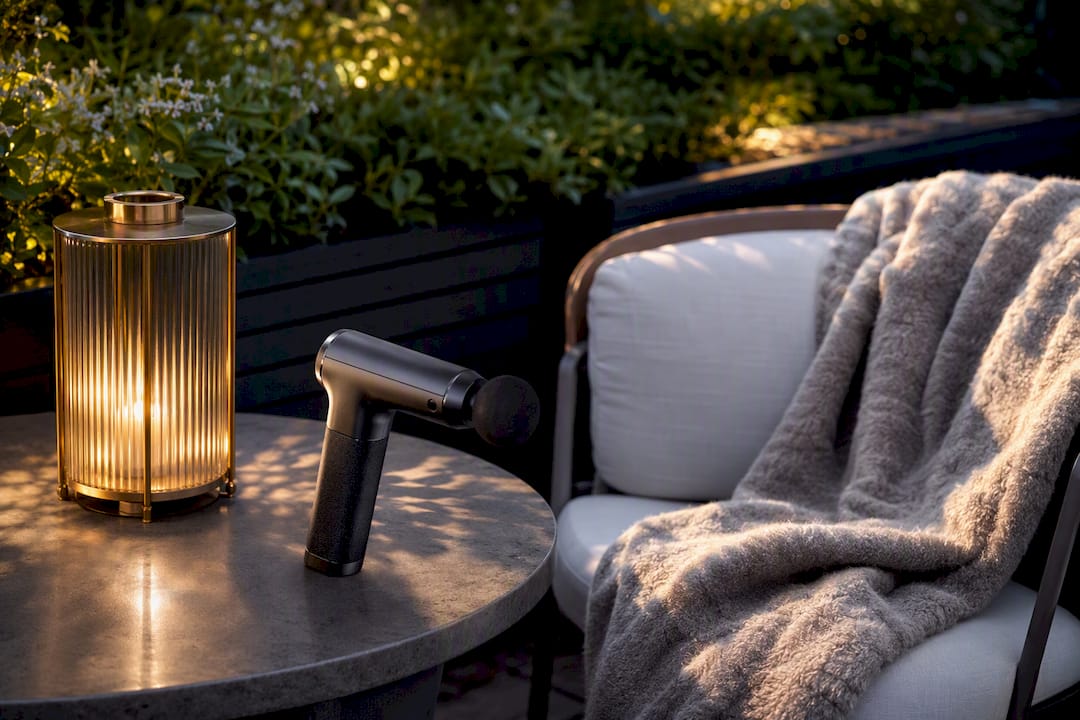
Massage guns deliver real, measurable benefits, just not the ones most marketing implies. The strongest evidence points to short-term improvements in range of motion, flexibility, muscle stiffness, and how sore you feel after a hard workout. What the research does not support, at least not yet, is a consistent boost to strength, power, or explosive performance, and there is no solid proof that percussive therapy changes muscle tissue over the long term.
Here is what a percussive device reliably does when used correctly:
- Loosens tight muscles and eases trigger points within minutes
- Produces short-term gains in flexibility and joint range of motion
- Reduces the intensity of delayed-onset muscle soreness (DOMS) after training
- Increases local blood flow to the treated area
- Lowers perceived stress and promotes relaxation
- Offers a quick, targeted alternative to foam rolling for specific muscle knots
The most consistent finding across clinical reviews is this: massage guns work well as a short-term recovery tool, but they are not a substitute for training, physical therapy, or medical treatment when something is actually injured.
Skip it, or check with a clinician first, if you have a blood clot risk, an open wound, a recent fracture, or numbness in the area you plan to treat.
Key Takeaways
Massage guns reliably improve short-term flexibility, muscle tension, and post-exercise soreness, but strength and long-term structural benefits remain unproven.
| Point | Details |
|---|---|
| Short-term ROM gains are real | Trials show modest flexibility improvements of a few degrees within minutes of use. |
| Strength claims are unproven | Evidence for strength, power, and explosive performance is mixed or absent across reviews. |
| DOMS relief is the biggest draw | Small trials show reduced post-exercise soreness compared to no treatment. |
| Safety rules matter | Avoid bones, wounds, and clot-risk areas; keep sessions under two minutes per spot. |
| Durability separates good devices | Mytotaltake curates massage and wellness gadgets for motor and battery longevity, not just speed specs. |
Table of Contents
- Massage Gun Benefits Start With Understanding Percussive Therapy
- What Massage Guns Can (and Can’t) Do for Your Body
- What the Research Actually Shows About Massage Gun Effectiveness
- How to Use a Massage Gun Safely and Effectively
- When Massage Guns Are Risky and Who Should Avoid Them
- How Often to Use a Massage Gun Without Overdoing It
- What to Look for When Choosing a Massage Gun
- Cleaning and Maintaining Your Massage Gun for the Long Haul
- An Editor’s Take on Massage Gun Hype vs. Reality
- A Smarter Way to Shop for Recovery Devices
- Sources
Massage Gun Benefits Start With Understanding Percussive Therapy
A massage gun delivers percussive therapy: rapid, repetitive pulses of pressure into a muscle, typically at 20 to 60 percussions per second, with a stroke length (amplitude) that ranges from about 4 to 16 millimeters depending on the device. That combination of frequency and amplitude is what separates a massage gun from a simple vibration plate. The head strikes the muscle, retracts, and strikes again, driving pressure deep into tissue without you having to apply your own body weight the way you would rolling on a foam roller.
That mechanical difference matters more than most buying guides admit. Foam rolling relies on your own weight and movement to create sustained pressure across a broad area, which makes it excellent for large muscle groups like the quads or lats but clumsy for something small and specific, like a knot under the shoulder blade. A massage gun does the opposite: it excels at pinpoint work but takes longer to cover a big surface area. Manual massage from a trained therapist sits somewhere between the two, adding human judgment about pressure and problem areas that no device can replicate.
So when does each tool make sense?
- Massage gun: targeted knots, a quick five-minute session before or after a workout, travel recovery when a foam roller will not fit in a bag
- Foam roller: large muscle groups, whole-body myofascial release, budget-friendly daily use
- Manual massage: complex pain patterns, deep tissue work, situations that need a trained eye rather than a fixed pulse pattern
Some comparative research has actually found no measurable difference between vibrating foam rollers and massage guns on certain outcomes, which suggests the tool matters less than the consistency of application. If you already own a foam roller and use it regularly, a massage gun is an upgrade in convenience and precision, not a guaranteed leap in results.
What Massage Guns Can (and Can’t) Do for Your Body
The honest picture on massage gun benefits requires separating what is well-supported from what is still speculative. Here is each claimed benefit, broken down by what the evidence actually shows.
Reduced muscle tension and trigger-point relief
This is the benefit massage guns were essentially built for, and it holds up. The percussive action applies rapid, localized pressure to tight bands of muscle fiber, often called trigger points, encouraging them to release faster than static pressure alone. University of Utah Health lists muscle tension reduction as one of the primary, clinically supported benefits, alongside circulation and nervous system stimulation.
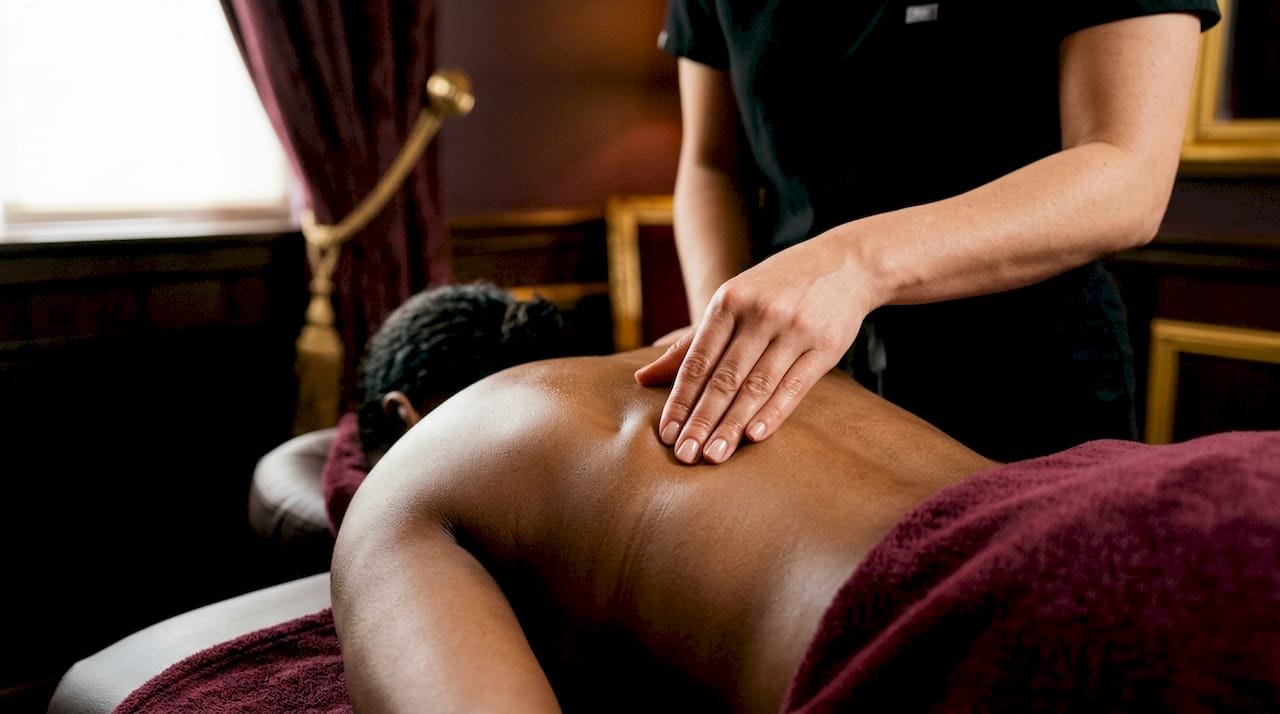
In practice, this means hovering over a tight spot in your upper trap or calf for 30 to 60 seconds usually produces a noticeable, if temporary, softening of the tissue. The takeaway: use it as a targeted tool for known problem spots, not a blanket full-body treatment.
Improved circulation and lymphatic flow
Percussive pressure pushes blood into the treated area, and Cleveland Clinic confirms massage guns can increase local blood flow and relieve muscle tightness. More circulation to a fatigued muscle theoretically speeds the clearance of metabolic byproducts, which is part of why athletes reach for these devices between sets or after a long run.
The lymphatic effect is less rigorously studied but plausible given the same mechanical logic: repeated pressure waves can assist fluid movement near the surface of the skin. Treat this as a supporting mechanism rather than a headline benefit on its own.
Reduced DOMS and faster subjective recovery
If you have ever used a massage gun the morning after leg day, you already know this one. Healthline points to small trials showing massage guns may reduce delayed-onset muscle soreness, with one recent randomized trial reporting less soreness in the treated group compared to a control. Cleveland Clinic echoes this, noting the tool can meaningfully reduce post-exercise soreness even though it will not replace an actual recovery day.
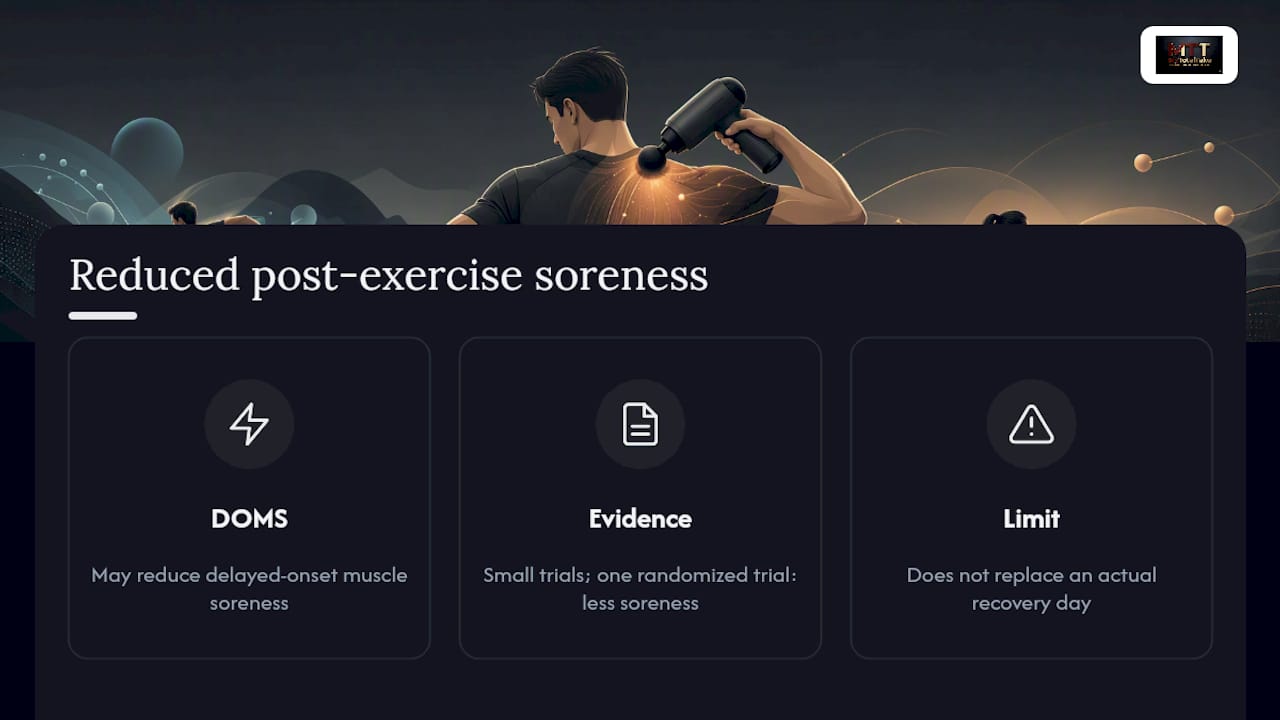
This is one of the most reliably reported effects across consumer and clinical sources alike, and it is probably the single biggest reason recreational athletes buy one in the first place.
Short-term increases in range of motion and flexibility
Here is where the numbers get specific. A systematic review published in PMC found brief massage gun application produced measurable short-term gains in range of motion: the Thomas test (a hip flexor flexibility measure) improved by roughly 4.5 to 5.4 degrees, the 90-90 hip test improved by about 3.4 to 4.8 degrees, and the weight-bearing ankle lunge test improved by roughly 3.9 to 4.3 degrees.
Short applications of percussive therapy, often under two minutes per muscle group, produced flexibility gains comparable to a light dynamic warm-up in several of the reviewed trials.
Those are modest but real gains, and they show up fast, often within a single 30 to 60 second application. A separate 2023 review of percussive therapy found similar acute increases in flexibility after a single treatment session. None of this means your hips will stay more flexible tomorrow. The effect is a window, not a permanent change.
Relaxation and stress relief
The psychological benefit gets less attention than it deserves, but using relaxing scents can enhance this effect as shown in the top spa candle scents for stress relief used for self-care practices. The rhythmic pressure and vibration of a massage gun activate a mild parasympathetic response for many people, similar to the calming effect of manual massage, and university health guidance lists nervous system stimulation as a legitimate mechanism alongside the physical effects. If you use one at the end of a long workday rather than after a workout, you are getting a stress-relief benefit that has nothing to do with athletic performance at all.
The limits: strength, power, and long-term change
This is the part that deserves more honesty than most product pages give it. The same PMC systematic review found mixed or absent improvements in strength, balance, acceleration, agility, and explosive movement following massage gun use. A single application might produce a temporary bump in explosive strength in some studies, per the 2023 review of thirteen trials, but the effect is inconsistent across the literature, and no study has shown that regular use permanently restructures muscle tissue or builds strength the way training does.
Practical takeaways:
- Use a massage gun to loosen up before a workout, not to replace your warm-up sets
- Expect flexibility and soreness benefits, not strength gains, from regular use
- Pair it with actual training and mobility work rather than treating it as a standalone fitness tool
What the Research Actually Shows About Massage Gun Effectiveness
The clinical picture on massage gun effectiveness is more nuanced than either the skeptics or the marketing copy suggest. Reviewers agree the devices produce real short-term benefits, and they agree the studies backing those claims have real limitations.
The 2023 systematic review of percussive therapy analyzed thirteen studies and concluded that single applications can produce acute gains in muscle strength, explosive strength, and flexibility, while repeated treatments reduced musculoskeletal pain over time. The PMC review covering performance and recovery outcomes reached a similar conclusion on flexibility and recovery, but found the evidence for strength, balance, and agility improvements was mixed or missing entirely, and flagged that most included trials carried a moderate risk of bias.
| Study Focus | Protocol | Reported Effect |
|---|---|---|
| Range of motion (hip, ankle) | Brief single application, 30 to 90 seconds per site | ROM gains of roughly 3.4 to 5.4 degrees across tested joints |
| Strength and explosive power | Single application before testing | Mixed results; some acute gains, others no measurable change |
| Musculoskeletal pain | Multiple treatments over time | Reported reduction in pain scores |
| DOMS / soreness | Post-exercise application | Reduced subjective soreness in small trials |
A review author’s core caution bears repeating: most positive findings come from short-term studies with small sample sizes, inconsistent protocols, and comparator groups that vary from one trial to the next.
The gaps worth knowing about before you put too much faith in any single claim:
- Most trials measure effects within minutes to hours, not weeks or months
- Sample sizes tend to be small, often a few dozen participants at most
- Protocols vary widely in session length, frequency, and device settings, making comparisons across studies difficult
- Few studies compare massage guns directly against other recovery tools using identical conditions
None of this means the benefits are fake. It means the science currently supports confident claims about short-term relief and flexibility, and tentative claims about anything longer.
How to Use a Massage Gun Safely and Effectively
The short answer: 15 to 120 seconds per muscle group, moderate pressure, and never directly on bone, joints, or bruised tissue. Beyond that baseline, how you use the device changes depending on your goal.
- Pre-workout warm-up: Glide the head slowly over major muscle groups you are about to train, 30 to 60 seconds each, using a low-to-medium speed setting. This primes tissue and can contribute to the short-term flexibility gains documented in clinical trials.
- Post-workout cool-down: Target the muscles you trained hardest for 60 to 90 seconds each, using a flatter or ball attachment. This is where the DOMS-reduction benefit is strongest.
- Targeted knot relief: Hold the device over a specific tight spot for 30 to 60 seconds, applying gentle downward pressure. Stop as soon as the tissue softens; more time is not automatically better.
- Daily recovery for stiffness: A short five-to-eight-minute session covering your neck, shoulders, and lower back can offset a day of sitting, using the lowest comfortable speed setting.
Dos and don’ts:
- Do use a rounded or flat attachment on large muscles and a bullet attachment only on small, deep trigger points
- Do stop immediately if you feel sharp pain, numbness, or tingling
- Don’t run the device directly over bones, joints, the spine, or the front of the neck
- Don’t use it on bruises, open cuts, or areas of recent injury
- Don’t exceed about two minutes on any single spot in one session
Pro Tip: Combine massage gun work with dynamic stretching for the best pre-workout results, and pair it with static stretching or foam rolling afterward. The gun loosens tissue fast; stretching helps lock in the range-of-motion gain a little longer.
When Massage Guns Are Risky and Who Should Avoid Them
A massage gun is not risk-free just because it is sold as a wellness gadget. A handful of conditions turn this from a helpful recovery tool into something you should set aside until you talk to a clinician.
Clear contraindications:
- Open wounds or recent cuts: direct pressure can worsen the injury and increase infection risk
- Deep vein thrombosis risk: percussive pressure near a clot can dislodge it, which is a medical emergency
- Acute fractures or recent surgery: tissue near the site needs to heal before any mechanical pressure is applied
- Areas with reduced sensation: if you cannot feel pain accurately (nerve damage, diabetic neuropathy), you cannot judge when pressure is too much
- Varicose veins: pressure over fragile, enlarged veins raises the risk of damage or clotting
Clinicians are consistent on one point: massage guns manage everyday muscle stress well, but they are not a treatment for injuries and should never replace a diagnosis from a medical professional.
Even outside those categories, misuse causes real problems. Running the device at high intensity for too long on one spot can cause bruising or actually increase soreness rather than relieve it. Watch for red flags that mean it’s time to stop and see a clinician: new or worsening severe pain, unexplained swelling, numbness that persists after you stop, or any neurological symptom like tingling that spreads down a limb.
Hygiene matters too, and it is often overlooked. Wipe attachments down with an alcohol wipe after each use, especially if you share the device or use it on bare skin after a sweaty workout.
How Often to Use a Massage Gun Without Overdoing It
Frequency depends entirely on what you’re using it for. Daily, short sessions work well for general stiffness. Targeted sessions between workouts help active recovery. Longer, deeper sessions once or twice a week suit people chasing a specific mobility restriction.
Three realistic protocols:
- Desk-bound daily user: five to eight minutes total, covering neck, shoulders, and lower back once a day, at low speed
- Athlete on a training day: a brief 30 to 60 second warm-up pass before lifting or running, then a longer 60 to 90 second session on worked muscles afterward
- Travel or flight recovery: a five-minute session on calves, hamstrings, and lower back after a long flight or drive, to counter stiffness from sitting still
Dos and don’ts for frequency:
- Do increase session length gradually rather than jumping straight to maximum time and pressure
- Do give a treated muscle at least a few hours before hitting it again with heavy pressure
- Don’t use high-intensity settings multiple times a day on the same spot
- Watch for lingering soreness, bruising, or fatigue in the area as signs you are overdoing it
What to Look for When Choosing a Massage Gun
Not every feature on a spec sheet actually matters once you own the device. A few do, and they are worth paying attention to before you buy.
- Amplitude (stroke length): deeper amplitude, generally 10mm or more, reaches muscle tissue more effectively than shallow strokes common in budget models
- Motor power and stall force: higher torque means the head keeps moving under pressure instead of bogging down on tight muscle
- Battery life: look for at least two hours of continuous use if you plan to travel with it or share it across a household
- Noise level: quieter motors (under 50 decibels) matter if you plan to use it while watching TV or in a shared space
- Attachment variety: a flat head, a bullet head, and a fork attachment cover most needs; more than that is often marketing padding
- Warranty and replaceable batteries: a longer warranty and a battery you can swap out yourself predicts a device that lasts years rather than one you replace after eighteen months
An athlete training daily benefits most from a high-amplitude, high-torque model that can handle dense muscle. A desk worker managing everyday stiffness is better served by a quieter, lighter device they will actually reach for. A traveler should prioritize battery life and a compact case over raw power. When you’re evaluating features that separate a device built to last from one that quietly fails within a year, it helps to know what genuine build quality actually looks like before you hand over your money.
Pro Tip: A strong warranty and a manufacturer that sells replacement batteries directly are better predictors of long-term value than any single spec on the box. A device with a great motor but no replacement parts becomes e-waste the day its battery dies.
Cleaning and Maintaining Your Massage Gun for the Long Haul
A massage gun sees more skin contact and sweat exposure than most home gadgets, which makes cleaning routine rather than optional. After each session, wipe the attachment heads with a damp cloth or an alcohol wipe, focusing on the foam or rubber tips that touch skin directly. Foam attachments absorb sweat and oils over time, so replace them every few months if you use the device daily.
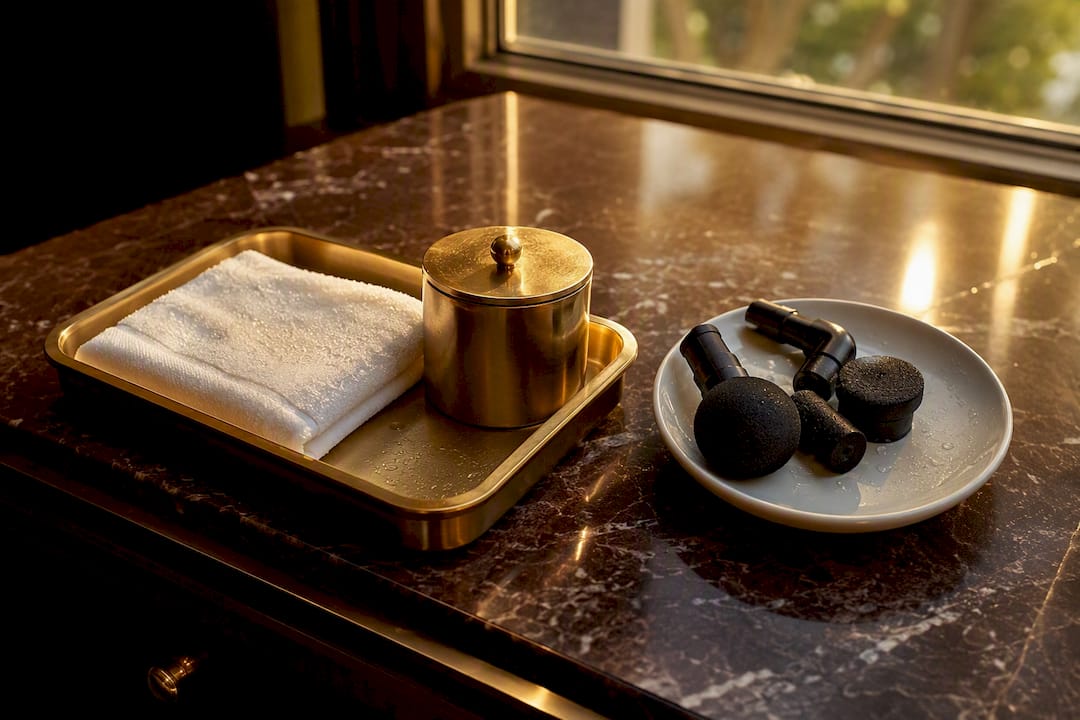
Never submerge the motor housing in water. Most units are not waterproof, and moisture in the motor casing is one of the fastest ways to end a device’s life early. A soft, slightly damp cloth on the body of the unit is enough; let it air dry fully before charging or storing it.
Battery care extends usable life significantly. Avoid leaving the device on the charger indefinitely once it hits 100 percent, and avoid letting it sit fully drained for long stretches, since both habits accelerate lithium battery degradation. Store it at room temperature, away from direct sunlight, garages, or car trunks where heat builds up.
Check the attachment connection points periodically for dust or debris buildup, which can cause the heads to loosen or rattle during use. A quick inspection every few weeks, paired with a proper case for storage and travel, is usually the difference between a device that lasts two years and one that lasts five.
An Editor’s Take on Massage Gun Hype vs. Reality
The gap between what massage guns promise and what they deliver is smaller than skeptics claim, but narrower than marketing suggests. The evidence genuinely supports using one for stiffness, short-term flexibility, and easing sore muscles after a hard session. Where I think most buyers go wrong is expecting a percussive device to somehow replace training, stretching, or professional care for an actual injury. It won’t, and no honest reading of the research says it will.
What tends to get lost in review roundups is durability. A device that delivers real percussive force needs a solid motor and a battery that survives daily use for years, not months. That’s the same standard Mytotaltake applies across its curated wellness and gadget picks: function first, then longevity, then design. If you’re shopping for a device that fits both your recovery routine and the rest of your home, that combination is worth prioritizing over flashy speed settings you’ll rarely use.
A Smarter Way to Shop for Recovery Devices
Most massage guns on the market are built to look impressive in a five-second unboxing video and start failing within a year. Mytotaltake takes a different approach: every wellness device in the collection is chosen for motor durability, battery longevity, and genuine build quality, not just marketing specs.

If you’re weighing a massage gun purchase against other recovery tools for your home, it helps to know what actually separates a device that lasts from one that doesn’t. Browse Mytotaltake’s guide on choosing upscale products that last before you commit to a model, or explore the advanced gadgets collection to compare options built with the same craftsmanship standard applied across the rest of the site. For readers focused on complementary leg and lower-body recovery, the compression leg massager collection is worth a look too. Start there, and pick a device meant to hold up past its first year.
Sources
- The Effects of Massage Guns on Performance and Recovery
- Percussive therapy delivered by massage guns: systematic review
- Massage gun: Uses, benefits, and risks
- Massage Guns: How to Use Them Safely and Effectively
- Do Massage Guns Actually Work?











Leave a comment