
Defining Premium Accessories: How to Spot Real Quality
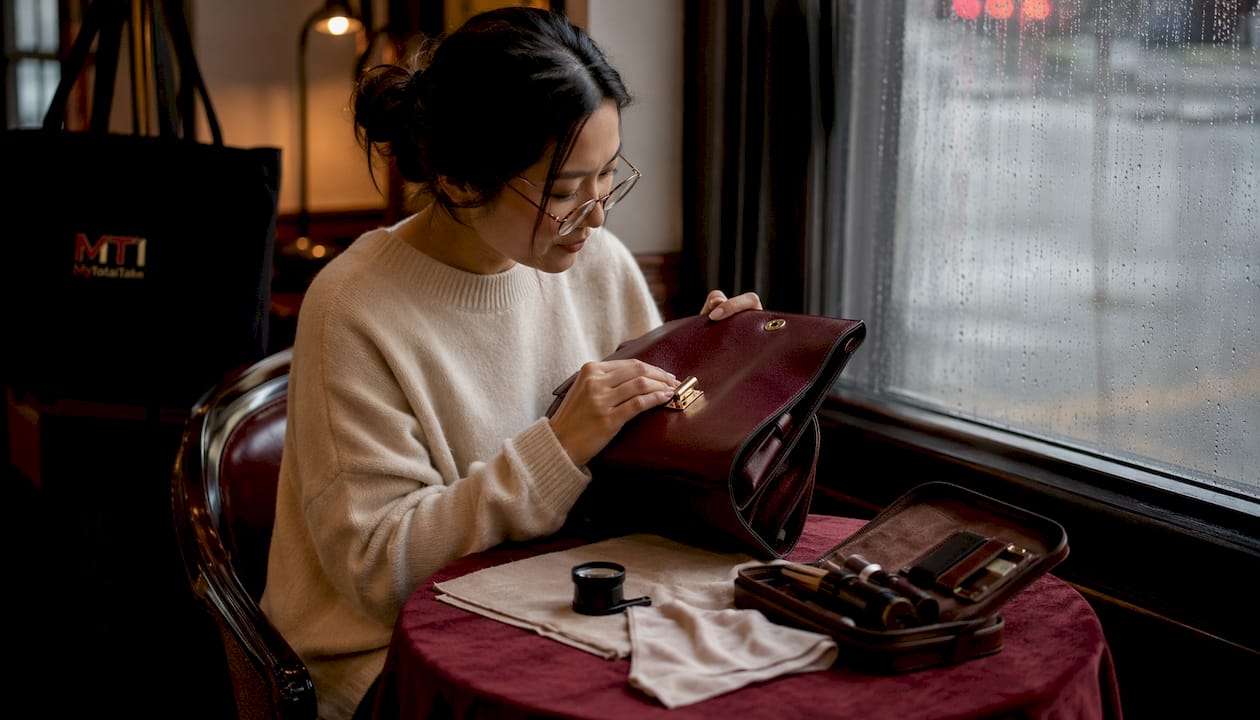
A premium accessory is defined by construction discipline, material stability, and finishing precision that hold up under daily use — not by a high price tag or a recognizable logo. When you pick up a genuinely premium piece, you feel it before you see it: the weight is balanced, the hardware moves without friction, and every edge is sealed as cleanly as the front face. Three signals separate premium from the rest:
- Construction discipline: Internal reinforcement panels and layered builds that resist sagging and retain their silhouette after months of wear
- Material stability: Consistent leather thickness, dense textile weaves, or stable metal alloys that resist cracking, fading, and stretching over time
- Hardware precision: Zippers, clasps, and buckles that operate silently and align without snagging — a direct result of controlled manufacturing tolerances
Mytotaltake curates accessories against exactly these criteria, filtering out pieces that rely on marketing rather than craft to justify their price.
Table of Contents
- How does premium differ from luxury in accessories?
- What are the hallmarks of a genuinely premium accessory?
- Which accessory categories show premium signals most clearly?
- How to inspect an accessory before you buy
- How do brands signal that a piece is genuinely premium?
- Why does investing in premium accessories actually make sense?
- When should you walk away? Red flags for “priced-up” accessories
- Key Takeaways
- The case for craft over convention
- Curated quality, ready to explore at Mytotaltake
- Useful sources
How does premium differ from luxury in accessories?
The core distinction is purpose. Premium means the piece is built to perform and endure — craft and durable performance are the primary value drivers. Luxury means the piece carries brand heritage, scarcity, and cultural status as its primary value drivers, sometimes regardless of how it is made.
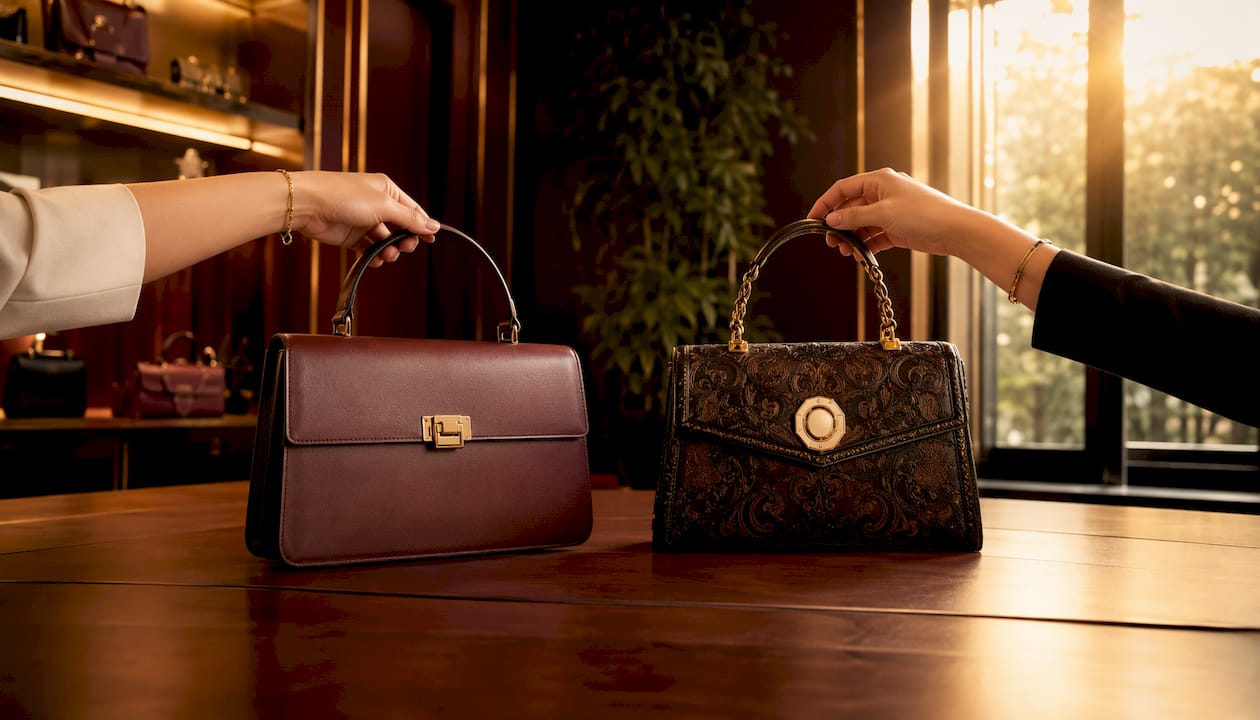
Both categories can use quality materials and command high prices, which is where the confusion starts. A well-made small leather wallet from an independent tannery and a house-branded runway bracelet from a storied fashion house can cost the same. The wallet earns its price through construction; the bracelet earns it through the name on the clasp. That is not a criticism of luxury — it is simply a different value proposition.
The overlaps are real. Luxury houses do sometimes produce genuinely premium goods: high-end fashion brands have expanded jewelry and accessories ranges specifically to create accessible entry points that combine brand heritage with quality materials. But they also produce gateway items where the logo does the heavy lifting and the construction is secondary.
One pricing heuristic worth knowing: some research datasets define “premium” as items priced roughly 20% above the category average. That threshold can be a useful starting point, but price alone misses craft and material signals entirely. A $400 belt with a celebrity endorsement and a $400 belt with full-grain leather and a solid brass buckle are both “premium” by that rule — and they are not remotely the same thing.
What are the hallmarks of a genuinely premium accessory?
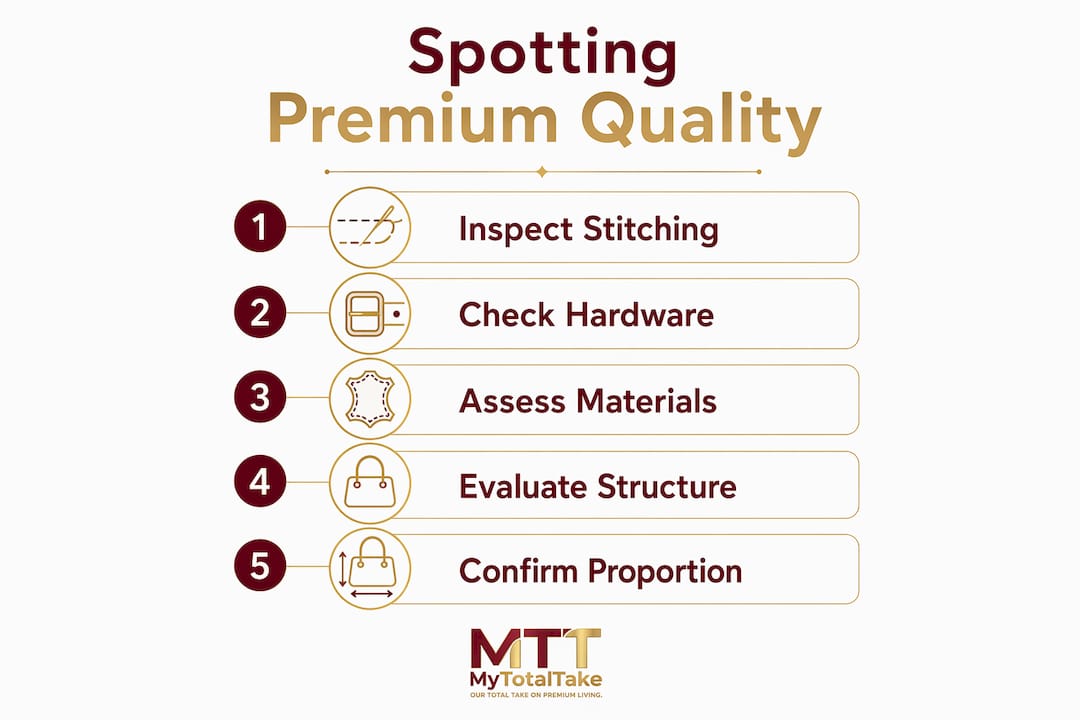
The most reliable signals of premium quality are visible and tactile before you ever read a product description. Structural integrity, consistent edge finishing, and balanced proportions are the three features that visibly distinguish premium pieces from lower-quality items that sag, warp, or show uneven transitions after a few months of use. Here is what to look for across five core dimensions:
Material stability
Premium materials resist cracking, fading, stretching, and peeling. In leather goods, look for consistent thickness and dense grain across the entire surface — not just the front panel. In textiles, a tight, even weave that does not pull or pill under light tension is the standard. Metal components should feel solid and show no surface oxidation at the seams.
- Leather: full-grain or top-grain with consistent thickness; no visible splits or corrected-grain patches on stress points
- Textiles: dense weave count, no loose threads at seam intersections, colorfast dye that does not transfer to your hand
- Metal: stable alloy with no surface pitting, consistent finish across all faces
Structural integrity
Internal reinforcement is the hallmark most buyers never see but always feel. A premium bag or wallet holds its shape because it has layered construction — stiffening panels, interfacing, or structured linings — not because the outer material is thick. Pieces without internal reinforcement sag within weeks of regular use.
Finishing: edges, stitching, and transitions
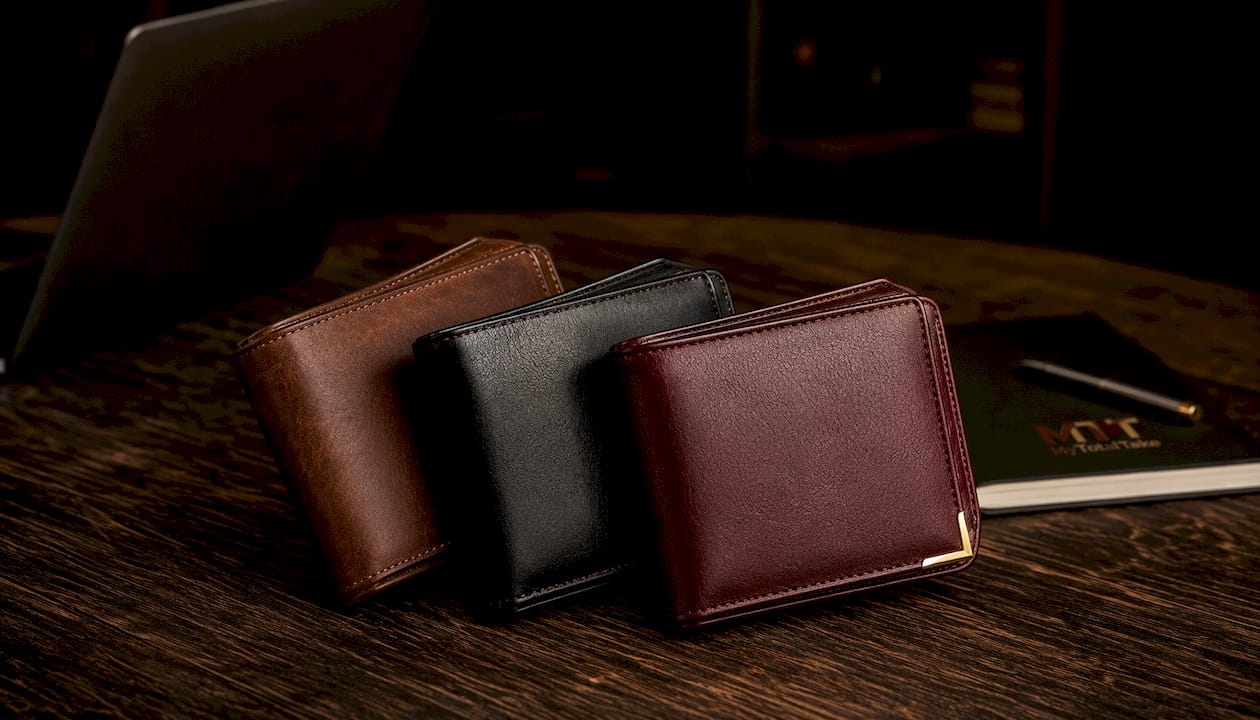
Finish quality predicts how an accessory ages better than almost any other single indicator. Check for burnished or painted edges with no raw fiber showing, stitch spacing that is perfectly even across the full seam length, and clean material transitions where two surfaces meet. Uneven stitching or fraying edges at stress points are early signs of shortcuts in production.
Hardware precision
Premium hardware moves silently and aligns perfectly. Manufacturers of genuinely premium pieces test zippers and clasps for friction and noise as part of quality control. A zipper that catches, a clasp that rattles, or a buckle that sits slightly off-center are all signs of hardware sourced for cost rather than performance.
Proportion and design restraint
Clean lines, balanced symmetry, and restraint in ornamentation allow construction and finish to communicate value on their own, showcasing the luxury of glass interior doors in premium design. Oversized logos, heavy decorative hardware, or asymmetrical proportions often signal that the design is compensating for weak underlying construction. When a piece looks expensive without announcing itself, that is design discipline at work.
Pro Tip: Run your thumbnail lightly along the edge of any leather good. A premium edge feels smooth and slightly waxy — burnished or painted to seal the fibers. A raw, slightly rough, or crumbling edge means the manufacturer skipped the finishing step, and that edge will deteriorate first.
Which accessory categories show premium signals most clearly?
Certain categories make the gap between premium and priced-up especially visible. Applying the hallmarks above to specific types helps you practice the evaluation before you spend.
-
Wallets and cardholders: The single most important indicator is edge finishing on the interior card slots. Premium wallets show the same burnished or painted edge treatment inside as outside. Red flag: raw, unfinished interior edges paired with a polished exterior. Buying tip: open every slot and check the bottom edge — that is where shortcuts appear first.
-
Belts: Look at the buckle tolerances and the leather core. A premium belt uses a solid metal buckle with no visible casting seams and a full-grain leather strap with consistent thickness from end to end. Red flag: a buckle that wobbles in its keeper or a strap that tapers unevenly. Buying tip: flex the strap gently — it should resist without cracking and return to flat without creasing.
-
Small leather goods (key fobs, passport covers, cardholders): Stitching symmetry and lining quality matter most here. The lining should be cut cleanly and lie flat with no bubbling. Red flag: a lining that is glued rather than stitched at stress points. Buying tip: press the piece flat and look for any rippling in the lining — it signals poor adhesive application.
-
Jewelry: Joint solder quality and clasp mechanics are the primary indicators. A premium piece shows no visible solder blobs at joins, and the clasp operates with a clean, positive click. Red flag: a clasp that requires force to open or close, or visible oxidation at joins. Buying tip: hold the piece up to light and look at every join — a clean join reflects light evenly.
-
Tech-integrated accessories: Material compatibility and integrated hardware testing define this category. The earKron audio ear-cuffs from CAS&Kera illustrate what premium looks like here: biocompatible zirconia ceramic from Tosoh, Japan, machined to a tolerance of +/- 0.05 mm, finished with 18ct gold or platinum, and paired with Bluetooth 5.3 hardware. That combination of precious materials and precision manufacturing tolerances is what separates genuinely premium wearable tech from fashion-forward plastic. Red flag: tech accessories where the electronic components are housed in materials that cannot withstand the thermal or mechanical stress of daily use. Buying tip: ask specifically about material compatibility testing — a premium maker will have documentation.
For readers interested in how these same principles apply to smart home upgrades, the material-compatibility and hardware-precision standards translate directly.
How to inspect an accessory before you buy
Use this checklist to grade any piece on structural, finishing, material, hardware, and proportional performance before committing. Work through it in order — from the easiest visual check to the more tactile tests.
Inspection checklist (score each item 0–3)
- Silhouette and shape retention — Does the piece hold its intended shape without support? (0 = collapses or sags; 3 = holds form cleanly)
- Stitching regularity — Is stitch spacing perfectly even across the full seam, including corners? (0 = irregular or skipped stitches; 3 = machine-precise spacing throughout)
- Edge finishing — Are all exposed edges burnished, painted, or otherwise sealed with no raw fiber? (0 = raw edges; 3 = fully sealed, smooth to the touch)
- Hardware operation — Do zippers, clasps, and buckles move silently and align without force? (0 = catches, rattles, or misaligns; 3 = silent, frictionless operation)
- Weight and balance — Does the piece feel balanced in hand, with weight distributed evenly? (0 = noticeably lopsided or hollow; 3 = solid, even weight distribution)
Score thresholds: 0–6 = avoid; 7–12 = consider with caution; 13–15 = premium construction confirmed.
How three product profiles perform
| Checklist dimension | Entry-level | Mid-tier | Premium craft |
|---|---|---|---|
| Silhouette retention | Sags under light load | Holds shape initially, softens over time | Maintains form after months of daily use |
| Stitching regularity | Uneven spacing, visible skips | Mostly even, minor inconsistencies at corners | Perfectly consistent, including stress points |
| Edge finishing | Raw or lightly painted, peels early | Painted edges, some wear at corners | Burnished or fully sealed, durable over years |
| Hardware operation | Catches or rattles with use | Smooth initially, loosens over time | Silent and precise throughout lifespan |
| Weight and balance | Hollow or unevenly weighted | Adequate weight, minor imbalance | Solid, evenly distributed, intentional heft |
Pro Tip: When evaluating from photos, request a macro shot of one interior corner seam and one hardware close-up shot in natural light. Shoot or ask for the image at a 45-degree angle to the surface — raking light reveals uneven stitching, surface pitting, and edge inconsistencies that flat-on photography hides completely.
How do brands signal that a piece is genuinely premium?
Brands communicate premium through evidence of craft and care, not by logo placement alone. Experts consistently note that authentic premium status shows through subtle artisanal details rather than loud branding. The signals worth paying attention to are behavioral — what the brand does, not just what it says.
Strong signals of genuine premium investment:
- Transparent material sourcing: Named suppliers, origin countries, and material grades (e.g., “full-grain leather from a named tannery” rather than “genuine leather”)
- Repair and aftercare programs: A brand that offers resoling, re-stitching, or hardware replacement is betting on the longevity of its own product
- Limited production runs with provenance: Small batches with documented production details signal that the maker controls quality at each step
- Refined packaging and hand-finishing processes: Packaging that protects and presents the piece without excess plastic or foam signals that the brand considers the full ownership experience
- Selective distribution: Pieces sold through curated retailers or direct-to-consumer channels are more likely to be genuinely premium than the same price point sold through mass marketplaces
Weak signals that often mask ordinary construction:
- Heavy logo placement on every surface, which draws attention away from the construction
- Frequent discounting or perpetual “limited-time” sales, which undercut the scarcity claim
- Opaque supply chain language (“premium materials,” “quality craftsmanship”) with no specifics
- Packaging that is more elaborate than the product itself
Distribution channel matters more than most buyers realize. A piece sold through a selective retailer with a curated buying process has passed at least one additional quality filter. The same piece sold through a mass marketplace with no curation has not. That does not make every mass-market item poor quality, but it removes one layer of accountability.
Consumers increasingly view premium purchases as personal expressions or heirlooms rather than purely status signals — which is exactly why provenance and aftercare matter more than they did a decade ago. The role of craftsmanship in luxury goods follows the same logic: a maker who documents their process is a maker who stands behind the result.
Why does investing in premium accessories actually make sense?
Premium items often cost less over time. That is the argument most buyers overlook when comparing sticker prices.
- Durability and shape retention: A piece built with internal reinforcement and stable materials holds its form and function for years, not seasons. The cost-per-use calculation shifts dramatically when a wallet lasts a decade instead of two years.
- Repairability: Brands with repair programs extend the useful life of a piece rather than requiring full replacement. Re-stitching a seam or replacing a clasp costs a fraction of a new purchase.
- Resale value: Well-constructed accessories in stable materials retain a meaningful portion of their original value on the secondary market. Pieces that sag, crack, or show hardware wear do not.
- Lower lifecycle environmental cost: Fewer replacements mean less manufacturing demand, less packaging waste, and a smaller material footprint over time. The eco-friendly luxury argument is not just ethical positioning — it is a practical consequence of buying things that last.
Some research datasets classify a product as “premium” when it is priced roughly 20% above the category average. That threshold is a useful market-research tool, but it says nothing about construction quality — which is the actual driver of long-term value.
Price vs. value: how to tell the difference. When a higher price reflects craft, you can point to specific evidence: the materials are named and sourced, the finishing is consistent, and the brand offers aftercare. When a higher price reflects markup or marketing, the evidence is absent: the materials are described vaguely, the finishing shows shortcuts under inspection, and there is no repair pathway. The inspection checklist above is the fastest way to separate the two.
When should you walk away? Red flags for “priced-up” accessories
If three or more of the following appear, walk away or ask for provenance and repair documentation before buying.
- Uneven or skipped stitching at any seam, especially at corners and stress points
- Raw or peeling edges on any leather or textile component, including interior surfaces
- Noisy or misaligned hardware — a zipper that catches, a clasp that rattles, or a buckle that sits off-center
- Uneven dye or surface finish — color that pools at edges, fades unevenly, or transfers to your hand
- Oversized decorative elements that draw attention away from the construction (heavy logos, large ornamental hardware on otherwise thin material)
- No repair or aftercare policy — a brand that does not stand behind its product’s longevity is telling you something
- Vague material descriptions — “premium leather,” “quality metal,” or “luxury fabric” with no specifics
Questions to ask sellers before purchasing:
- Where is this piece produced, and can you name the material suppliers?
- What is your repair or aftercare policy if a seam fails or hardware breaks?
- What reinforcement materials are used in the interior construction?
- Can you provide macro photos of the interior seams and hardware?
For online purchases specifically: always request macro photos of at least one interior corner seam and one hardware close-up before buying. Verify the return policy covers quality defects, not just sizing. Ask directly whether the piece is repairable — a seller who cannot answer that question has not thought about the product’s longevity, and neither has the maker.
Key Takeaways
Premium accessories earn their price through construction discipline, material stability, and finishing precision — not through logos or price alone.
| Point | Details |
|---|---|
| Construction over branding | Internal reinforcement, layered builds, and consistent stitching define premium — not logo size or price point. |
| The 20% price rule is incomplete | Pricing roughly 20% above category average may flag a product as “premium” in research datasets, but it misses craft and material signals entirely. |
| Hardware is the fastest tell | Silent, frictionless hardware that aligns perfectly is a direct result of controlled manufacturing tolerances — the easiest single check in person or from photos. |
| Premium pays over time | Repairability, shape retention, and resale value make well-constructed accessories cost less per year of use than cheaper replacements. |
| Mytotaltake curates by craft | Mytotaltake selects accessories against construction, material, and finishing criteria — offering fast delivery and free returns on pieces vetted for lasting quality. |
The case for craft over convention
There is a persistent assumption in the accessories market that price and prestige are reliable proxies for quality. They are not, and the inspection framework above makes that clear quickly. A piece with a storied name on the clasp and a thin, unfinished interior edge is not a premium accessory — it is a luxury-adjacent one, and those are different things.
What I find most telling is how few buyers ever look at the interior of a wallet or the underside of a belt before purchasing. The exterior is where the marketing lives. The interior is where the construction lives. A brand that finishes the inside as carefully as the outside is a brand that expects you to own the piece for years, not seasons. That expectation is built into the materials, the stitching, and the aftercare program — not into the packaging or the price tag.
The tech-integrated accessory category makes this even clearer. When a wearable audio piece is built from biocompatible zirconia ceramic machined to sub-millimeter tolerances and finished in 18ct gold, the premium claim is verifiable. When a “luxury” tech accessory is a plastic housing with a fashion logo, it is not. The materials and tolerances either support the claim or they do not.
Consumers who shift their evaluation from “what does this cost?” to “what does this do, and for how long?” tend to make better purchases. The checklist in this article is designed to make that shift practical rather than theoretical.
Curated quality, ready to explore at Mytotaltake
Readers who want to skip the inspection process and shop from a pre-vetted selection will find Mytotaltake’s curated catalog built around the same criteria this article covers: construction integrity, material provenance, and finishing consistency.
Every piece in the collection is selected with durability and repairability in mind, not just aesthetics. Mytotaltake backs that selection with fast delivery and free returns, so you can evaluate a piece in person before committing. For readers focused on accessories that hold their value and their shape, the designer pieces that last collection is the clearest starting point. Those who want the full picture on what separates a well-made piece from a marketed one can also browse tips for choosing upscale products that stand the test of time.
Useful sources
The following sources informed the claims and inspection criteria in this article. Each is worth consulting directly for deeper detail on specific topics.
- The Role of Premium Accessories in Modern Fashion — Fashion ABC; context on consumer framing of premium purchases as personal expression and lasting value
- Premium Products curriculum resource — Discover Data; source for the 20% pricing heuristic and its limitations as a quality classifier
- What Makes an Accessory Look Expensive: Proportion, Structure, and Finish — Splurge Frugal; primary evidence for hallmarks, finishing cues, and structural integrity indicators
- High-End Fashion Brands Pile On Jewelry Accessories — WWD; industry reporting on luxury brand strategy and the overlap between premium and luxury positioning
- earKron Fine Jewelry Infused with Audio — CAS&Kera; real-world example of premium tech-integrated accessory construction using precious materials and precision tolerances
- ACCESSORY definition — Cambridge English Dictionary; scope-setting definition of what counts as an accessory
- LUXURY GOODS definition — Cambridge English Dictionary; authoritative definition distinguishing luxury goods from premium goods by purpose and necessity
- The Role of Craftsmanship in Luxury Goods Explained — Mytotaltake; editorial context on how craftsmanship communicates value beyond logos
Recommended
Laser Projector vs LED Projector for Your Home
What Defines Sophisticated Living: A Practical Guide
Comments
[…] want the full picture on what separates a cushion that lasts from one that doesn’t, our piece on premium accessories breaks down the craftsmanship markers worth paying for. Browse the current outdoor collection and […]
[…] warranty terms, and return policy are laid out the same way Mytotaltake handles the rest of its premium accessories, with fast delivery and free returns backing every order. Browse the current diffuser selection, […]








Leave a comment