
Is Wireless Charging Safe for You and Your Devices?

Wireless charging is safe for most people and most phones, provided the charger carries genuine Qi or Qi2 certification and you follow a few sensible precautions. The technology meets FCC requirements for consumer electronics, and certified pads use safety features designed specifically to prevent overheating and shock. Mytotaltake has vetted enough charging gear to know where the real risks hide, and they’re rarely about the physics of induction itself.
The caveats worth your attention:
- Heat matters more than radiation. Poor alignment or a cheap adapter generates warmth that can shorten battery life over time.
- Counterfeit and unbranded chargers are the biggest practical hazard, not certified name-brand pads.
- Pacemakers and other implants require a manufacturer-specific safety distance, not a general “wireless charging is fine” assumption.
Skip ahead to the safe-use best practices section if you just want the action list.
Key Takeaways
Wireless charging is safe for daily use when the charger carries genuine Qi or Qi2 certification, and the real risks trace back to heat, counterfeit accessories, and unverified implant-device guidance rather than the induction technology itself.
| Point | Details |
|---|---|
| Certification confirms safety features | Look for Qi or Qi2 certification, which requires foreign object detection and temperature monitoring. |
| Heat drives battery aging | Wireless charging runs at roughly 50 to 80 percent efficiency, converting the rest into heat that speeds up battery wear. |
| Alignment reduces risk | Magnetic alignment systems like Qi2 and MagSafe cut misalignment heat that plagues older pads. |
| Implant users need direct guidance | Pacemaker and implant owners should confirm safe distances with their device manufacturer, not general assumptions. |
| Mytotaltake vets accessories before featuring them | The site checks certification and manufacturer documentation before recommending chargers and gadgets to shoppers. |
Where to Verify Charger Safety Claims Yourself
Cross-check any charger against these sources before trusting it overnight.
- The official Qi certification database confirms whether a product’s certification claim is real.
- FCC compliance guidance explains testing requirements for wireless power devices.
- Wirecutter’s charger testing and Android Authority’s battery analysis offer independent, hands-on evaluation beyond manufacturer claims.
Table of Contents
- How Does Wireless Charging Actually Work?
- Does Wireless Charging Emit Harmful Radiation?
- Is Wireless Charging Bad for Your Phone’s Battery?
- What Certifications Prove a Wireless Charger Is Safe?
- Best Practices for Wireless Charging Every Day
- How Do You Know When a Charger Has Become Unsafe?
- Does Wireless Charging Wear Out a Battery Faster Than Just Heat?
- Wireless Charging vs. Wired Charging: Which Is Actually Safer?
- Sources
How Does Wireless Charging Actually Work?
Wireless charging relies on electromagnetic induction: a coil in the charging pad generates a magnetic field, and a matching coil inside your phone converts that field back into electrical current. No cables, no exposed contacts, just two coils talking to each other across a few millimeters of air.
Alignment is everything. When the coils sit directly opposite each other, energy transfers efficiently and with minimal waste heat. When they’re offset, even slightly, more energy gets lost as heat instead of stored as charge. This is exactly why MagSafe and Qi2 introduced magnetic rings that snap the phone into perfect position automatically, rather than leaving alignment to guesswork.
Modern chargers also negotiate power levels with the phone through a small onboard chip, often called a smartchip, which throttles or halts the transfer if temperatures climb too high. And because these are near-field magnetic systems, the field strength drops off sharply with distance. That falloff is a built-in safety margin, not a marketing claim.
Does Wireless Charging Emit Harmful Radiation?
No. The electromagnetic fields from a wireless charger are non-ionizing, meaning they don’t carry enough energy to damage DNA or cells the way ionizing radiation (X-rays, gamma rays) does. Health agencies including the International Agency for Research on Cancer classify these low-frequency magnetic field exposures in a category that reflects consumer-level safety, with defined exposure guidance already baked into product design.
Wireless chargers operate in the low hundreds of kilohertz, a frequency range with fields that weaken rapidly as you move away from the coil, which is why the safety margin for casual use is wide.
Two practical rules still apply. Don’t rest an active pad directly against bare skin for extended stretches, and never tuck a charging phone under a pillow or blanket where heat has nowhere to escape. If you or someone in your household has a pacemaker or another implanted device, contact the device manufacturer directly. Distance and use rules vary by model, and a general safety assurance isn’t a substitute for device-specific guidance.
Is Wireless Charging Bad for Your Phone’s Battery?
The honest answer is that wireless charging runs less efficient than plugging in, typically converting power at somewhere in the 50 to 80 percent real-world efficiency range, compared to the near-total efficiency of a wired connection. That gap doesn’t disappear. It becomes heat, and heat is the single biggest accelerant of lithium-ion battery aging.
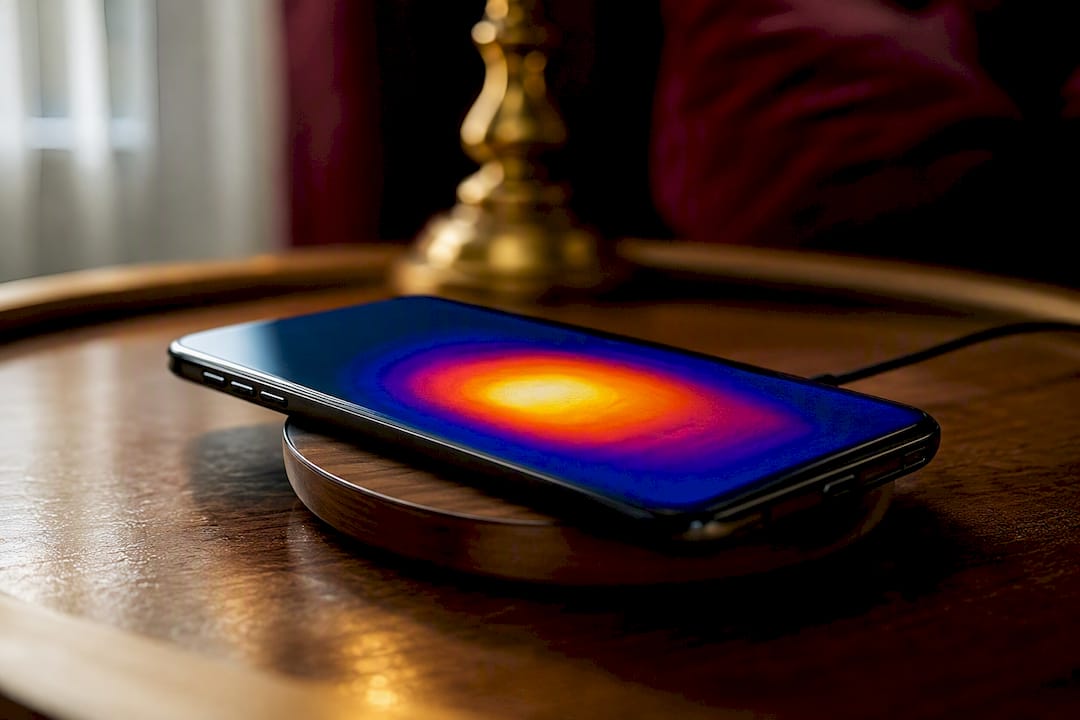
Manufacturers know this, which is why every modern phone includes thermal protections that quietly reduce charge speed once internal temperatures rise past a safe threshold. You may not even notice it happening. It’s a background safeguard, not a malfunction.
A few habits make a real difference. Choose a slower charging mode overnight rather than a fast-charge pad, since the marginal time savings rarely justify the extra heat load over eight hours. Avoid wireless fast-charging for long sessions when you have the option to charge more slowly. And keeping your battery between roughly 20 and 80 percent charge, when practical, remains one of the more effective ways to extend a battery’s usable years, regardless of charging method.
One detail people overlook: cases matter. A thick case or one with metal accents traps heat against the phone’s back panel exactly where the receiver coil sits. If you’re doing an extended or fast-charge session, pull the case off first.
What Certifications Prove a Wireless Charger Is Safe?
Before you trust a pad with your phone overnight, check for the marks that actually mean something.
- Qi or Qi2 certification confirms the charger meets an interoperability and safety standard, and you can verify a product against the certification database rather than trusting a package label alone.
- Foreign object detection (FOD) stops the charger from dumping energy into a stray coin, key, or paperclip that could heat up dangerously on the pad.
- Temperature monitoring and thermal throttling slow or halt charging automatically before things get dangerously warm.
- FCC Part 18 and EMC compliance testing covers the electromagnetic emissions side, and reputable manufacturers document this at the model level rather than making a vague blanket claim.
Before buying, look at the packaging and listing for a specific model number, confirm the seller can be traced to a real manufacturer, and pair the pad with the power adapter it was actually designed to use.
Best Practices for Wireless Charging Every Day
Most of the risk in wireless charging comes down to habits, not hardware. Get these right and you’ve eliminated the vast majority of realistic concerns.
- Set the pad on a hard, flat surface with open air around it. Soft surfaces like a comforter or couch cushion trap heat underneath.
- Remove thick or metal-lined cases before any extended or fast-charge session.
- Match the charger to its intended power adapter. An underpowered or mismatched adapter can cause voltage instability that stresses the pad’s internal circuitry.
- Choose wired charging for long overnight fast-charge sessions. If you want to top up overnight on a pad, use a slower 5 to 10 watt wireless mode instead of a fast one.
- Turn on your phone’s built-in battery optimization features, if your device offers charge limiting or adaptive charging, and let the software manage the finer details for you.
Pro Tip: Run a quick hand test after the first 20 minutes on any new charger. Warm is normal. Uncomfortably hot to the touch, especially near the edges, means something is off with alignment, the adapter, or the pad itself.
Keeping your nightstand setup simple also helps. A dedicated charging spot away from bedding reduces the temptation to tuck a phone somewhere insulated overnight.
How Do You Know When a Charger Has Become Unsafe?
Stop and inspect if anything feels off. Look for cracked casings, frayed cables, or a missing model number, which is often the first sign of a counterfeit product sold under a vague listing.
- If the phone or the pad itself becomes unusually hot, stop charging immediately and let both cool in a ventilated spot before trying again.
- If you feel heat concentrated under one section of the phone, check for a coin, key, or other object trapped against the pad. FOD systems catch most of this, but not all off-brand chargers include the feature.
- A pad that clicks, buzzes, or smells faintly of plastic under heat should be retired, not troubleshooted further.
If problems persist with a certified charger from a known brand, contact the manufacturer’s support line rather than continuing to use it. A quality wall adapter paired with a properly wired outlet eliminates a surprising share of these issues before they start.
What the Research Actually Shows
Mytotaltake vets gadgets using the same standards professional reviewers use, and the pattern across independent testing is consistent: Qi2’s magnetic alignment measurably reduces the heat that comes from misaligned coils, making it the safer default over older Qi pads. Before any charger earns a spot in your daily routine, confirm its certification and give it a short heat test of your own.
Does Wireless Charging Wear Out a Battery Faster Than Just Heat?
Heat gets most of the attention, but it isn’t the only factor shaping how long a battery holds its capacity. Charge cycling patterns matter just as much. A phone left on a wireless pad tends to trickle-charge in short bursts throughout the day, topping off from 85% to 100% repeatedly rather than completing full, clean charge cycles. That pattern of frequent partial charges near the top of the battery’s range puts more cumulative stress on the cells than fewer, more complete cycles.
There’s also a voltage-related factor. Batteries age faster when they spend extended time sitting at a full or near-full charge, because the cell chemistry is under more electrochemical strain at high voltage. A phone parked on a wireless pad all night, already full within an hour, then sits at that peak voltage for hours longer than it needs to. Wired charging suffers from the same issue if you leave a phone plugged in overnight, but wireless setups tend to encourage more casual, all-day topping off simply because the pad is more convenient to use.
None of this means wireless charging ruins batteries. It means the convenience factor works against you slightly if you’re not paying attention. Using a phone’s adaptive or optimized charging feature, which learns your schedule and delays that final charge push until closer to when you wake up, closes most of this gap. So does keeping a reliable portable power bank on hand for daytime top-ups instead of leaving your phone parked on a pad for hours at a stretch.
Wireless Charging vs. Wired Charging: Which Is Actually Safer?
Wired charging wins on efficiency and heat generation, full stop. A cable delivers power almost directly to the battery with minimal conversion loss, while wireless charging loses energy at every step of the induction process. That efficiency gap is exactly why wireless pads run warmer for the same charge speed.
Wired charging carries its own distinct risks, though. A frayed cable exposes live wires. A cheap or knockoff USB adapter can deliver inconsistent voltage that damages charging circuitry over time. Port damage from repeated plugging and unplugging is a real, cumulative wear issue that simply doesn’t exist with an inductive pad, since there’s no physical connector to degrade.
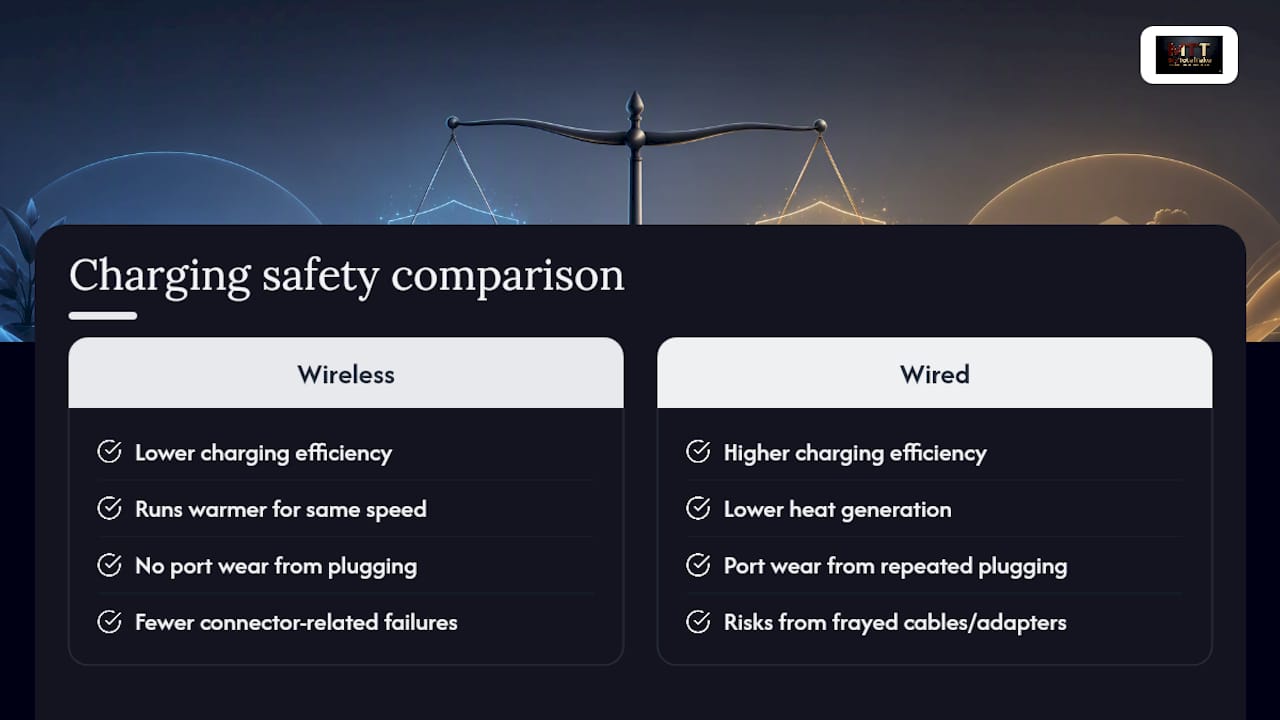
The safety comparison depends heavily on what you’re optimizing for. If your priority is minimizing heat and maximizing charging efficiency, wired wins clearly. If your priority is avoiding port wear, reducing plug-in fumbling in the dark, and eliminating one more possible point of physical damage on the device itself, wireless has a real advantage. Neither method is inherently unsafe when you’re using certified, quality hardware. The risk in both cases traces back to the same root cause: cheap, uncertified, or damaged accessories, not the charging method itself.
For most people, the practical answer is to use wired charging for fast, high-demand sessions and reserve wireless for convenient, lower-power top-ups throughout the day.
A note on convenience versus caution
Convenience is worth choosing when it comes paired with a certified, traceable charger and a real warranty behind it. For readers building out a premium tech setup, that documentation matters more than the price tag. It’s worth exploring curated gadget picks built around exactly that standard.
Curated Charging Accessories Worth Trusting
Sorting genuine Qi2 certification from marketing language on a crowded product page takes more time than most shoppers want to spend, which is exactly the gap Mytotaltake’s curation closes. Every accessory in the collection gets checked against real certification records and manufacturer documentation before it earns a spot, so you’re not the one running that verification at midnight before a trip.

If you’re ready to upgrade your nightstand setup with something that’s already been vetted for build quality and traceable support, the premium accessories guide is the place to start. For a broader look at how the site chooses tech worth keeping around for years, the advanced gadgets breakdown walks through the standards behind every pick. Either page gets you to a charger you won’t need to second-guess.
Sources
- Is wireless charging bad for smartphone battery health? – Android Authority
- The 2 Best Qi Wireless Chargers of 2026 | Reviews by Wirecutter
- Wireless power transfer and wireless charging — Element
- Iarc











Leave a comment