
Understanding Artisanal Quality: A Consumer’s Guide

Artisanal quality is defined as the standard achieved when a skilled maker produces goods by hand, in small batches, using traditional techniques that prioritize individual attention over speed. Understanding artisanal quality matters because it separates products built to last from those built to sell fast. The global handicrafts market is projected to reach USD 983.12 billion by 2030, driven by consumers who want more than a product. They want a story, a standard, and something that holds its value over time.
What is artisanal craftsmanship and why does it matter?
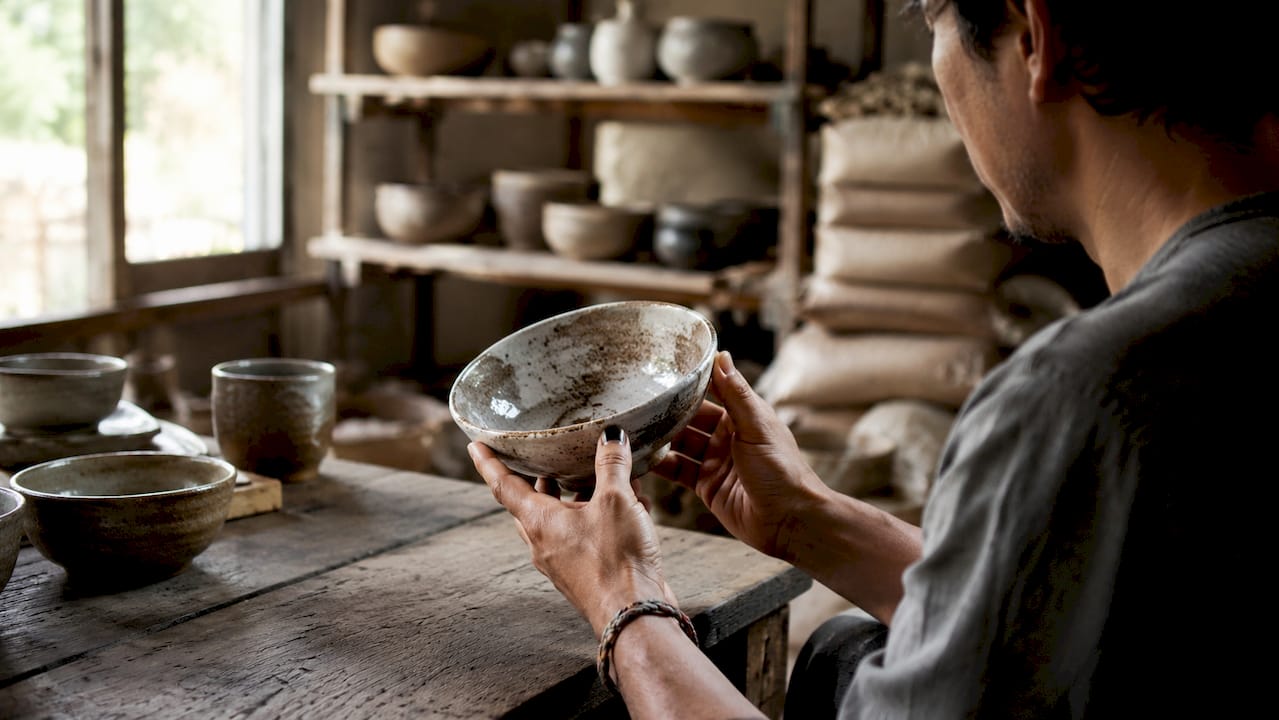
Artisanal craftsmanship is the practice of making goods by hand using skills developed over years, not a production formula learned in days. A true artisan brings personal judgment to every piece. That judgment, applied to material selection, technique, and finishing, is what separates a handcrafted ceramic bowl from one pressed by a machine in identical thousands.
Mass production prioritizes efficiency and standardization, while artisanal production focuses on uniqueness, quality, and cultural heritage. The practical difference shows up in how each item behaves over time. A machine-pressed bowl chips cleanly. A hand-thrown one develops a patina that tells you something about the clay, the kiln, and the person who made it.
Small-batch production also changes quality control fundamentally. When a maker produces 12 items instead of 12,000, each piece gets individual assessment. True artisanal food avoids additives precisely because small batches allow that individual attention without the need for preservatives. The same logic applies to textiles, furniture, and ceramics: fewer units means more eyes on each one.
Local sourcing is another defining characteristic. Artisans typically source materials from known suppliers, specific farms, or regional producers. That traceability adds both authenticity and accountability to the finished product.
- Skill depth: Artisans develop techniques over years, not weeks, producing results that reflect genuine expertise.
- Small-batch production: Fewer units per run means each piece receives direct attention and quality assessment.
- Material traceability: Local or named sourcing connects the product to a specific place and process.
- Cultural continuity: Traditional methods preserve regional techniques that industrial production cannot replicate.
Pro Tip: When evaluating a handcrafted piece, ask the seller how long the maker has practiced the specific technique. A vague answer is a red flag. A confident, specific answer, such as “she has been weaving this pattern for 22 years,” signals the real thing.
How do you recognize and evaluate true artisanal quality?
Recognizing genuine artisanal goods requires more than reading a label. The words “handmade,” “craft,” and “artisan” carry no legal definition in most markets. Any brand can print them on packaging. Savvy consumers look past the label and into the product itself.
The industry standard for verified origin is the Protected Designation of Origin (PDO) certification, a legal framework used across food, textiles, and ceramics to confirm that a product comes from a specific region and follows traditional methods. Broad “handmade” labels can mask industrial manufacturing; PDO certification and specific provenance details are the credible alternatives. When you see a PDO mark, you know a regulatory body has verified the claim.
Here is a practical checklist for evaluating any artisanal product:
- Check provenance specificity. A genuine artisan product names a specific farm, village, workshop, or maker. “Handmade in Italy” is vague. “Woven by the Ferraro family in Calabria since 1948” is specific.
- Read the ingredient or material list. Short, natural, and pronounceable lists signal small-batch production. Long lists with chemical stabilizers signal industrial scale.
- Look for natural variation. True artisan products showcase variations and imperfections as marks of authenticity. Identical uniformity across every unit is a factory signal.
- Assess complexity. Artisanal goods, whether food, textiles, or ceramics, carry nuance. A hand-fermented cheese has layers of flavor. A machine-processed one tastes the same from the first bite to the last.
- Verify certifications. PDO, Protected Geographical Indication (PGI), and similar marks are legally enforced. They are not marketing language.
A genuine artisan product requires individual attention to every batch, which yields nuanced quality variations that mass production cannot replicate. Those variations are features, not flaws.
Pro Tip: For home decor and furniture, ask whether the piece is signed or numbered. Artisans who stand behind their work tend to mark it. An unsigned, unnumbered piece sold as “handcrafted” deserves closer scrutiny.
Why do consumers value artisanal goods over mass-produced alternatives?
Consumer preference for artisanal goods reflects a clear shift in what people consider worth paying for. 68% of shoppers prioritize manufacturing method over price when making purchasing decisions. That figure tells you the conversation has moved beyond cost. Buyers are asking how something was made, not just what it costs.
Consumers increasingly seek artisanal goods for emotional connection, authenticity, and sustainable production methods. Each of those three motivations is distinct. Emotional connection comes from knowing a person made the object. Authenticity comes from verified origin and traditional technique. Sustainability comes from small-batch production that generates less waste and relies on natural materials. Artisanal goods often deliver all three at once.
The importance of artisanal goods also shows up in how they enrich personal and home aesthetics. A hand-thrown vase on a shelf does not just hold flowers. It holds the evidence of a specific skill, a specific material, and a specific moment of making. That depth of meaning is something a factory-produced equivalent cannot carry.
Misleading marketing does dilute this value. Brands that apply “artisan” as a descriptor to industrially produced goods erode consumer trust across the entire category. The practical defense is the evaluation checklist above. When you know what to look for, the imitations become easy to spot.
- Emotional connection to the maker and the process
- Verified authenticity through provenance and certification
- Sustainable production with lower waste and natural materials
- Unique aesthetic character that mass production cannot replicate
- Long-term value retention compared to disposable goods
For consumers who want to go deeper on artisanal decor choices, the principles above apply directly to furniture, textiles, and decorative objects.
How does artisanal quality enhance personal style and home aesthetics?
Artisanal craftsmanship is resurging in home decor through hand-carved furniture, natural materials, and unique finishes that add character and personal connection. The reason is straightforward: a room filled with identical, mass-produced objects feels like a showroom. A room with even two or three artisan pieces feels inhabited.
Handcrafted furniture and textiles bring what designers call “material honesty.” The wood grain is visible. The weave is irregular. The glaze shows the heat of the kiln. These qualities signal that real materials were used by real hands, and they age beautifully. An artisan oak table develops a patina over decades that a veneer-covered particleboard table cannot. That patina is not wear. It is evidence of quality.
The advantages of bespoke artwork and handcrafted objects in a home extend beyond aesthetics. They signal a considered approach to living. Choosing a hand-thrown lamp base over a catalog equivalent is a statement about what you value: time, skill, and permanence over convenience and disposability.
| Artisanal characteristic | Impact on home aesthetics |
|---|---|
| Natural material variation | Creates visual warmth and depth that uniform surfaces cannot match |
| Hand-applied finishes | Produces unique surface texture that changes with light and angle |
| Small-batch production | Limits duplication, so your piece is unlikely to appear in another home |
| Traditional joinery techniques | Delivers structural longevity measured in decades, not years |
| Maker provenance | Adds cultural narrative and conversation value to the object |
Mindful purchasing in this category means prioritizing fewer, better pieces over many average ones. One well-chosen handmade furniture piece anchors a room more effectively than a full suite of mass-produced alternatives. The investment pays back in durability, distinctiveness, and the quiet satisfaction of owning something genuinely well made.
Key Takeaways
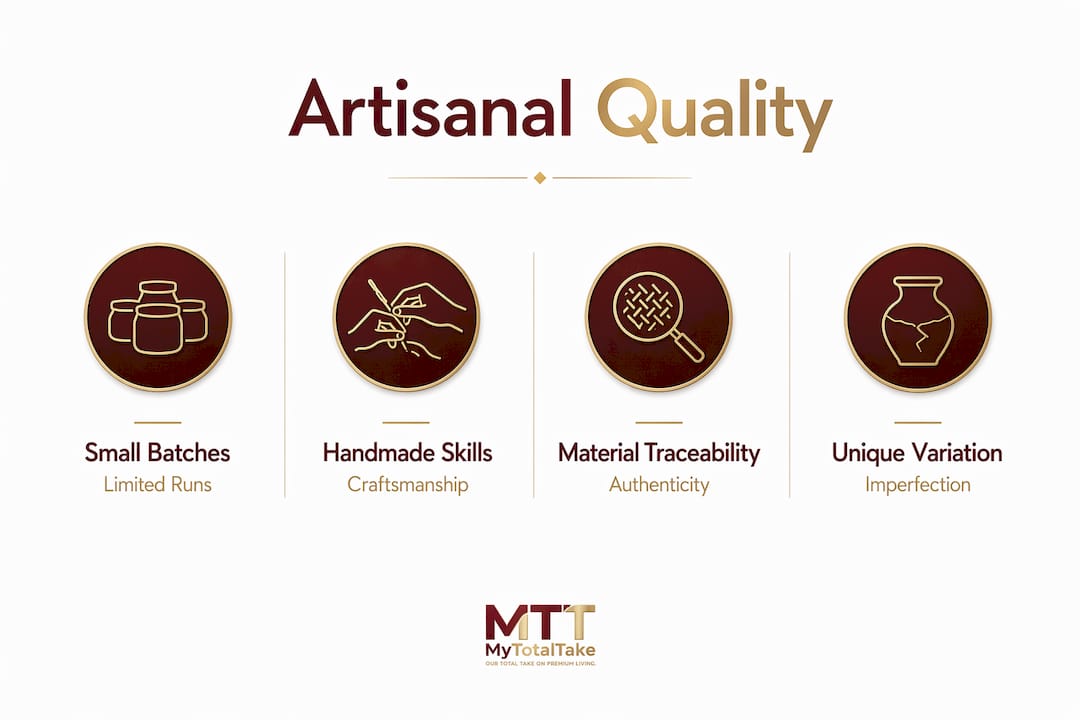
Artisanal quality is defined by skilled human production, small-batch methods, and material traceability, and these three factors together determine whether a product delivers lasting value or merely looks the part.
| Point | Details |
|---|---|
| Definition of artisanal quality | Goods made by hand in small batches using traditional techniques, with individual attention to each piece. |
| How to evaluate authenticity | Check for PDO certification, specific provenance, natural variation, and short material lists. |
| Consumer preference shift | 68% of shoppers prioritize manufacturing method over price, signaling that process matters more than cost. |
| Impact on home aesthetics | Artisan pieces develop patina, carry maker provenance, and create visual depth that mass-produced goods cannot. |
| Misleading labels | “Handmade” and “artisan” carry no legal definition in most markets; certification and specificity are the reliable signals. |
Why imperfection is the most underrated quality signal
I have handled a lot of objects described as artisanal. The ones that actually were had something in common: they made me slow down. A hand-stitched leather wallet with a slightly uneven seam. A ceramic mug where the glaze pooled differently on one side. A linen throw where the weave tightened at one edge. None of those things were defects. They were proof.
The objects that claimed artisanal status but were not had a different quality: they were too perfect. Identical weight, identical surface, identical finish across every unit. That uniformity is the signature of a machine, not a maker.
What I have found is that the most rewarding purchases are the ones where I asked questions and got specific answers. Not “it’s handmade in Portugal” but “it’s thrown on a wheel by a ceramicist in Porto who trained under her grandmother.” That specificity is not marketing. It is accountability. The maker’s name and place are attached to the object, which means the maker’s reputation is too.
My advice is to treat imperfection as a filter, not a flaw. If a product described as artisanal is flawless and uniform, ask harder questions. If it shows the marks of a human hand, you are probably looking at the real thing. Embrace those marks. They are the point.
— Lysander
Artisan craftsmanship at Mytotaltake
Mytotaltake curates products that meet the standards this article describes: verified craftsmanship, material honesty, and lasting construction. The collections span luxury furniture built to hold its value for decades, home decor with genuine maker provenance, and premium lifestyle goods selected for durability and distinctiveness.

For consumers who want to invest in pieces that age well and carry real story, Mytotaltake’s premium home decor selections offer a curated starting point. Every product in the collection is chosen with the same criteria outlined here: quality of construction, traceability of materials, and the kind of design that does not date. When you are ready to move from understanding artisanal quality to owning it, that is where to begin.
FAQ
What is artisanal quality, exactly?
Artisanal quality is the standard achieved when a skilled maker produces goods by hand in small batches, using traditional techniques that prioritize individual attention and material integrity over speed and uniformity.
How do I tell if a product is genuinely artisanal?
Look for specific provenance details, a short and natural material list, visible variation between units, and legal certifications such as Protected Designation of Origin (PDO). Vague labels like “handcrafted” without supporting detail are not reliable indicators.
Why do artisanal goods cost more?
The higher price reflects the time, skill, and individual attention required to produce each piece. Small-batch production cannot achieve the cost efficiencies of industrial manufacturing, and that difference shows up directly in the price.
Do artisanal goods hold their value better?
Artisanal goods built from quality materials and traditional techniques typically outlast mass-produced equivalents and develop desirable patina over time, which supports long-term value retention in furniture, textiles, and decorative objects.
Is “handmade” the same as artisanal?
Not necessarily. “Handmade” carries no legal definition in most markets and can be applied to industrially assisted production. True artisanal goods require skilled human judgment at every stage, not just a final hand-finishing step.











Leave a comment