
What Is Craftsmanship in Decor and Why It Matters
Most people assume craftsmanship in decor simply means something was made by hand. That assumption misses most of the story. Understanding what is craftsmanship in decor means recognizing a convergence of skill, intentionality, material knowledge, and cultural heritage that transforms ordinary objects into lasting possessions. A handcrafted ceramic bowl and a factory-stamped replica may look similar at a glance, but one carries the weight of real decisions made at every step of its creation. That difference shapes how a room feels, how long a piece lasts, and what it ultimately says about the person who chose it.
Table of Contents
- Key takeaways
- What is craftsmanship in decor, really
- Historical roots and cultural weight
- How craftsmanship transforms your interior spaces
- How to assess decor craftsmanship before you buy
- My take on craftsmanship and where it’s heading
- Discover craftsmanship-driven decor at Mytotaltake
- FAQ
Key takeaways
| Point | Details |
|---|---|
| Craftsmanship goes beyond handwork | True decor craftsmanship combines skill, care, material knowledge, and intentional artistry at every stage. |
| Imperfections signal authenticity | Subtle asymmetry, tool marks, and natural grain variation are quality indicators, not flaws. |
| Historical techniques still define quality | Methods like mortise-and-tenon joinery have proven their value across centuries of use. |
| Verification drives market value | Maker’s marks and documented provenance significantly increase a piece’s worth and buyer confidence. |
| Craftsmanship supports lasting investment | Artisan-made pieces outlast mass-produced decor and often appreciate in cultural and monetary value over time. |
What is craftsmanship in decor, really
The definition of decor craftsmanship is broader than most buyers realize. At its core, craftsmanship refers to the disciplined application of skill, care, and artistry in creating an object. In decor, this means every element of a piece receives deliberate attention: the selection of raw materials, the technique used to shape or join them, the finishing process, and the integrity of the final form.
What separates craftsmanship from simple production is intentionality. A craftsperson making a side table does not just cut wood to size. They select boards based on grain direction, choose joinery that allows the wood to expand and contract naturally with humidity, and sand with progressively finer grits to reveal depth in the surface. Each decision compounds into something that a machine cannot replicate at scale.
Several core elements distinguish craftsmanship in decor:
- Precision without sterility. Skilled makers work within tight tolerances, but they do not seek the cold perfection of a machine. The human hand introduces micro-variations that give pieces warmth.
- Material knowledge. A craftsperson understands how walnut differs from oak, how fired stoneware behaves differently than porcelain, and how hand-blown glass carries light in ways molded glass cannot.
- Attention to the unseen. The inside of a drawer, the back of a cabinet, the underside of a bowl. Craftsmanship extends to surfaces no one may ever look at directly.
- Intentional imperfection. Asymmetry and irregular grain add warmth and authenticity that sterile mass production simply cannot offer.
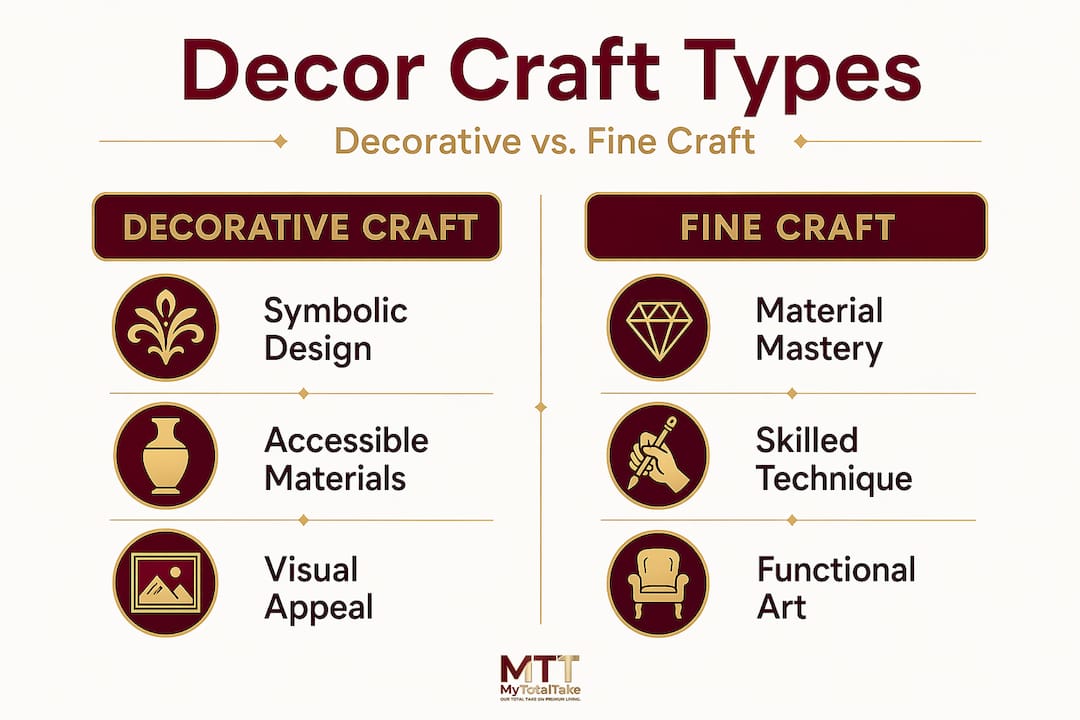
There is also an important distinction worth knowing. Decorative craft focuses on cultural symbolism and visual appeal using accessible materials, while fine craft emphasizes technical mastery and rare or demanding materials. A hand-painted tile border is decorative craft. A hand-thrown porcelain vase with a reduction-fired glaze is fine craft. Both carry real craftsmanship. The difference lies in scale of technical ambition and material rarity.
Pro Tip: When evaluating any decor piece for craftsmanship, turn it over and examine the parts no one is supposed to see. Consistent finish quality on hidden surfaces is one of the clearest signs of a maker who holds their own standards.
Historical roots and cultural weight
Craftsmanship in furniture and decor does not exist in a vacuum. Its current forms are the product of centuries of accumulated knowledge, much of which was passed through guilds, family workshops, and regional traditions that valued quality as a matter of cultural pride.
Chinese classical furniture offers one of the most instructive examples. The quality of these pieces is assessed through harmony of wood, structure, proportion, tool marks, and patina, not simply by age or visual appeal. The Ming dynasty workshops developed furniture proportions that feel balanced to the eye because they were calculated with the same rigor applied to architecture. That geometry was not decorative. It was structural and philosophical at once.
The mortise-and-tenon joinery central to this tradition allows wood to breathe and move without cracking or splitting, enabling furniture to last centuries. Nails and screws resist wood movement and cause damage over time. This single joinery decision is why some pieces made four hundred years ago remain structurally sound today.
“Good furniture is not made. It is cultivated over time through the relationship between maker, material, and method.”
The 19th-century Arts and Crafts movement in Britain and America arose as a direct reaction to the industrialization stripping meaning from made objects. William Morris and his contemporaries argued that artisan-made objects carry values that machine production destroys. That argument resonates more strongly now than it did then, because the contrast between handmade and machine-made has never been sharper.
These historical philosophies shape how we select and value decor today. A buyer who understands mortise-and-tenon joinery walks into a furniture showroom differently. They know what to look for. They recognize when a dovetail joint is cut by hand versus routed by machine. That knowledge changes what they purchase and how much they are willing to invest in it.
How craftsmanship transforms your interior spaces
The role of craftsmanship in furniture and decor extends beyond durability. It shapes the entire sensory and emotional experience of a room. Here is how that plays out in practice:
- Handcrafted pieces add narrative. A thrown ceramic lamp base carries the slight irregularity of the potter’s hands. A hand-stitched textile shows the rhythm of someone’s work across its surface. These details give a room a lived quality that no catalog photo can manufacture.
- Material depth creates sensory richness. Hand-rubbed oil finishes on solid wood feel different under your palm than lacquered particle board. Cut crystal refracts light in patterns that molded glass never achieves. These sensory differences register subconsciously and change how comfortable and alive a space feels.
- Artisan decor supports sustainability. A piece built to last decades does not end up in a landfill after three years. The growing preference for traceable provenance in the market signals that buyers are connecting quality with environmental responsibility.
- Craftsmanship supports personal expression. Mass-produced decor places the same object in thousands of homes. A handcrafted piece, particularly one made to order, reflects choices that are genuinely yours: the wood species, the glaze color, the stitch pattern.
The contrast with mass production becomes undeniable once you have spent time in a space furnished with authentic artisan pieces. Modern interior trends now explicitly request what designers call visible evidence of making: hand-planed facets, exposed joinery, and surfaces that show their history. This is not nostalgia. It is a deliberate design philosophy that machine precision simply cannot satisfy.
Consider materials specifically. Wood shows figure, grain, and color variation that make each piece unique. Hand-thrown ceramics carry the compression marks of centering on a wheel. Handwoven textiles display the slightly uneven weft that tells you a human being sat at a loom. Even large-scale luxury installations in commercial spaces can require nearly 50 skilled artisans and over 60,000 labor hours for major gold-work installations, illustrating just how deeply craftsmanship scales when the commitment is genuine.

Pro Tip: Start one room at a time. Replace one mass-produced accent piece with a handcrafted equivalent and live with it for a month. The difference in how the room feels will tell you everything.
How to assess decor craftsmanship before you buy
Knowing what craftsmanship means is one thing. Recognizing it in a specific piece you are considering is another skill entirely. Here is how to evaluate what you are looking at.
| What to examine | Craftsmanship indicator | Mass-production red flag |
|---|---|---|
| Joinery on wood pieces | Hand-cut dovetails, mortise-and-tenon joints | Staples, pocket screws, or visible dowels |
| Surface finish | Layered, tactile, slightly varied | Uniformly sprayed, plastic-feeling |
| Material quality | Solid wood, full-grain leather, hand-thrown clay | Veneers, bonded leather, slip-cast uniformity |
| Maker documentation | Signature, mark, or origin certificate | No attribution, anonymous origin |
| Imperfections | Subtle, consistent with handwork | Random, structural, or cost-cutting |
Beyond the table above, there are several questions worth asking any seller directly:
- Who made this piece, and can you show documentation or video of the process?
- For wood furniture: was the wood kiln-dried or air-dried, and for how long?
- Is there a maker’s mark, signature, or certificate of authenticity?
- What joinery technique was used, and why?
Artisan-made furniture with verifiable documentation commands a 60 to 80 percent price premium over mass-produced equivalents. That premium is not arbitrary. It reflects real labor, real material selection, and real accountability. Sellers who cannot answer basic provenance questions are almost certainly selling production-line goods at artisan prices.
One practical note: expect deposits of 40 to 60 percent on custom artisan furniture orders. This is standard practice and actually a good sign. It indicates the maker is committing time and materials to your specific piece, not pulling inventory from a warehouse.
My take on craftsmanship and where it’s heading
I have spent years looking at how people actually live with their decor, and the pattern that stands out most clearly to me is this: the pieces people genuinely love are almost always the ones with a story. Not a marketing story. A making story.
I have seen living rooms transformed not by expensive renovation but by one well-placed handcrafted sideboard or a set of thrown mugs on an open shelf. These objects shift the energy of a space in ways that are hard to articulate but immediately felt by everyone who walks in. That is not mysticism. It is the result of a human being having made thousands of small, skilled decisions that accumulate into something coherent and alive.
What I find most exciting right now is that the market is catching up to what discerning homeowners have known for decades. The demand for traceable artisan furniture is rising sharply, and buyers are asking better questions than they used to. The days of accepting “handcrafted style” as a substitute for actual handcraft are ending.
My advice: do not wait until you are furnishing an entire home to think about craftsmanship. Buy one genuinely made piece now. Learn its joinery. Learn its maker’s name. That single experience will recalibrate how you see every object in every room. The imperfections will stop looking like flaws and start looking like exactly what they are: proof that something real was made by someone who cared.
— Lysander
Discover craftsmanship-driven decor at Mytotaltake

Mytotaltake curates pieces where craftsmanship is not a marketing term but a verifiable standard. If you are ready to move beyond mass-produced options, the high-end home decor guide offers a focused starting point for understanding what quality looks like across every room. For homeowners ready to invest with confidence, the premium decor tips resource covers how to integrate artisan-made pieces into a coherent, lasting interior. Every selection at Mytotaltake reflects the same standard: worth owning, worth keeping, worth passing on.
FAQ
What is the core definition of craftsmanship in decor?
Craftsmanship in decor refers to the disciplined application of skill, material knowledge, and intentional artistry in creating decorative objects. It distinguishes itself from mass production through deliberate decision-making at every stage of the making process.
How do imperfections indicate quality in handcrafted decor?
Subtle asymmetry, tool marks, and irregular grain in handcrafted pieces are signs of authentic human making, not defects. These intentional imperfections add warmth and authenticity that machine-made uniformity cannot replicate.
What is the difference between decorative craft and fine craft?
Decorative craft emphasizes cultural symbolism and visual appeal using accessible materials, while fine craft centers on technical mastery and rare or challenging materials. Both involve genuine craftsmanship, but at different levels of technical ambition.
How do I verify craftsmanship quality when buying decor?
Look for maker’s marks, documented provenance, and visible joinery techniques like mortise-and-tenon. Sellers offering video documentation of the making process or signed certificates of authenticity are the clearest indicators of genuine craftsmanship.
Is craftsmanship worth the higher price in home decor?
Yes. Artisan-made pieces consistently outlast mass-produced alternatives and often appreciate in both sentimental and monetary value. The price premium reflects real labor, material quality, and the accountability of a named maker standing behind their work.
Recommended
Bathroom Fixtures That Feel Like a Daily Upgrade
Comments
[…] importance of craftsmanship extends beyond cultural pride. Skilled craftspeople contribute to local economies, support heritage […]










Leave a comment