
How to Choose an Outdoor Lounge Set That Lasts
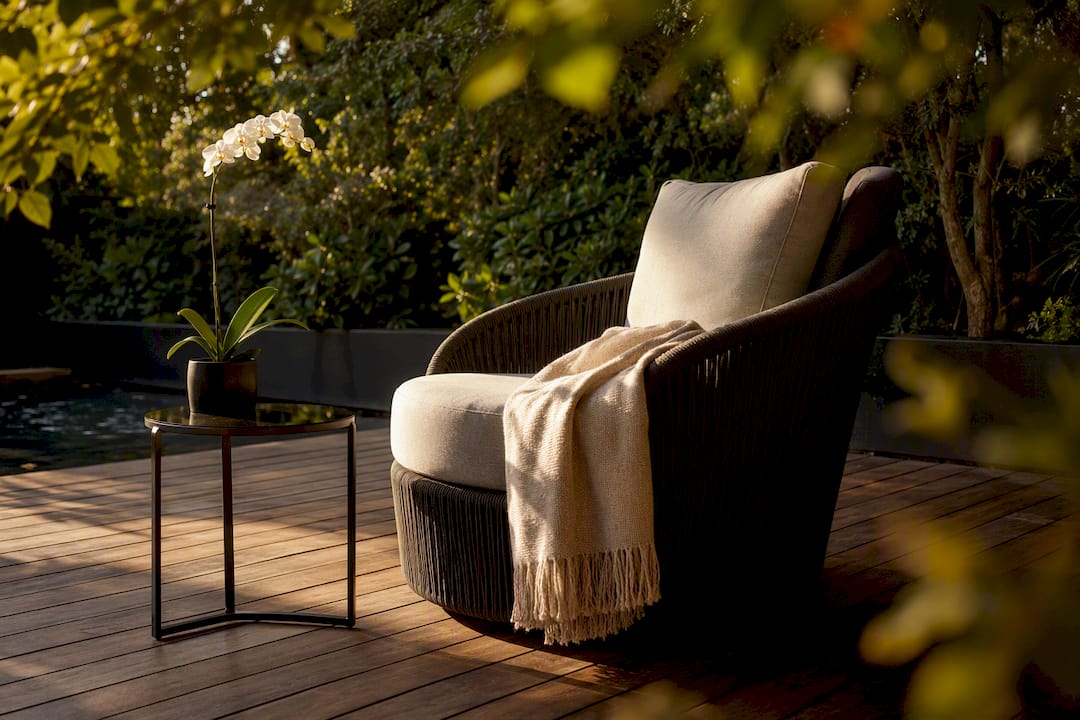
Choose your outdoor lounge set by material first, then size, then cushions, then warranty. That order matters more than style, and it’s the fastest way to skip past sets that look good in photos but sag, rust, or fade within a season. Powder-coated aluminum, teak, and resin wicker over aluminum frames are the three materials that consistently hold up across climates, and Forbes Vetted’s testing points to extended warranties as a genuine signal of a manufacturer’s confidence in its own construction.
Once you know your material, your next move is simple: measure the space you’re furnishing before you shop. A set that looks proportional online can swallow a small patio or leave a large one feeling sparse. If you’d rather browse pieces that have already cleared the durability bar, Mytotaltake curates outdoor lounge collections specifically for climate performance and long-term wear, which shortens the research phase considerably.
Here’s the shortlist to run through before you commit:
- Material check: Aluminum, teak, or resin wicker over a metal frame for most climates.
- Size check: Measure your usable footprint, not just the “patio size” listed on a listing.
- Fabric check: Solution-dyed acrylic or performance polyester for anything that sees sun or splashes.
- Warranty check: Look for frame coverage of at least three years, ideally longer.
Key Takeaways
Choosing an outdoor lounge set comes down to picking a weather-resistant frame material first, sizing it to a measured space, and confirming a warranty that actually backs the frame’s construction.
| Point | Details |
|---|---|
| Material comes first | Choose aluminum, teak, or resin wicker over aluminum based on your specific climate before considering style. |
| Measure before you shop | Calculate your usable footprint, doorway widths, and circulation clearance before picking a configuration. |
| Fabric affects usability | Solution-dyed acrylic resists fade and mildew far better than standard polyester or olefin. |
| Warranty signals confidence | Longer frame warranties, sometimes up to a decade on premium lines, usually indicate sturdier construction. |
| Shop curated for confidence | Mytotaltake curates outdoor lounge sets for durability and craftsmanship, backed by free returns. |
Table of Contents
- Materials and Durability: Which Frame and Weave Actually Survive Your Climate
- What Cushion Fabrics Hold Up Best Outdoors?
- How Do You Measure and Layout an Outdoor Lounge Set?
- How Much Maintenance Does an Outdoor Lounge Set Really Need?
- What Should You Expect at Each Budget Level?
- Your Step-by-Step Checklist Before You Buy
- How Sustainable Are Outdoor Furniture Materials?
- How Should You Store Furniture and Cushions Off-Season?
- What Accessories Complete an Outdoor Lounge Setup
- Frequently Asked Questions
- Sources
Materials and Durability: Which Frame and Weave Actually Survive Your Climate
The frame is the one part of an outdoor lounge set you’re not replacing in three years, so it deserves the most scrutiny. Everything else, cushions, covers, even the table, can be swapped out later. Get the frame wrong and you’re shopping again by next summer.
Powder-coated aluminum resists rust because there’s no iron to oxidize, and the powder coating adds a second layer of protection against chipping and UV breakdown. It’s light enough to rearrange easily, which matters if you like to reconfigure your layout for parties, and it performs well in nearly every climate, including coastal air that eats through cheaper metals within a year or two.
Teak is the classic choice for a reason: its natural oils repel water and resist rot without any sealant. Left untreated, teak weathers to a soft silver-gray that many homeowners prefer over the original honey tone. Treated teak keeps its color longer but needs annual oiling to stay that way.
Treated hardwoods like eucalyptus or acacia offer a similar look to teak at a lower price, but they’re more porous and need sealing every one to two years to prevent cracking. Skip that maintenance step and you’ll see checking and graying within a couple of seasons.
Powder-coated steel is heavier and sturdier than aluminum, which makes it a strong pick for high-wind regions, but it’s more prone to rust at scratches or welds where the coating has worn through.
Resin and PE (polyethylene) wicker woven over an aluminum frame combines a high-end look with minimal upkeep. The Spruce’s testing across more than 30 pieces found that material choice, more than any other single factor, determines how a set holds up over time, and resin wicker consistently performed well because the weave doesn’t absorb water or fade the way natural rattan does.
Polywood (recycled high-density polyethylene lumber) never needs staining, sealing, or painting, and it won’t splinter or rot. It’s a strong choice for anyone who wants zero-maintenance style with a wood-like appearance.
Match your material to your actual conditions:
- High-UV climates: Aluminum with performance fabric, or polywood.
- Coastal or salt-air locations: Powder-coated aluminum or marine-grade polymer, never untreated steel.
- Wet or winter-prone regions: Teak, aluminum, or polywood; avoid untreated hardwoods.
- Households with kids or pets: Resin wicker or polywood for easy wipe-downs and scratch resistance.
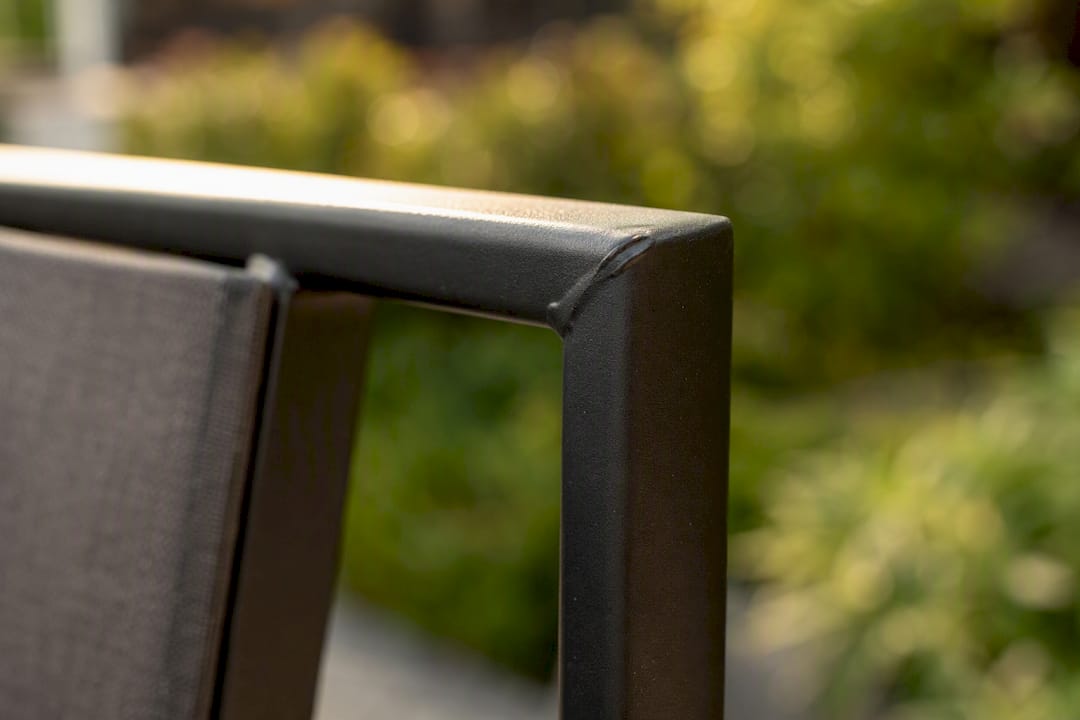
Before you buy, inspect the construction details that separate a set that lasts a decade from one that wobbles by year two. Look for continuous, welded joints rather than bolted brackets, which loosen over time. Check the frame’s wall thickness (thicker aluminum tubing resists denting), confirm the set has adjustable foot levelers for uneven patios or decks, and ask whether the resin wicker carries a recycled-content or UV-stabilization rating.
Pro Tip: Run your hand along every weld and seam before buying in person, or ask for close-up photos online. A rough or uneven weld is often the first place rust starts, even on premium powder-coated frames.
For a deeper look at how different frame materials compare across styles, Mytotaltake’s guide to types of outdoor furniture breaks down the tradeoffs in more depth.
What Cushion Fabrics Hold Up Best Outdoors?
Solution-dyed acrylic, sold under names like Sunbrella, is the gold standard for outdoor cushions because the color is woven into the fiber itself rather than applied as a surface coating. That means it resists fading even after years of direct sun, and it sheds mildew far better than standard polyester upholstery.
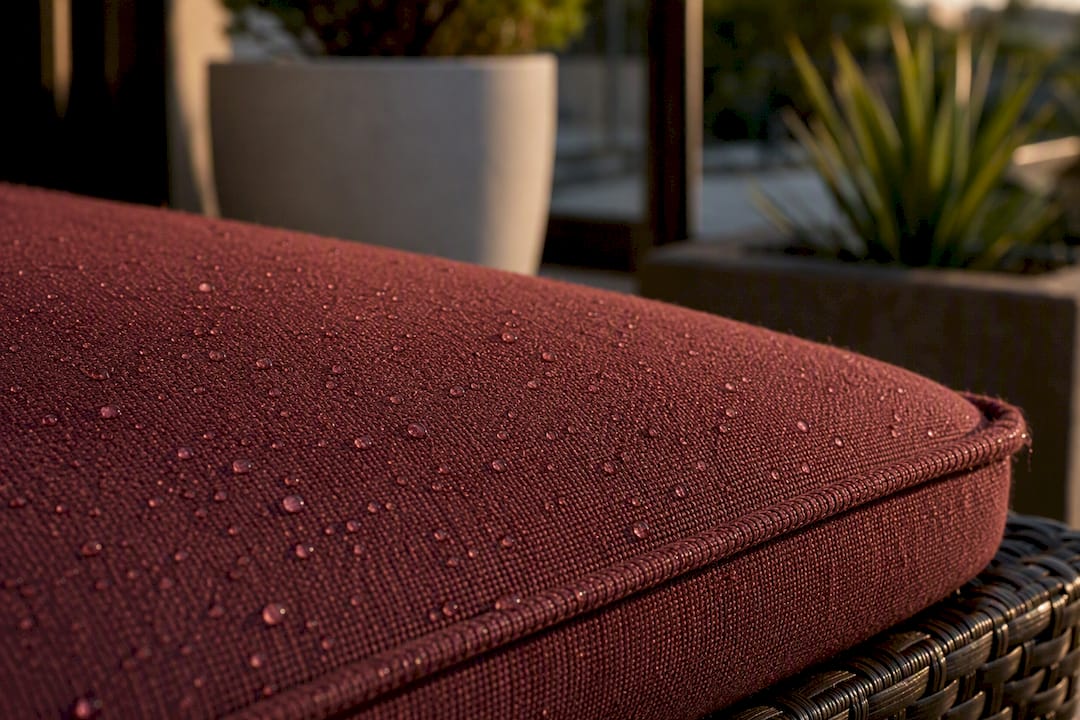
Olefin is a budget-friendly alternative that resists staining well but tends to fade faster under intense UV exposure than acrylic. Performance polyester sits in the middle: it’s more affordable than solution-dyed acrylic, holds color reasonably well, and dries quickly after rain.
Foam matters as much as fabric. Standard foam absorbs water and can take days to dry, breeding mildew in the meantime. Quick-dry foam, which uses an open-cell structure to let water pass through rather than pool inside, is worth the upgrade for anyone near a pool or in a rainy region. Wirecutter’s testing of outdoor sofas and sectionals flags removable, zippered covers and reinforced seams as the two construction details that most reliably predict long-term satisfaction, since they let you actually clean or replace a cover instead of living with a stain.
Sets built with resin wicker and machine-washable cushion covers, a combination increasingly common on higher-end sectionals, cut care time significantly since you can toss covers in the wash instead of scrubbing them by hand.
Quick fabric care checklist:
- Removable, zippered covers: Machine wash on cold, air dry only.
- Non-removable cushions: Spot clean with mild soap and water, then let dry fully in the sun.
- Off-season storage: Store cushions indoors or in a weatherproof bin rather than leaving them under a cover outside.
- Mildew prevention: Never stack damp cushions; store them flat or upright with airflow.
Solution-dyed acrylic fabrics can run noticeably higher in upfront cost than standard outdoor polyester, but the fade resistance typically means you’re not replacing cushions every other season, which changes the real cost comparison over five years. For more on how fade-resistant textiles are engineered, this technical breakdown of fade-resistant fabrics covers the fiber science in plain terms.
How Do You Measure and Layout an Outdoor Lounge Set?
Getting the size right prevents the two most common regrets: a set too bulky for the space, or one so small it looks lost on a large patio.
- Measure your usable footprint, not the total patio area. Subtract space needed for walkways, grills, planters, and doorway swing.
- Check doorway and gate widths if the set needs to pass through them for delivery or seasonal storage.
- Leave clearance for circulation: a minimum of 30 to 36 inches around seating so people can move comfortably, more if you entertain often.
- Plan for the coffee or side table: 14 to 18 inches between seat edge and table edge keeps drinks within reach without crowding knees.
- Confirm storage access if you plan to bring cushions or furniture indoors seasonally, since bulky sectionals don’t always fit through standard doors once assembled.
Once you’ve got your measurements, match the configuration to how you actually use the space. A conversation set (four chairs and a table) suits smaller patios and works well for daily coffee or evening drinks. A sectional maximizes seating in an L-shape or U-shape and fits larger patios or families who host often. A chaise pairing prioritizes lounging over conversation, ideal for poolside setups. Ottomans add flexible extra seating or footrests without committing to a permanent piece.
Modular sets, ones built from individual sectional pieces you can rearrange or add to, offer real long-term value here. The Spruce’s testing notes that modularity lets homeowners scale seating up for parties and back down for everyday use without buying an entirely new set. That flexibility also matters for delivery: modular pieces typically ship and assemble individually, which is easier to manage than a single oversized sectional that needs a crew to maneuver through a gate.
A few sizing rules of thumb worth memorizing: seat depth of 20 to 24 inches accommodates most body types comfortably, seat height around 17 to 19 inches matches typical indoor furniture for an easy transition, and armrest height between 24 and 26 inches supports your arm without forcing your shoulders up. If you’re still working out exact dimensions for your space, Mytotaltake’s guide on measuring for a sofa that fits walks through the same principles applied indoors, and they translate directly outdoors.
How Much Maintenance Does an Outdoor Lounge Set Really Need?
Most homeowners underestimate the upkeep an outdoor set needs, even the “low maintenance” ones. Forbes and The Spruce both note that wood and metal carry different upkeep realities, and skipping basic care shortens lifespan regardless of how much you spent upfront.
A light weekly routine covers most of it:
- Wipe down frames with a damp cloth to remove pollen, dust, and salt residue.
- Bring cushions inside during rain or store them in a deck box if you don’t want to keep hauling them in.
- Check fasteners and levelers every few months, since outdoor temperature swings can loosen hardware over time.
Seasonally, plan to store cushions indoors over winter, cover frames left outside with breathable furniture covers, and reseal wood pieces (teak, eucalyptus, acacia) once a year if you want to maintain their original tone rather than let them weather naturally.
Most fixes are simple enough to handle yourself: tightening a loose bolt, replacing a foot leveler, re-oiling a teak arm. Call a professional only for structural welds that have cracked or frames that have visibly warped, since DIY repairs there rarely hold.
With reasonable care, powder-coated aluminum frames commonly last 10 to 20 years, teak can last decades with annual oiling, and quality resin wicker over aluminum typically holds up for 8 to 12 years before the weave shows wear. Cushions, regardless of fabric, usually need replacing every 5 to 7 years even with good care, since foam compresses and fabric eventually loses its finish.
Pro Tip: Set a phone reminder for the first weekend of spring and fall. That’s when most people actually do seasonal maintenance, not because they planned it, but because it’s already on their calendar for something else.
For more detail on keeping a set looking new for years, Mytotaltake’s piece on patio furniture that looks great for years covers seasonal upkeep by material.
What Should You Expect at Each Budget Level?
Entry-level sets, generally under $800, tend to use thinner aluminum tubing or basic sling fabric and often carry warranties of a year or less. Mid-range sets, roughly $800 to $2,500, typically move into powder-coated aluminum frames, resin wicker, or treated hardwood with better fabric options and warranties in the two to five-year range.
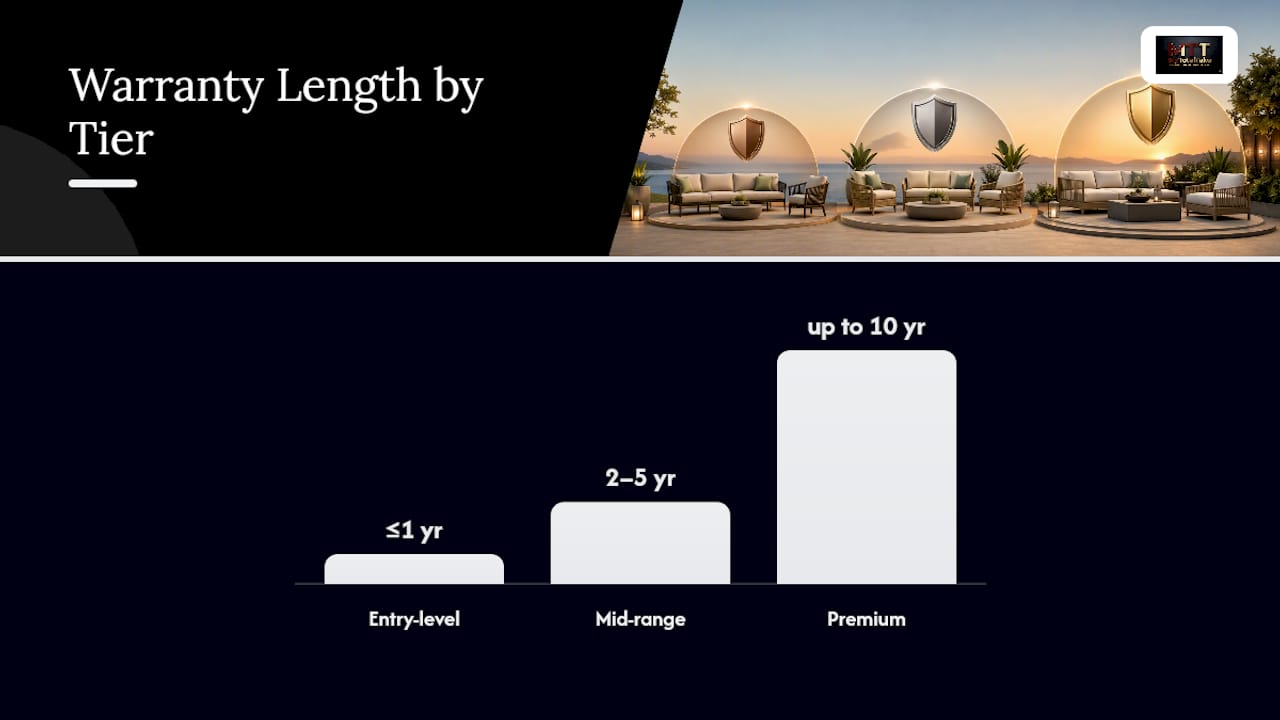
Premium sets above $2,500 usually bring solution-dyed acrylic cushions, teak or heavy-gauge aluminum, and the longest warranties on the market. Forbes points to some premium lines, including select Frontgate sets, carrying frame warranties as long as a decade, a strong signal the manufacturer expects the frame to genuinely last that long.
A meaningful warranty covers frame integrity, weld failure, and often fabric fade under normal use. Watch for common exclusions: many warranties void coverage for damage from improper storage, extreme weather events, or commercial use in a residential warranty.
Before buying, check three things:
- Delivery method: White-glove delivery and assembly versus curbside drop-off changes both cost and convenience.
- Return window: Look for at least 30 days, ideally longer for large furniture you can’t fully judge until it’s assembled.
- Restocking fees: Some retailers charge 15 to 20 percent to return oversized furniture, which erases most of the savings on a discounted set.
Paying more upfront for a longer warranty and better materials almost always reduces your lifetime cost, since you’re not replacing cushions every other year or a rusted frame within five.
Your Step-by-Step Checklist Before You Buy
Run through this sequence before adding anything to your cart, whether you’re shopping online or standing in a showroom.
- Measure your space first. Know your usable footprint before you look at a single product.
- Filter by material. Narrow to aluminum, teak, or resin wicker based on your climate.
- Evaluate the fabric. Ask specifically whether cushions are solution-dyed acrylic or a comparable performance fabric.
- Check the warranty terms. Read what voids coverage, not just the length of the warranty.
- Read recent reviews. Look for mentions of fading, rust, or loose joints after a full season outdoors.
When you’re talking to a seller or reading a spec sheet, ask these exact questions:
- Is the fabric solution-dyed, or is the color applied to the surface?
- What alloy or gauge is the aluminum frame, and is it welded or bolted?
- What voids the warranty, specifically?
- Are cushion covers removable and machine washable?
A few red flags mean you should walk away regardless of price: no stated warranty at all, cushion covers that can’t be removed, or vague material labeling like “premium metal” with no alloy specified. That kind of language usually means the manufacturer doesn’t want you comparing specs.
Households with kids, pets, or a pool should prioritize resin wicker or polywood with quick-dry foam cushions, since those materials shrug off spills, sunscreen, and chlorine splashes far better than natural fabrics or untreated wood.
Why Trust Mytotaltake’s Outdoor Furniture Picks
Mytotaltake curates outdoor lounge sets specifically for craftsmanship and weather performance, not just style trends, backed by fast delivery and free returns on every order. That combination matters most when you’re buying furniture you genuinely can’t fully evaluate until it’s assembled on your patio.
- Curated selection focused on durable materials and construction quality
- Free returns if a set doesn’t match your space or expectations once assembled
- Dedicated outdoor furniture guides covering materials, fabrics, and layout
Craftsmanship shows up in the details most shoppers skip past: a welded joint instead of a bracket, a foot leveler instead of a fixed base, a cushion cover that actually unzips. Those are the things worth checking before anything else.
Lysander, editorial contributor at Mytotaltake, brings a materials-first lens to outdoor furniture coverage, prioritizing construction details over marketing copy.
How Sustainable Are Outdoor Furniture Materials?
Material choice affects your environmental footprint as much as your maintenance schedule. Teak from certified sustainable forestry operations regenerates responsibly, while teak harvested from unregulated sources contributes to deforestation, so look for Forest Stewardship Council certification when buying teak pieces.
Polywood is manufactured largely from recycled plastic, often including reclaimed milk jugs and detergent bottles, which diverts material from landfills and never needs chemical sealants or stains that can leach into soil. Aluminum is highly recyclable at the end of its life, and powder coating itself produces less volatile organic compound emissions than traditional liquid paint finishes.
Resin wicker made from virgin plastic carries a heavier environmental cost than recycled alternatives, so ask specifically whether a set’s PE wicker includes recycled content. Solution-dyed acrylic fabrics also tend to last far longer than cheaper alternatives, and a cushion that survives eight seasons instead of two keeps that much more fabric out of a landfill.
The most sustainable choice, in practical terms, is usually the most durable one. A teak set that lasts 25 years with proper care has a smaller lifetime footprint than three cheaper wood sets replaced over the same period.
How Should You Store Furniture and Cushions Off-Season?
Off-season storage is where a lot of otherwise well-chosen furniture gets ruined. Cushions left outside under a flimsy cover trap moisture, and a single humid week can breed mildew that never fully washes out.
Store cushions indoors whenever possible, in a closet, garage, or basement, rather than relying on outdoor storage. If indoor space isn’t available, a weatherproof deck box keeps them dry and adds a place to sit or set drinks in the meantime.
For frames, breathable furniture covers matter more than heavy-duty tarps, which trap condensation underneath and can cause more moisture damage than leaving furniture uncovered. Look for covers with vents or a water-resistant (not fully waterproof) fabric.
Aluminum and polywood frames can typically stay outside year-round without covers in most climates, since neither rusts nor rots. Teak also tolerates outdoor winters well, though a cover helps preserve its color if you’re maintaining an oiled finish. Untreated hardwoods and steel benefit most from full winter storage in a garage or shed, since freeze-thaw cycles accelerate cracking and rust.
What Accessories Complete an Outdoor Lounge Setup
A lounge set rarely stands alone. Side tables extend usable surface space for drinks and books without crowding the main seating, and matching the material to your set (aluminum-framed tables with resin wicker seating, for instance) keeps the look cohesive rather than mismatched.
An umbrella or shade structure changes how usable a space is during peak sun hours, and cantilever umbrellas free up floor space compared to a center-pole design that eats into your seating footprint. Look for the same solution-dyed acrylic fabric on your umbrella that you chose for your cushions, since mismatched fade rates between fabrics become obvious within a year.
Lighting, whether string lights, integrated LED strips, or standalone lanterns, extends your patio’s usable hours into the evening and makes a lounge set feel finished rather than temporary. Solar-powered options avoid extension cords entirely, which matters for sets positioned away from an outlet.
For small balconies or compact patios, a two-piece bistro set paired with a single umbrella often accomplishes more than trying to squeeze in a full sectional. For a deeper look at working with limited square footage, this guide to decorating a small apartment patio offers practical layout ideas that apply directly to lounge set placement.
Style Versus Longevity: Where I’d Spend the Money
If I had to choose between a striking frame design and a genuinely durable one, I’d take durability every time and treat cushions as the seasonal style refresh. A powder-coated aluminum frame in a plain finish will still be solid in a decade; a trendy woven pattern in a lower-grade resin might not survive five summers.
Think of the frame as the investment piece and the cushions as the wardrobe. You can swap fabric colors every couple of years for the cost of new covers, but you can’t cheaply undo a frame that’s already rusting. My practical recommendation: spend the bulk of your budget on frame quality, then buy one extra set of cushion covers on day one so restyling later costs you nothing but time.
Shop Curated Outdoor Lounge Sets at Mytotaltake
Mytotaltake gives you a shortcut past the guesswork this guide just walked through: every set in the collection is chosen for frame durability and craftsmanship first, not just how it photographs. That means you’re not gambling on vague “premium metal” listings or cushion covers that turn out to be sewn shut.

Every purchase comes with free returns, so if a set doesn’t fit your space the way you measured it, sending it back costs you nothing. Start by browsing the curated outdoor furniture guide for this year’s lineup, or explore luxury furniture picks if you’re furnishing more than one room. If you want the full buying framework before you commit, the guide to buying outdoor furniture for lasting luxury walks through the same material and warranty checks in more depth. Measure your space today, then browse by material to see what actually fits.
Frequently Asked Questions
What’s the most durable material for an outdoor lounge set?
Powder-coated aluminum and teak both consistently outperform other materials across most climates. Aluminum resists rust entirely, while teak’s natural oils resist rot without chemical treatment.
How do I choose an outdoor lounge set for a small patio or balcony?
Prioritize a compact conversation set or a two-piece bistro configuration over a sectional, and measure your usable footprint before shopping so you don’t overcommit the space.
Are modular outdoor lounge sets worth the extra cost?
Yes, for most households. Modular pieces let you scale seating up for gatherings and down for everyday use, and testing consistently shows modularity as a key driver of long-term value.
How often should I replace outdoor cushions?
Even with good care, most outdoor cushions need replacing every 5 to 7 years as foam compresses and fabric loses its finish, regardless of how well the frame has held up.
What warranty length should I look for on an outdoor lounge set?
Aim for at least three years of frame coverage; premium lines sometimes offer up to a decade, which is a strong signal the manufacturer trusts its own construction.
Sources
For deeper testing-based comparisons, Forbes Vetted’s patio furniture guide, The Spruce’s tested patio furniture picks, and Wirecutter’s outdoor sofa reviews all offer hands-on evaluations worth cross-checking. For fabric specifics, see this fade-resistant fabric guide, and for layout in tight spaces, Mytotaltake’s modular sofa layout guide applies well outdoors too.
- Best Patio Furniture 2026 – Forbes Vetted
- The 9 Best Patio Furniture Sets The Spruce Has Tested
- The 8 Best Outdoor Sofas and Chairs of 2026








Leave a comment