
OLED vs QLED TV: Which One Fits Your Home?
You can tell a lot about a room by what’s on the wall.
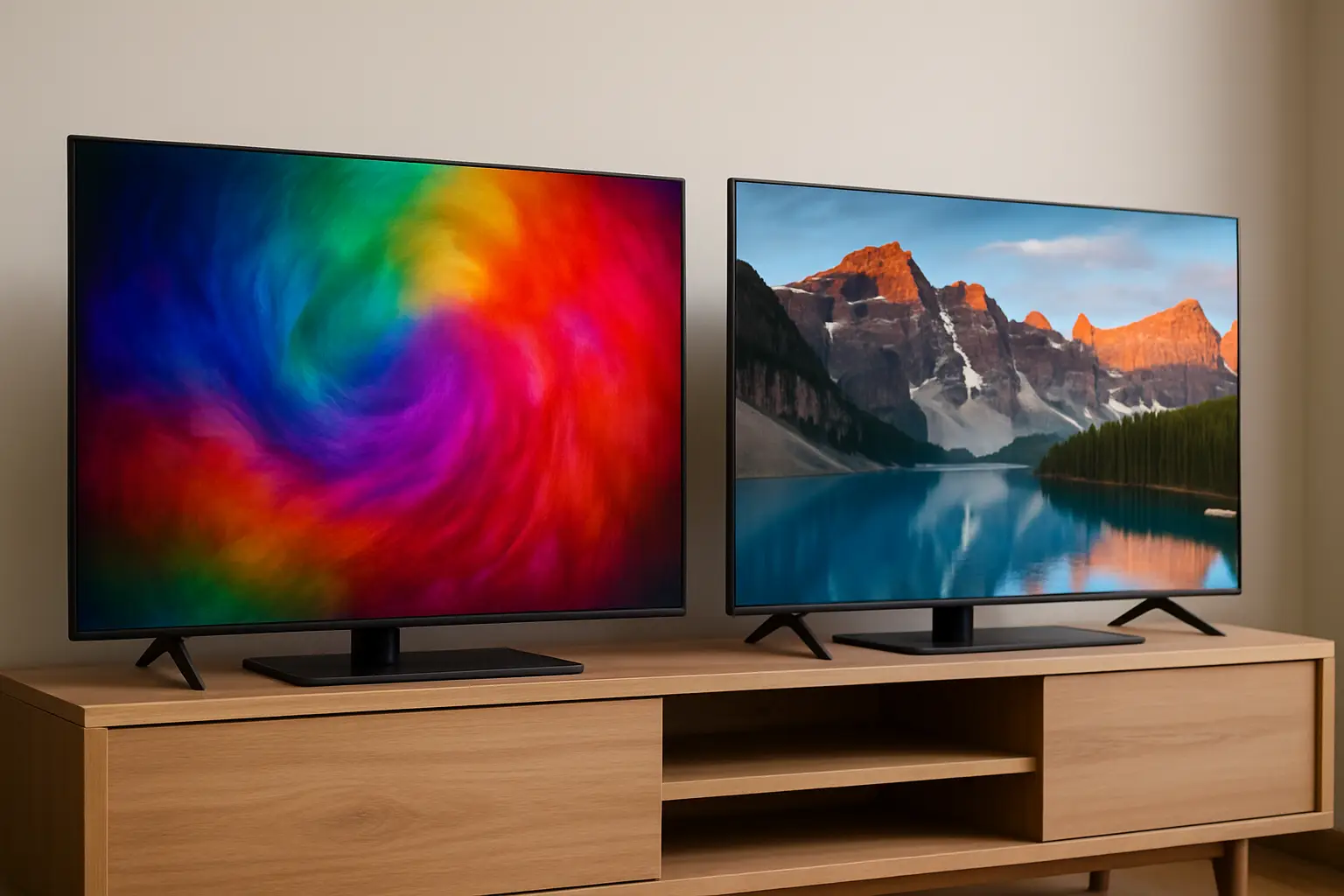
A big-screen TV isn’t just a rectangle of pixels anymore – it’s a design decision, a weekly movie ritual, the Sunday sports hub, and the “one upgrade” that makes a living room feel finished. If you’re weighing an OLED vs QLED TV, you’re already shopping at the right altitude. Both are premium categories. Both can look spectacular. The difference is in how they get there – and which trade-offs you’ll actually notice in your space.
OLED vs QLED TV: the real difference
OLED (organic light-emitting diode) panels are self-emissive. Each pixel creates its own light and can shut off completely. That’s why OLED is famous for true black levels and precise contrast.
QLED (quantum dot LED) is an LED/LCD TV that uses a quantum dot layer to boost color and brightness. It still relies on a backlight (often paired with local dimming), which is why QLED’s strengths show up in bright rooms and high-impact highlights.
If you remember one idea, make it this: OLED wins by controlling darkness. QLED wins by pushing light.
Picture quality, where you’ll actually see it
Contrast and black levels
OLED’s calling card is contrast that feels sculpted. In a dim room, black bars on a widescreen movie can disappear into the wall. Night scenes hold detail without turning gray, and small highlights – a city skyline, a candle flame – pop with a “floating” effect.
QLED can look excellent here too, especially higher-end models with strong local dimming, but it’s doing a balancing act. Because the backlight illuminates zones rather than individual pixels, you can sometimes see blooming (a halo around bright objects on dark backgrounds). The best sets minimize it, yet OLED still looks more precise when the content is moody or cinematic.
Brightness and daytime viewing
If your TV lives in an airy great room with sun pouring in, QLED often feels more effortless. It can hit higher peak brightness, which helps during daytime sports, news, and casual viewing where you don’t want to baby the lighting.
OLED has improved significantly, but in the brightest rooms it may not feel as punchy, especially with lots of reflections. You can absolutely use OLED in a bright space, but it tends to shine most when you can control lighting even a little – shades, a lamp instead of overheads, evening viewing.
Color volume and “wow” factor
Both can deliver rich, premium color. The subtle difference is how they maintain it at high brightness.
QLED’s quantum dots help it keep saturation when the image gets very bright – think snow scenes, daytime stadium shots, animated films, or vivid travel footage. OLED, because of its contrast and per-pixel control, can look more natural and dimensional, especially in darker scenes where color gradations matter.
In real homes, the “wow” is situational: QLED impresses when the room is bright and the content is bright. OLED impresses when the room is calm and the content is crafted.
Viewing angles for wide seating
OLED is typically the easy choice if you have a sectional, open-concept layout, or frequent hosting. Colors and contrast hold up well off-center.
QLED varies. Some models maintain solid angles, but many LED/LCD panels lose contrast and wash out as you move to the side. If your seating is spread out, don’t treat viewing angle as a footnote – it affects the whole room’s experience.
Gaming, sports, and fast motion
Modern OLEDs and QLEDs can both be excellent for gaming. Look for HDMI 2.1 support, 120Hz refresh rate, variable refresh rate (VRR), and low input lag.
OLED’s near-instant pixel response can make motion feel crisp in fast games. QLED can counter with higher brightness that makes HDR gaming look bold in daylight.
For sports, the decision often comes down to your room. In a sunlit space, QLED’s brightness can keep the image lively for afternoon games. In the evening with dimmer lighting, OLED’s contrast can make the field or court feel more three-dimensional. Motion handling also depends heavily on a TV’s processing, so two models of the same tech can look different with the same broadcast.
Longevity, burn-in, and peace of mind
This is where many shoppers pause – and where nuance matters.
OLED burn-in (more accurately, permanent image retention) is possible if static elements sit on-screen at high brightness for long periods: news tickers, scoreboards, or a game’s HUD day after day. Most OLEDs include protection features (pixel shifting, logo dimming, compensation cycles), and normal mixed viewing is typically fine. But if the TV will run the same channel all day in a home office, or you regularly leave a paused screen up for hours, QLED is the lower-stress choice.
QLED, as an LED/LCD technology, is far less susceptible to burn-in. Its long-term considerations are different: backlight uniformity, possible blooming, and the reality that LED/LCD blacks won’t match OLED in a dark room.
If you’re buying a premium screen, it’s smart to align the technology with your habits rather than hoping your habits change.
HDR formats and the “premium” feel
HDR is where a great TV earns its place in a refined home setup: controlled highlights, deep shadow detail, and image depth that feels almost architectural.
OLED’s perfect blacks make HDR contrast look dramatic, especially in movies and prestige series. QLED can deliver very bright HDR highlights that feel punchy and luxurious, particularly in rooms with ambient light.
One more subtlety: HDR isn’t just about peak brightness. It’s about how the TV maps tones, preserves detail, and avoids crushing blacks or blowing out whites. Two TVs with the same panel type can feel wildly different here. If you’re comparing models, pay attention to real content performance, not just specifications.
Design and placement: the room matters
Premium shoppers often care as much about the object as the image. OLED TVs tend to be extremely thin, with an elegant, gallery-like profile that looks intentional on a wall. QLED sets can also be sleek, though they’re typically thicker due to backlighting.
Placement also ties back to reflections. If your wall faces windows, prioritize strong reflection handling. If the TV is the focal point of a darker media space, prioritize black levels and uniformity.
And if you’re planning a clean, minimalist look, think about cable management and whether you’ll use a soundbar or a full audio setup. A beautiful picture deserves sound with the same sense of finish.
Price and value: where your money shows
OLED is often priced as the connoisseur pick, especially at larger sizes. You’re paying for per-pixel lighting control and the cinematic payoff that comes with it.
QLED spans a wider price range, from affordable “bright and big” options to high-end models with advanced local dimming. That range can be an advantage: you can choose where to invest – size, brightness, processing – without committing to OLED pricing.
The value question isn’t “Which is cheaper?” It’s “Which upgrade will you notice every day?” If your living room is bright and busy, QLED’s strengths show constantly. If your favorite viewing happens at night and you love film-grade contrast, OLED’s strengths feel personal.
Which should you buy for your space?
If your home leans toward daytime viewing, open windows, and lots of ambient light, QLED is often the most satisfying match. It’s also the safer bet for heavy news, sports tickers, or marathon gaming sessions with static UI.
If your home viewing is a nightly ritual – lights low, shows and movies that live and die on shadow detail – OLED tends to feel more elevated. It’s also a great fit for wide seating, where you want the image to look premium from every angle.
If you’re building a curated tech setup with the same care you’d bring to furniture and decor, the best move is to choose the screen that complements how the room is lived in, not just how it’s photographed. And if you want a premium-shopping experience that treats TVs like part of a broader home upgrade, mytotaltake.com is built around that curated, design-forward mindset.
A helpful closing thought: pick the display technology that flatters your daily light, not your once-a-month movie night – because the TV you love at 2 p.m. on a Saturday is the one you’ll keep appreciating long after the newness wears off.








Leave a comment