
What Size Ceiling Fan for Room? Get It Right
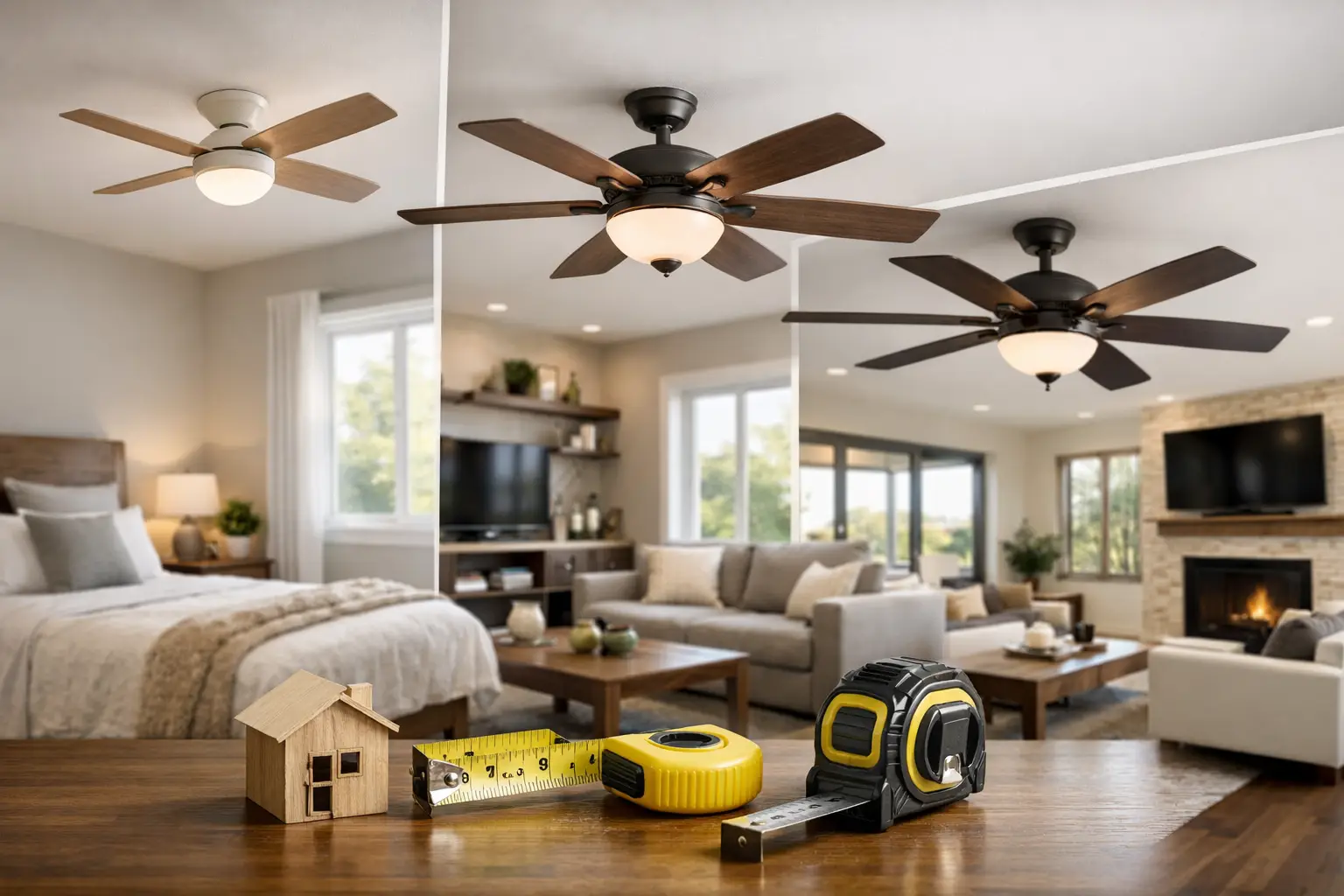
A ceiling fan that looks perfect in the box can feel completely wrong once it is installed. Too small, and the room still feels warm and stagnant. Too large, and it can overwhelm the ceiling line, dominate the design, or create more airflow than the space needs. If you are asking what size ceiling fan for room planning, the answer starts with square footage – but the best choice also depends on ceiling height, layout, and the kind of atmosphere you want the room to have.
In a well-designed home, a ceiling fan is not just a utility piece. It affects comfort, visual balance, and how polished the entire room feels. Choosing the right size is what turns it from an afterthought into a smart, elevated upgrade.
What size ceiling fan for room dimensions?
The simplest rule is to match the fan blade span to the room’s square footage. Blade span is the full diameter of the fan from one blade tip to the opposite blade tip. This is the number most shoppers use when deciding between a 44-inch, 52-inch, or 60-inch model.
For rooms up to 75 square feet, a fan around 29 to 36 inches usually works well. Small bathrooms, compact home offices, and laundry rooms often fall into this category. For rooms between 76 and 144 square feet, a 36- to 42-inch fan is typically the better fit. Think guest bedrooms, breakfast nooks, or smaller kitchens.
Once you move into spaces between 144 and 225 square feet, a 44- to 50-inch fan tends to be the sweet spot. This is a common range for standard bedrooms and many living rooms. For rooms from 225 to 400 square feet, a 50- to 54-inch fan is a strong choice, offering enough airflow without feeling undersized. In large great rooms or open-concept spaces over 400 square feet, you will often want a 60-inch fan or larger, or even two fans if the room is long or divided into functional zones.
That baseline is useful, but it is not the whole story. Two rooms with the same square footage can need different fans if one has soaring ceilings and the other has a low, compact profile.
Why room shape matters as much as square footage
Square footage gives you the starting point. Room shape tells you whether to stay there or adjust.
A long, narrow room may technically qualify for one larger fan, but that does not always produce the best airflow across the entire space. In many cases, two appropriately sized fans create a more even, refined result than one oversized fixture in the center. This is especially true in open-plan kitchens and living areas, covered patios, and elongated primary suites.
On the other hand, a square room with standard proportions can usually handle one centered fan beautifully. The airflow feels more balanced, and the fixture reads as intentional rather than oversized.
Furniture placement matters too. If a fan sits over a bed, dining table, or seating area, you want enough circulation where people actually spend time. A large room with heavy visual elements – a statement bed, a wide sectional, dramatic cabinetry – can also support a larger fan aesthetically. In a more delicate or minimalist room, a slightly smaller, cleaner-lined fan may preserve the look better while still performing well.
Ceiling height changes the calculation
A fan’s width is only part of sizing. Its drop from the ceiling is just as important.
For standard ceilings around 8 feet high, a flush-mount or low-profile fan is often the right call. It keeps the blades at a safe height while maintaining a sleek profile. In rooms with 9-foot or higher ceilings, a fan with a downrod usually performs better because it brings the blades closer to the occupied space where airflow is most noticeable.
The ideal position places the fan blades about 8 to 9 feet above the floor. There should also be at least 7 feet of clearance from the floor to the blades for safety. If your ceiling is especially tall, using the proper downrod is not optional – it is what helps the fan actually move air where you need it.
This is where many shoppers go wrong. They buy the correct blade span for the room, then mount it too close to a vaulted or very high ceiling. The fan may look impressive, but the airflow can feel weak because the blades are too far from the living zone.
For vaulted and sloped ceilings
A vaulted ceiling can make a room feel expansive, but it complicates fan sizing. First, make sure the fan is compatible with angled mounting. Second, do not assume that a dramatic ceiling automatically calls for the largest possible fan.
If the room is large and open, a bigger span may make sense. But if the footprint is moderate and the ceiling simply rises higher, the more important decision may be mounting and downrod length rather than jumping up multiple fan sizes. Proportion still matters. A beautifully scaled fan often looks more luxurious than a massive one chosen purely for visual impact.
Airflow matters more than blade span alone
When people ask what size ceiling fan for room comfort, they usually focus on inches. A better metric is airflow, measured in CFM, or cubic feet per minute. This tells you how much air the fan actually moves.
Two fans with the same blade span can perform very differently depending on blade pitch, motor quality, and overall engineering. A premium fan with a well-designed motor and blade system can outperform a cheaper model of the same size while running more quietly and looking more refined.
For smaller rooms, a lower CFM can still feel comfortable. Medium rooms generally benefit from moderate airflow, while larger living areas and covered outdoor spaces usually need higher CFM to feel effective. If you are choosing between two sizes that both seem plausible, comparing airflow ratings can help you make the smarter decision.
This is also where design-forward shoppers gain an edge. The best ceiling fan is not always the biggest one. It is the one that balances performance, quiet operation, finish quality, and visual proportion.
Choosing the right fan for each room
Bedrooms usually benefit from balanced, gentle airflow rather than dramatic wind. In many primary and guest bedrooms, a 44- to 52-inch fan feels right, depending on room size. The goal is comfort while sleeping and a calm visual presence above the bed.
Living rooms often need more flexibility. If the space is used for lounging, entertaining, and everyday family life, a 52- to 60-inch fan is common. In larger open-concept layouts, one fan may not be enough, especially if airflow has to reach both the seating area and adjacent kitchen zone.
Dining rooms are a bit more nuanced. A fan can work beautifully there, but scale and placement are everything. You want the fixture to feel integrated with the table and ceiling height, not like an oversized appliance hovering overhead. In design-conscious spaces, cleaner silhouettes and integrated lighting often create a more elevated look.
Kitchens, home offices, and smaller flex rooms usually do best with mid-size or compact fans, chosen as much for clearance and line of sight as for airflow. Covered patios and sunrooms often call for larger spans and stronger airflow, especially in warmer climates, but the finish and damp- or wet-rated construction matter just as much.
Common sizing mistakes that ruin the look
The most common mistake is sizing down too far because the shopper is worried a larger fan will look bulky. In reality, a fan that is slightly too small often looks more awkward because it feels visually underpowered in the room.
The second mistake is choosing purely by style. A sculptural fan in a premium finish can be stunning, but if it is too small for the room or mounted at the wrong height, the comfort payoff disappears.
The third is ignoring blade clearance. Ideally, fan blades should have at least 18 inches of space from walls. Tight clearances can affect both safety and airflow. In compact rooms, that may guide you toward a smaller model even if the square footage suggests otherwise.
A simple way to choose with confidence
Measure the room length and width, multiply to get square footage, and use that as your starting size range. Then look up and assess the ceiling height. After that, consider the room’s shape, where people sit or sleep, and whether one fan or two would create a better balance.
Finally, compare CFM, mounting style, and overall design language. In a curated home, a ceiling fan should feel like part of the architecture, not a compromise. That is especially true when shopping premium assortments like the kind featured at My Total Take, where function and finish are expected to work together.
A well-sized ceiling fan does more than move air. It quiets the room, softens summer heat, supports energy efficiency, and completes the space with a sense of intention. Choose for proportion first, then performance, and the room will feel better every day you live in it.











Leave a comment