
Why Quality Matters in Gifts: Lasting Impact and Value

A quality gift does one thing a cheap gift rarely can: it stays. It sits on a desk, gets worn, gets used, and keeps quietly signaling that someone thought carefully about you. Research synthesis confirms that price has virtually no correlation with long-term appreciation. What actually drives how a recipient feels is usefulness, fit, and the sense that the giver paid attention. That is why quality matters in gifts far more than cost.
The short version:
- Quality gifts trigger stronger emotional memory because they are reused and noticed repeatedly
- Reciprocity research shows a well-chosen gift invites goodwill in return; a generic one, however expensive, does not
- The endowment effect means durable items build attachment over time, not just at the moment of unwrapping
- For brands and professionals, a high-quality gift becomes a daily touchpoint that protects and builds reputation
- Mytotaltake curates durable, heirloom-worthy options across home decor, tech, fashion, and wellness for exactly this kind of gifting
Table of Contents
- Why quality gifts carry more psychological weight
- What high-quality gifts say about you and your brand
- The practical case for durability, utility, and cost-per-use
- How to choose a high-quality gift that will actually be used
- Why provenance and repairability are now part of what “quality” means
- Gift ideas by recipient type that reliably signal quality
- What the research actually says about price, thoughtfulness, and the handmade effect
- When should you invest in quality, and when is pragmatism enough?
- Key Takeaways
- A curator’s perspective on choosing gifts that hold up
- Mytotaltake brings curated quality to every gifting occasion
- Useful sources and further reading
Why quality gifts carry more psychological weight
The psychology here is not complicated, but it is often underestimated. Three mechanisms explain why a well-made gift lands differently than an expensive-but-forgettable one.
Reciprocity and perceived investment
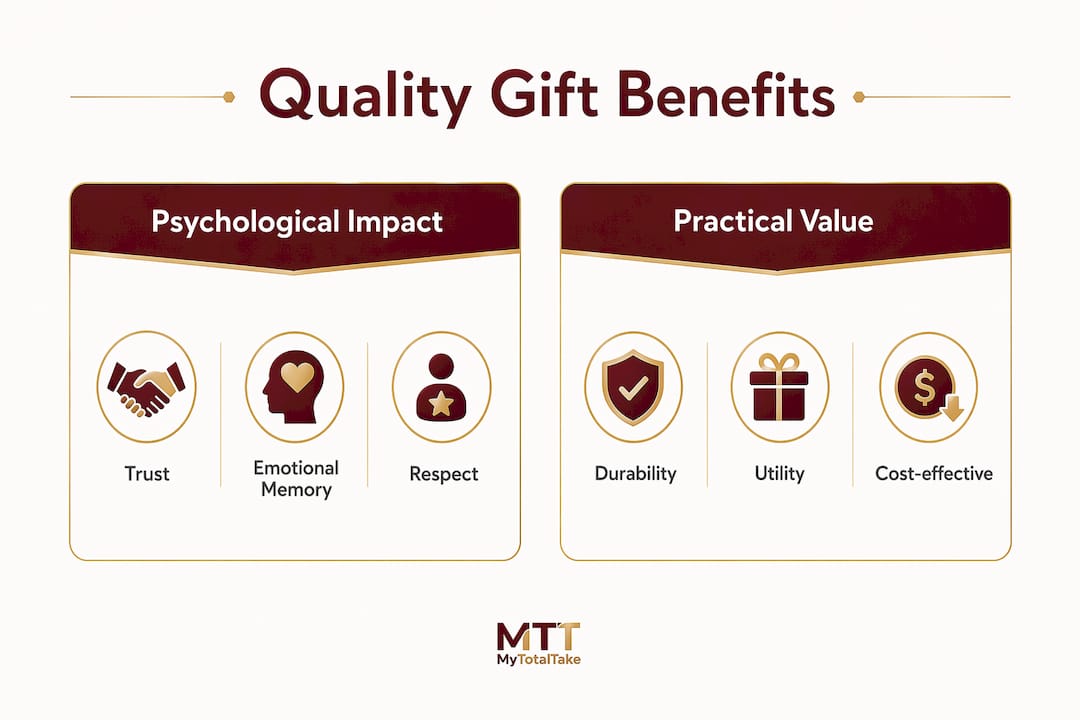
Gift-giving functions as a social strategy that builds trust and signals respect. When a recipient senses genuine thought behind a gift, the social norm of reciprocity activates: they feel an organic pull toward goodwill and closeness. A generic item at the same price point does not trigger that response, because the signal of investment is absent. A client who receives a beautifully crafted leather portfolio reads it as attention to their professional identity, not just a line item on someone’s expense report.
Emotional memory and repeated exposure
Quality gifts get used. And every time they are used, the memory of receiving them is briefly reactivated. A handblown glass vase on a dining table, a double-walled ceramic mug at a morning desk, a well-balanced pen pulled from a jacket pocket: each use is a micro-reminder of the relationship. The handmade paradox reinforces this further. When recipients know an item was made with skill and care, they rate it as more meaningful, even when compared to an otherwise identical object. Provenance and visible craft are reliable shortcuts to emotional impact.
The endowment effect and ownership
Durable objects encourage a sense of ownership that disposable ones never develop. Once someone integrates a quality item into their daily life, they begin to value it above its market price. That attachment is the endowment effect at work. For corporate gifting, this is especially useful: a premium home-office accessory that a new hire uses every day builds a quiet, positive association with the company that gave it.
What high-quality gifts say about you and your brand
The importance of quality gifts extends well beyond the moment of exchange. In both personal and professional contexts, the caliber of what you give communicates something about how you see the recipient.
In business settings, a quality gift:
- Signals that the relationship is worth a considered investment, not a last-minute order
- Reinforces brand trust when the item’s craftsmanship mirrors the company’s own standards
- Boosts employee morale by communicating that the company notices individual contributions
- Becomes a daily brand cue when placed on a desk or used in the home, providing repeated visibility without additional spend
In personal settings, a quality gift:
- Communicates that you paid attention to who the recipient actually is
- Creates an ongoing reminder of the relationship every time the item is used
- Signals long-term regard rather than a transactional gesture
One subtle risk worth naming: ostentatious or mismatched quality can backfire. Psychology Today’s overview notes that a gift perceived as too extravagant relative to the relationship can read as manipulation rather than generosity. The goal is a gift that feels proportionate and perceptive, not one that overwhelms. A well-chosen, beautifully made item at a moderate price point often outperforms an expensive one that misses the mark on fit.
The practical case for durability, utility, and cost-per-use
Abstract psychology aside, there is a straightforward financial logic to choosing quality. A single well-made item used daily for three years delivers far more value per dollar than three cheap items that each last a season. That cost-per-use framing reframes the conversation from “how much did you spend?” to “how much did you give?”

Sustainable or repairable items often carry lower lifecycle cost per year and are perceived as more considerate in modern gifting contexts. A gift with a clear warranty, replaceable parts, and care instructions signals that the maker and the giver both expect it to last.
| Axis | Cheap gift | Quality gift |
|---|---|---|
| Lifespan | Weeks to months | Years, often a decade or more |
| Likelihood of daily use | Low; often set aside | High; integrated into routine |
| Brand or relationship visibility | Minimal after first week | Ongoing with each use |
| Perceived thoughtfulness | Moderate at best | Consistently high |
The table above reflects a pattern that research on usefulness and fit supports: recipients prioritize gifts that slot into their actual lives. A quality item earns that slot. A cheap one rarely does.
How to choose a high-quality gift that will actually be used
The best gift decisions start before you open a browser. Work through these questions first.
- What does this person do every day? Identify one habit or routine the gift could improve or complement.
- What is their existing aesthetic? A gift that clashes with someone’s home or style will be stored, not displayed.
- What friction point could this solve? The most-used gifts remove a small daily annoyance.
- How much maintenance will they tolerate? A hand-wash-only item given to someone with no patience for care instructions is a gift that disappears.
- Are there cultural or personal constraints? Dietary, religious, or lifestyle factors that would make a gift awkward or unusable.
- What is the intended use context? Home, office, travel, or outdoor use each demands different material choices.
- Does the packaging suggest care or bulk? Presentation matters. A brief usage prompt included with the gift, such as a note suggesting how to use it tonight, measurably increases perceived thoughtfulness.
- Is there a return or repair option? A seller who stands behind the product signals confidence in its quality.
Three red flags to avoid:
- Materials that feel hollow, lightweight, or plasticky on first touch
- No warranty, no return window, and no care instructions
- Packaging that suggests the item was bought in bulk or assembled at the last minute
Purchase workflow: Shortlist two or three options, then confirm one high-signal quality clue (full-grain leather, solid hardware, a named material with a known provenance). Validate with the return and warranty policy. Then write a short note explaining why you chose it for this person specifically. That note, more than anything else, closes the gap between a good gift and a memorable one.
Pro Tip: For corporate gifting at volume, personalize the thinking rather than every item. One beautifully chosen category, selected because it fits the recipient’s role or lifestyle, reads as more thoughtful than a generic item with a name laser-etched on it.
Why provenance and repairability are now part of what “quality” means
The definition of a high-quality gift has expanded. Today, where something comes from and how long it can be maintained are as much a part of its quality as its materials.

Giving something that lasts signals long-term regard and aligns with slow-consumption values. A durable, well-made object speaks to future-oriented commitment in a way that a disposable alternative simply cannot. For brands, this carries an additional layer: a gift that reflects ethical sourcing tells the recipient something about the company’s values, not just its budget.
Signals of ethical and sustainable quality to look for:
- Clear country of origin and named materials (e.g., “full-grain vegetable-tanned leather from Italy”)
- A stated repair or warranty policy, not just a return window
- Care instructions that assume the item will be kept for years
- Natural materials that develop patina rather than degrade: solid wood, natural textiles, uncoated metals
Consider the contrast: a handcrafted ceramic bowl made by an artisan with a named studio, sold with care instructions and a repair guarantee, versus a mass-produced decorative piece with no provenance. Both might cost the same. But the first communicates that the giver thought about the recipient’s future, not just the moment of giving. For a brand, that distinction shapes how the company is remembered long after the gift is opened. Understanding artisanal craftsmanship and its emotional resonance helps both individuals and companies make choices that hold meaning over time.
Gift ideas by recipient type that reliably signal quality
The benefits of high-quality gifts show up most clearly when the category matches the recipient’s life. These are not brand recommendations but category-level guidance grounded in the quality principles above.
Client:
- Full-grain leather journal or portfolio (signals professionalism, used daily, ages beautifully)
- Handcrafted desk accessory in solid wood or brushed metal (stays visible, reinforces brand association)
- Premium loose-leaf tea or single-origin coffee set with quality brewing equipment (consumable with a lasting vessel)
New hire or employee:
- Double-walled ceramic or stainless travel mug (daily use, high visibility, practical)
- Home-office upgrade such as a quality desk lamp or cable management system (maps directly to their new work context)
- Artisanal candle or diffuser with natural materials (sensory, personal, used in their own space)
Close friend or partner:
- Handblown glass ornament or vase (unique, display-worthy, conversation piece)
- Natural-fiber throw blanket in a neutral palette (used constantly, tactile quality is immediately apparent)
- A home improvement experience or service that adds lasting value to their space
Host:
- Solid-wood serving board with food-safe oil finish (used at every gathering, visible to guests)
- Hand-poured soy or beeswax candle in a reusable vessel (zero-waste signal, practical)
Milestone celebration:
- Heirloom-worthy object in a durable material: a solid-brass compass, a hand-stitched leather wallet, a piece of art glass
- An experiential gift (cooking class, wine tasting, concert) paired with a quality keepsake that marks the occasion
On the experiences question: research published in the Journal of Consumer Research found that experiential gifts strengthen relationships more reliably than material ones, because recipients think of the giver while consuming the experience. Pairing an experience with a small, quality object that marks it gives you both effects.
What the research actually says about price, thoughtfulness, and the handmade effect
The academic record on this is unusually consistent. Peer-reviewed findings show that givers systematically overestimate how much price affects recipient happiness. Recipients, by contrast, weight usefulness and perceived intent far more heavily than retail value.
Key finding: Studies in psychological science show recipients value usefulness and thoughtfulness as stronger predictors of satisfaction than price. Givers who focus on cost are optimizing for the wrong variable.
The Greater Good Science Center at UC Berkeley summarizes the pattern clearly: in repeated experiments, people felt closer to givers who chose practical, usable gifts over fancier alternatives, even when told both items cost the same. The perceived practicality of the gift, not its price, drove the sense of closeness.
The handmade paradox adds another layer. When recipients know an item required skill and labor, they rate it as more beautiful and more meaningful than an identical mass-produced version. This is not sentimentality; it is a documented shift in perceived value driven by knowledge of effort and intent. Heritage craftsmanship carries this effect even in commercially produced goods when provenance is clearly communicated.
Sentimental gifts also outperform expectations. Time’s review of gift-giving research notes that recipients prefer gifts tied to shared memories or relationships more than givers predict, because givers worry the gift will seem low-effort. It rarely does.
When should you invest in quality, and when is pragmatism enough?
Not every gift warrants a premium investment. Here is a short decision framework.
Invest in quality when:
- The relationship is important and ongoing (key client, close friend, long-term employee)
- The gift will be used frequently or displayed in a visible space
- It represents a brand touchpoint where craftsmanship reflects company values
- The recipient’s lifestyle or identity makes fit and durability especially meaningful
A more pragmatic choice is reasonable when:
- The occasion is casual and the relationship is new
- The gift is one of many in a large-volume program where individual fit is impossible
- An experience gift better serves the relationship than any object would
The closing principle is simple: a gift that gets used is a gift that keeps working. Quality is the most reliable predictor of use.
Key Takeaways
Quality in gifting is the single most reliable driver of long-term appreciation, relationship strength, and brand recall, outperforming price at every stage of the recipient’s experience.
| Point | Details |
|---|---|
| Price does not predict appreciation | Research shows usefulness and thoughtfulness drive recipient satisfaction far more than cost. |
| Durability creates ongoing visibility | A quality gift used daily reinforces the relationship or brand every time it appears. |
| Provenance and craft raise perceived meaning | The handmade paradox shows that knowledge of skill and effort measurably increases emotional impact. |
| Sustainability signals long-term regard | Natural materials, repair options, and clear provenance communicate commitment to the recipient’s future. |
| Mytotaltake curates for exactly this standard | Its collections span home decor, tech, fashion, and wellness, selected for craftsmanship, durability, and lasting elegance. |
A curator’s perspective on choosing gifts that hold up
The conventional wisdom in gifting is to spend more when in doubt. That instinct is understandable and almost always wrong. What I have found, working through hundreds of gift decisions for clients and personal occasions, is that the question is never “how much?” It is “how well does this fit this person’s actual life?”
The gifts that land hardest are rarely the most expensive ones in the room. They are the ones where the recipient pauses and says, “How did you know?” That moment comes from observation, not budget. A full-grain leather notebook given to someone who journals every morning. A precision-made pour-over coffee set for someone who treats their morning ritual seriously. A handcrafted piece of art glass for someone whose home already shows they care about beautiful objects. The gift fits because the giver paid attention.
What I find most underestimated is the role of materials in sustaining that feeling. A gift made from natural materials that age with use, leather that develops patina, wood that warms with handling, metal that acquires a quiet luster, keeps delivering that “how did you know?” feeling for years. A cheap alternative stops delivering it within weeks.
My three quick filters before any gift purchase:
- Material: Does it age gracefully, or will it look worse with use?
- Evidence of craft: Can I see or feel how it was made? Is there a story behind it?
- Immediate use-case fit: Will this person use it within the first week, or will it sit in a drawer?
If all three pass, the gift is worth buying. If any one fails, keep looking.
Mytotaltake brings curated quality to every gifting occasion
When you know what makes a gift worth giving, the next step is finding it without spending hours sorting through mediocre options. Mytotaltake was built for exactly that: a curated selection of premium goods across home decor, tech, fashion, wellness, and outdoor living, each chosen for craftsmanship, durability, and the kind of lasting elegance that makes a gift memorable long after the occasion.
For clients, the leather accessories and refined desk objects in Mytotaltake’s collection make strong professional touchpoints. For employees, the home-office and premium tech upgrades deliver daily visibility and genuine utility. For close friends and milestone occasions, the handcrafted home objects and wellness selections carry the provenance and material quality that the research consistently links to lasting appreciation.
Start with the tips for choosing upscale products that last to match the right category to your recipient, then browse Mytotaltake’s curated collections to find the specific piece that fits. Fast delivery and free returns mean the decision carries no risk, only the confidence that what you give will be used, noticed, and remembered.
Useful sources and further reading
- How Psychology Can Help You Choose a Great Gift — Greater Good Science Center, UC Berkeley. Summarizes experimental research on practicality, closeness, and what recipients actually value; essential reading for anyone who wants the academic foundation without the jargon.
- Gift-giving psychology (LA Times) — Accessible analysis of why price and appreciation are weakly correlated; useful for framing the cost-vs-value conversation.
- SAGE: Gift-giving psychology — Peer-reviewed meta-level findings on usefulness and thoughtfulness as primary drivers of recipient satisfaction; the most rigorous source in this list.
- How to Give Better Gifts, Based on Science (Time) — Practical synthesis of academic research including sentimental gifts, experiential giving, and the “wow moment” trap; highly readable.
- Why Handmade Gifts Are Better (Aspire Art Glass) — Explains the handmade paradox and how provenance raises perceived meaning; useful for both personal and corporate gifting contexts.
- Giving Something That Lasts Is a Way of Caring (Midipy) — Essay on slow consumption, durability, and the emotional logic of choosing gifts built to last; good for the sustainability angle.










Leave a comment