
The Role of AI in Smart Homes: 2026 Guide

Artificial intelligence is defined as the technology that autonomously manages, optimizes, and personalizes every system inside a modern home. The role of AI in smart homes now extends far beyond voice commands. It covers energy management, security, climate control, and predictive automation, all running simultaneously. AI methodologies including machine learning, deep learning, and reinforcement learning form the technical backbone of this shift. For homeowners and tech enthusiasts ready to get more from their smart home technology, understanding how these systems actually work is the first step toward building a home that truly works for you.
How AI improves smart home automation and energy management
AI-driven automation learns your daily patterns and adjusts your home accordingly. A traditional timer-based thermostat follows a fixed schedule. An AI-powered system notices you leave early on Fridays, that your bedroom stays warmer in summer, and that you prefer 68°F before bed. It adapts without you reprogramming anything.
The energy savings are measurable. A systematic review published in 2026 found that AI methodologies including machine learning and reinforcement learning improve smart home energy efficiency by over 20% compared to non-AI automation systems. That figure represents real dollars off your utility bill, not a theoretical projection.
AI manages far more than heating. Lighting systems dim automatically when natural light is sufficient. Smart appliances run dishwashers and washing machines during off-peak electricity hours. Water management systems detect unusual usage patterns that may signal a leak. Each of these functions runs through the same AI layer, coordinating decisions across your entire home.

| Feature | Traditional automation | AI-enhanced system |
|---|---|---|
| Scheduling | Fixed timer-based rules | Learns and adapts to resident habits |
| Energy use | Static, often inefficient | Reduces consumption by over 20% |
| Fault detection | Manual monitoring required | Proactive anomaly alerts |
| Personalization | None | Adjusts to individual preferences |
| Water management | Manual or basic sensors | AI detects leaks and usage spikes |
Pro Tip: Pair your AI thermostat with a smart thermostat guide to understand which settings to expose to your AI layer first. Start with climate and lighting before adding appliances.
What technologies underpin the intelligent home?
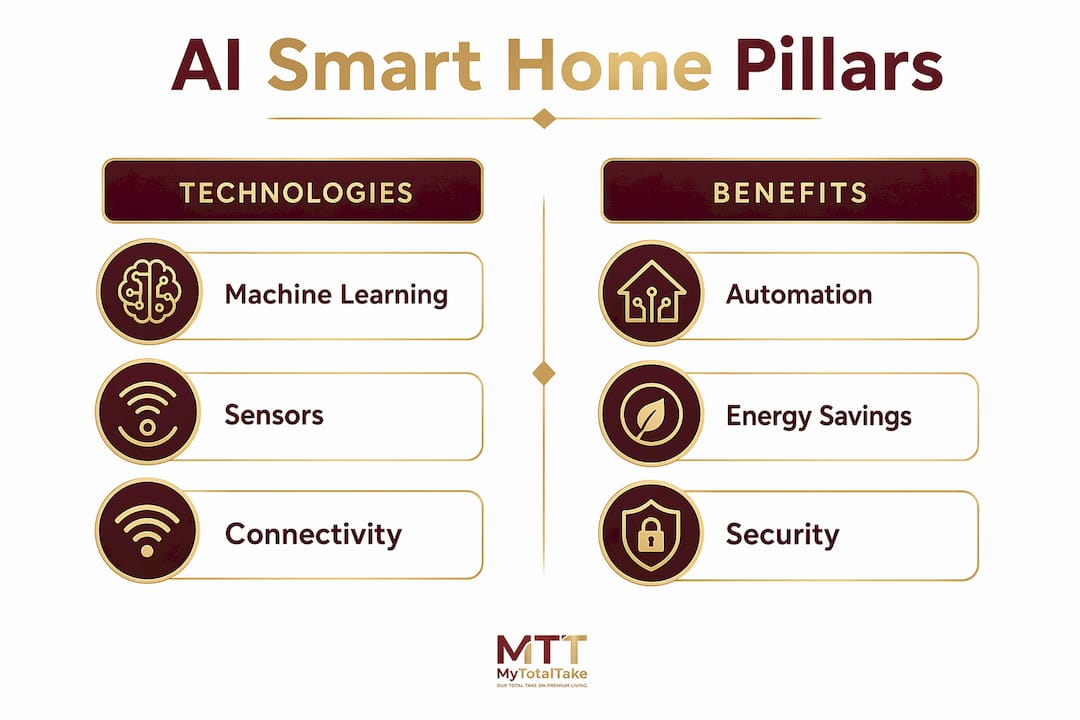
The intelligent home rests on three technological pillars. A synthesis of 113 research papers from 2020–2025 identifies multi-modal sensing, hierarchical AI architecture, and the Matter/Thread protocol as the defining foundations of modern smart home systems.
Here is what each pillar does in practice:
- Multi-modal privacy-preserving sensing combines cameras, microphones, motion detectors, and environmental sensors to build a real-time picture of your home. Privacy-preserving designs process data locally so raw video or audio never leaves your network.
- Hierarchical cloud-edge-TinyML architecture distributes AI processing across three levels. Cloud handles complex reasoning. Edge devices like smart hubs process mid-level tasks. TinyML runs lightweight models directly on sensors, cutting latency to milliseconds.
- Matter/Thread protocol is the standardized communication layer that lets devices from different manufacturers talk to each other. Without it, your smart lock, thermostat, and lighting system operate in separate silos.
Together, these pillars enable what researchers call ambient intelligence. Your home perceives its environment, reasons about it, and responds without you issuing a command. A smart humidifier, for example, can adjust humidity automatically based on sensor data and learned preferences, with no manual input required.
The local versus cloud distinction matters more than most homeowners realize. Cloud AI offers more processing power but introduces latency and privacy exposure. Local AI keeps your data on-site and responds faster. The best setups use both, routing simple commands locally and complex reasoning to the cloud.
How to implement AI in your smart home
Setting up AI in an open-platform smart home system is more accessible than it sounds. Open platforms allow you to integrate AI models by inputting API keys or configuring local servers. Basic AI integration typically takes a few hours for most homeowners with a modern smart home hub.
Follow these steps to get started:
- Choose your AI model. Options include cloud-based models like OpenAI and Google Gemini, or locally hosted large language models (LLMs) for full privacy control.
- Input your API key or configure your local server. Cloud models require an API key from the provider. Local models need a dedicated home server running the LLM software.
- Set your device exposure. Decide which devices your AI agent can control. Start with lights and climate. Leave locks, cameras, and alarms off the list until you fully understand the system.
- Generate and test automations. AI can write complex automation code in YAML format, cutting manual programming time significantly. Test each automation in a low-stakes environment first.
- Optimize for latency. Without local processing, voice command latency can reach 10–20 seconds. Dedicated local integrations like Piper reduce that to near-instant response.
Pro Tip: Be deliberate about which devices you expose to your AI agent. Practitioners call this the “picky” entity exposure approach. It balances convenience with security by keeping sensitive devices isolated from the AI layer.
The automation layer is where AI delivers its most practical value for advanced users. It can generate, debug, and refine complex automation sequences that would take hours to write manually. For homeowners tracking the latest home automation trends for 2026, this capability alone justifies the setup investment.
Pool automation is another area where AI control pays off. Systems that manage pumps, heating, and chemical dosing benefit from the same AI scheduling logic. Resources like pool automation guides for smart controls show how this extends beyond the home interior.
Balancing AI convenience with smart home security
AI expands what your home can do, but it also expands the attack surface for potential threats. Security experts describe this as a “double-edged sword” for modern homeowners. Every new connected device is a potential entry point if not properly secured.
| AI feature | Advantage | Risk |
|---|---|---|
| Voice control | Hands-free convenience | Susceptible to voice spoofing |
| Remote access | Manage home from anywhere | Exposes network to external attacks |
| Behavioral learning | Personalized automation | Behavioral data can be harvested |
| Cloud AI processing | More powerful reasoning | Privacy exposure and data retention |
| Local AI hosting | Full privacy, no fees | Requires hardware investment and setup |
The most effective protection combines privacy-preserving design with deliberate configuration. Running local LLMs on a home server eliminates cloud subscription costs and keeps all behavioral data within your network. That trade-off, paying once for hardware instead of recurring fees, is increasingly attractive to privacy-conscious homeowners.
Ethical AI audits are becoming standard practice in enterprise smart building management. Homeowners benefit from applying the same logic at a smaller scale. Review which devices your AI agent accesses every few months. Remove permissions that are no longer necessary. Treat your AI configuration the way you treat your home’s physical security: review it regularly and tighten it when needed.
Cloud dependency carries a specific risk that local hosting avoids entirely. If a cloud AI provider changes its terms, raises prices, or experiences an outage, your automations stop working. Local AI keeps your home running regardless of what happens upstream.
Key Takeaways
AI in smart homes delivers measurable energy savings, personalized automation, and stronger security when configured with deliberate device exposure and a local-first processing approach.
| Point | Details |
|---|---|
| Energy savings are proven | AI systems reduce energy consumption by over 20% compared to non-AI automation. |
| Three pillars define the intelligent home | Multi-modal sensing, hierarchical AI architecture, and Matter/Thread protocol work together. |
| Local AI beats cloud for privacy | Hosting LLMs locally eliminates recurring fees and keeps behavioral data on your network. |
| Limit device exposure | Keep locks and cameras isolated from AI agents to reduce your security risk. |
| Automation code generation saves time | AI can write and debug complex YAML automations, cutting manual programming hours. |
AI in smart homes: what the next five years actually look like
The conversation around AI in smart homes tends to focus on what it can do right now. I think the more interesting question is what it will demand from you as a homeowner.
The shift from reactive to proactive home environments is real. The research on intelligent home paradigms points toward hyper-personalization as the defining feature of the next generation. Your home will not just respond to commands. It will anticipate needs based on learned patterns, health data, and even calendar context. That is genuinely useful. It is also genuinely complex to configure well.
What I have seen consistently is that homeowners who get the most from AI are the ones who treat it like a system to be managed, not a feature to be switched on. The “picky exposure” principle is not just a security tip. It is a philosophy. Give your AI agent exactly the access it needs, nothing more. Review that access regularly. The homeowners who skip this step are the ones who end up with automations that misbehave or, worse, with a security gap they did not know existed.
Local AI is the most underrated option available right now. The upfront cost of a dedicated home server feels steep compared to a monthly API subscription. But the privacy benefit and the elimination of latency issues make it the better long-term choice for anyone serious about their setup. I would rather pay once and own my data than pay monthly and share it indefinitely.
The future of AI in smart living is not about adding more devices. It is about making the devices you already have work together with genuine intelligence. That requires patience, deliberate configuration, and a willingness to learn the system. The payoff, a home that genuinely adapts to your life, is worth the effort.
— Lysander
Where smart technology meets timeless home design
The best smart homes do not look like technology showrooms. They look like beautifully designed living spaces where the technology is invisible.

At Mytotaltake, we curate luxury furniture and home decor that complements the intelligence of your home without competing with it. A well-chosen piece of furniture anchors a room. The right lighting system, guided by AI, makes it glow. These two things belong together. Our collections include tech-integrated furnishings and premium decor designed for homeowners who want both elegance and function. If you are building a home that works as well as it looks, our modern home decor ideas offer a curated starting point for every room.
FAQ
What is the role of AI in smart homes?
AI autonomously manages and optimizes home systems including energy, climate, security, and lighting by learning resident habits and adapting in real time. It uses machine learning, deep learning, and reinforcement learning to deliver personalized, efficient home environments.
How much energy can AI save in a smart home?
A 2026 systematic review found that AI-driven smart home systems reduce energy consumption by over 20% compared to non-AI automation. The savings come from adaptive scheduling, predictive climate control, and off-peak appliance management.
Is local AI better than cloud AI for smart homes?
Local AI offers full privacy, eliminates recurring subscription fees, and reduces voice command latency significantly compared to cloud processing. Cloud AI provides more processing power but exposes behavioral data to third-party servers.
How do I keep my smart home secure when using AI?
Limit your AI agent’s access to non-sensitive devices like lights and climate controls, and keep locks and cameras isolated. Review device permissions regularly and consider running a local LLM to avoid cloud-based data exposure.
What is the Matter protocol and why does it matter?
Matter is a standardized communication protocol that allows smart home devices from different manufacturers to work together on the same network. Without it, devices operate in separate ecosystems that cannot share data or coordinate actions.
Recommended
A Guide to Creating a Home Bar That Feels Luxe
How to Style Floating Wall Shelves Well
Comments
[…] Voice compatibility is the first filter. Alexa, Google Assistant, and Siri each have their own ecosystems, while Matter is designed to make compatible accessories easier to use across platforms. A Matter-certified plug can be an elegant choice for a household with mixed devices or for anyone who prefers flexibility as their smart home grows. […]











Leave a comment