
The Role of Technology in Luxury Homes in 2026
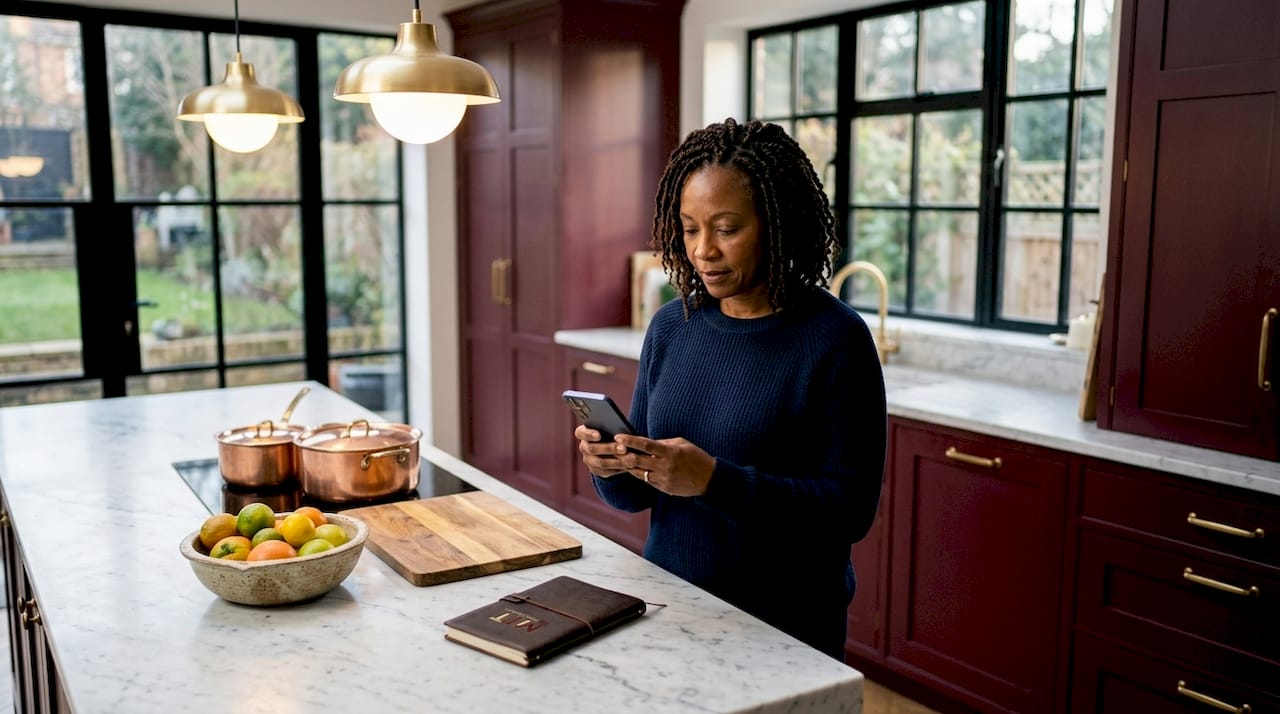
The role of technology in luxury homes is defined by one principle: the best technology disappears. In 2026, the most sophisticated residences are not filled with visible gadgets or complex control panels. They are environments that think, adapt, and respond before you consciously register a need. Platforms like LG ThinQ and Samsung EdgeAware represent a new generation of intelligent home systems where AI anticipates your preferences, biometric entry replaces keys, and a single lifestyle mode coordinates every system in your home simultaneously. This is the new standard for elegant living, and it is reshaping what buyers expect from a premium residence.
How does the role of technology in luxury homes actually work?
The shift from smart home to invisible home is the defining technology trend of 2026. Spatial intelligence is the concept at the center of this shift. It means your home does not wait for instructions. It reads occupancy patterns, time of day, ambient conditions, and personal preferences to act on your behalf.
The most tangible expression of spatial intelligence is the lifestyle mode. A single “Cinema” command dims lighting to a calibrated level, lowers motorized blinds, activates the AV system, adjusts HVAC to your preferred viewing temperature, and locks the entry points. “Arrival” mode triggers the reverse: lights warm, music starts, the kitchen begins preheating, and the security system shifts to home mode. These coordinated lifestyle modes replace dozens of individual commands with one intention.
AI plays a specific role within this architecture. It does not just execute commands. It learns. Over weeks, it recognizes that you prefer the living room at 71°F on weekday evenings, that you rarely use the guest wing before Friday, and that your sleep quality improves when the bedroom cools by 2°F at 10 p.m. The system adjusts without prompting.
Key capabilities that define this generation of intelligent home systems:
- Biometric entry using facial recognition or fingerprint scanning, eliminating physical keys entirely
- Contextual scent layering, where diffusers adjust fragrance intensity based on room occupancy and time of day
- Predictive appliance management, where the refrigerator, oven, and coffee system coordinate around your daily schedule
- Mood lighting adaptation that shifts color temperature and intensity based on circadian rhythms, not just manual input
Pro Tip: When evaluating AI home platforms, prioritize systems that allow you to set behavioral boundaries. The goal is a home that serves your preferences, not one that overrides them.
What are the real energy savings from smart home technology?
Energy efficiency in luxury homes is no longer a compromise between comfort and conservation. It is a measurable outcome of intelligent design. Pilot home energy management systems report approximately 9 to 10% electricity savings over several months, with real-world measurement accuracy within ±3% of utility bill figures. That level of precision means the savings are verifiable, not theoretical.

The more significant gains come from AI-driven HVAC control. AI-based building control frameworks achieve over 90% energy savings while maintaining indoor temperature within 1.0°C of the target comfort level. Reinforcement learning systems accomplish this with inference times of approximately 120 milliseconds, meaning the adjustment is imperceptible to the occupant. The home stays comfortable. The energy bill drops.
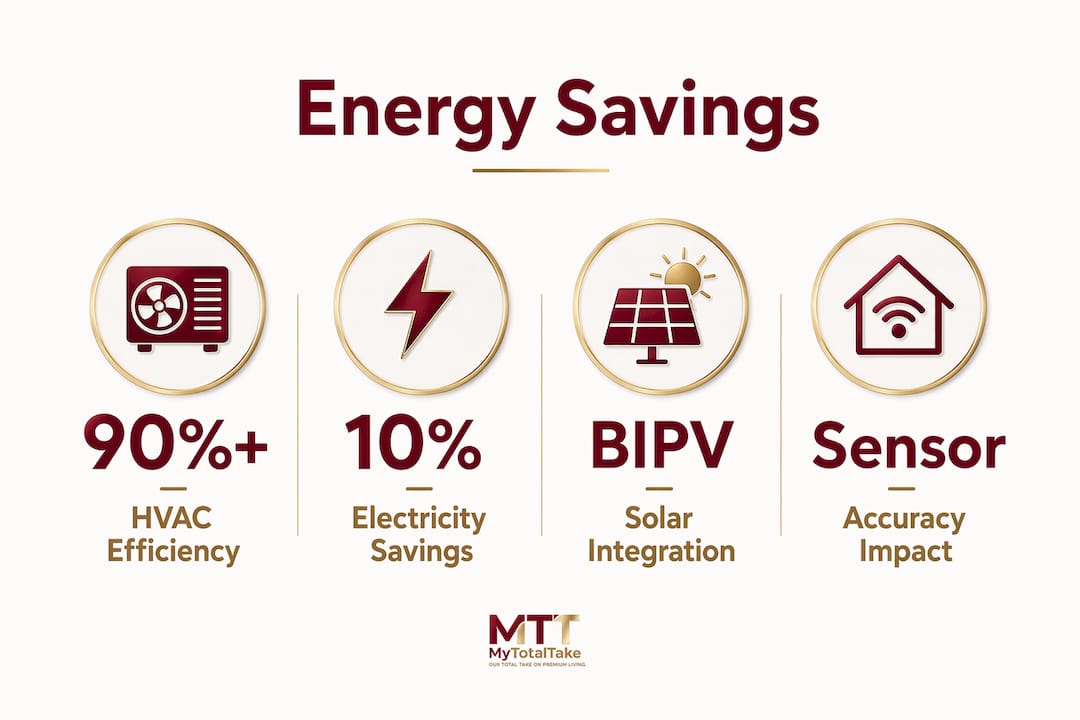
| Technology | Primary benefit | Measurable outcome |
|---|---|---|
| Cloud-enabled HEMS | Electricity reduction | 9 to 10% savings in pilot studies |
| AI reinforcement learning for HVAC | Comfort and efficiency balance | Over 90% energy optimization, 1.0°C accuracy |
| Building-integrated photovoltaics (BIPV) | On-site renewable generation | Reduces grid dependency without altering facade aesthetics |
| Predictive maintenance systems | Operational cost reduction | Prevents failures before they affect comfort or efficiency |
Building-integrated photovoltaics, or BIPV, deserve particular attention. Unlike rooftop solar panels, BIPV systems are embedded directly into the building envelope, appearing as glass facades, roof tiles, or cladding. They generate power without compromising the architectural lines that define a luxury residence. Kinetic facades take this further, using movement-responsive panels that adjust to sun angle throughout the day, optimizing both energy capture and interior light quality.
Pro Tip: Sensor placement determines the accuracy of every automated system in your home. Sensor quality and placement critically affect automation performance. Invest in professional sensor calibration during installation, not as an afterthought.
How do you protect privacy in a connected luxury home?
A connected home is only as secure as its least-protected device. The NIST 2026 cybersecurity guidelines for IoT product manufacturers establish foundational requirements that every luxury homeowner should verify before purchasing any smart device. These include update mechanisms, authentication protocols, encryption standards, and lifecycle protection commitments.
Vendor transparency is not a minor consideration. When a manufacturer cannot clearly explain how firmware updates are delivered, how long security patches will be supported, or what data leaves your network, that product does not belong in a high-value residence. The architecture of your smart home network is as much a design decision as the finishes you select for your kitchen.
Practical security measures for luxury connected homes include:
- Network segmentation: Keep smart home devices on a dedicated VLAN, separate from personal computers and financial devices
- Hub placement strategy: Central hubs should be physically secured and positioned to minimize signal bleed beyond the property boundary
- End-to-end encryption: Require AES-256 encryption for all device communication, particularly for security cameras and access control systems
- Regular firmware audits: Schedule quarterly reviews of all connected devices to confirm they are running current security patches
- Zero-trust access control: Require authentication for every device interaction, even within the home network
For high-value estates, military-grade AI security systems offer a level of protection that consumer-grade platforms cannot match, combining physical and digital threat monitoring in a single integrated framework.
Why does network infrastructure matter before you buy a single device?
The network is the foundation of every smart home experience, and it must be treated as an architectural element from the first design meeting. Structured cabling and Power over Ethernet (PoE) are deployed during construction because retrofitting them after walls are closed is costly, disruptive, and often impossible without visible conduit runs that compromise the aesthetic of a finished luxury interior.
Here is the correct sequence for technology integration in a luxury residence:
- Engage a technology integrator at the architectural design stage. Decisions about conduit routing, equipment room placement, and outdoor coverage zones must be made before structural elements are finalized.
- Specify structured cabling for all fixed locations. Wi-Fi handles mobility. Ethernet handles reliability. 8K audiovisual systems, security cameras, and access control panels all perform better on hardwired connections.
- Plan for PoE throughout. Power over Ethernet eliminates the need for separate power outlets at every device location, keeping walls clean and reducing electrical complexity.
- Design the equipment room as a premium space. Rack-mounted systems, proper ventilation, and cable management in the equipment room directly affect system longevity and serviceability.
- Document everything. A complete infrastructure map, including cable runs, IP addresses, and device configurations, is a material asset that transfers with the property and supports future upgrades.
Professionally integrated smart home systems maintain resale value more effectively than collections of consumer devices. Insurers and resale buyers prefer systems controllable as a single platform with documented infrastructure. This is not a minor distinction. It is the difference between a home that commands a premium and one that requires a discount.
Pro Tip: Ask your architect to include a dedicated technology riser in the building plans. This vertical conduit pathway allows future cable runs without opening finished walls, protecting your investment for decades.
Does smart home technology reduce the warmth of luxury living?
The risk of over-automation is real. A home that responds to every variable with algorithmic precision can feel clinical rather than considered. The FIU Luxury Leadership Forum identifies this directly: AI in luxury must complement human judgment, not replace the deliberate, singular moments that define a genuinely elevated experience.
The practical answer is human-led AI. The system handles the operational layer, temperature, lighting, security, energy, so that your attention is freed for the experiential layer. You are not managing your home. You are living in it. AI-curated scent layering, for example, does not remove your choice. It presents the right fragrance at the right moment, which you can accept, adjust, or override. The technology serves the preference. It does not dictate it.
Personalization is the mechanism that preserves emotional warmth. A home that learns your specific rhythms, your preferred morning light intensity, the music tempo you favor on Sunday afternoons, the temperature differential between your home office and your bedroom, feels attentive rather than automated. That distinction is worth protecting. Explore premium home decor tips that address how to maintain intimacy and warmth in technology-enhanced interiors.
Key takeaways
The role of technology in luxury homes is to create an invisible, anticipatory environment that serves the resident without demanding their attention, grounded in professional infrastructure, AI-driven automation, and deliberate personalization.
| Point | Details |
|---|---|
| Invisible integration defines luxury | Lifestyle modes and spatial AI replace visible gadgets with anticipatory, effortless automation. |
| Energy savings are measurable | AI-driven HVAC and IoT energy management deliver verified reductions, not theoretical estimates. |
| Security starts at the architecture level | Network segmentation, NIST-compliant devices, and hub placement protect both data and aesthetics. |
| Infrastructure must precede technology | Structured cabling and PoE planned at design stage prevent costly retrofits and preserve resale value. |
| Human-led AI preserves luxury’s warmth | Automation should handle operations so residents focus on experience, not system management. |
My perspective on getting smart home integration right
I have reviewed enough luxury home technology projects to say this with confidence: the single most common and most expensive mistake is treating technology as a finishing touch rather than a structural decision. Homeowners who engage a certified technology integrator after the architect has finalized plans spend significantly more money for a result that is always a compromise. Conduit runs get rerouted through visible spaces. Equipment rooms end up in inconvenient locations. Outdoor coverage zones have dead spots because access point placement was never part of the structural conversation.
The second mistake is prioritizing feature count over system coherence. A home with twelve different apps controlling twelve different systems is not a smart home. It is a management burden. The homes that genuinely impress are controlled through a single platform, whether that is Control4, Savant, or Crestron, where every subsystem speaks the same language and responds to a single command.
My honest recommendation: select providers who publish their security update timelines and can demonstrate lifecycle support commitments of at least ten years. Technology that becomes unsupported in three years is not a luxury investment. It is a liability. The goal is a home that frees you from operational thinking entirely, so that what remains is pure enjoyment of the space you have built.
— Lysander
Elevate your home with premium furnishings that complement smart living
Technology transforms how a home functions. What it sits alongside determines how it feels. At Mytotaltake, we curate luxury furniture designed to complement the clean lines and considered aesthetics that intelligent home systems demand. Every piece in our collection is selected for craftsmanship, material quality, and the kind of lasting elegance that holds its presence in a technology-enhanced environment.

If you are building or refining a luxury residence, our high-end home decor collection offers a curated starting point for interiors that balance warmth with precision. We also offer guidance on integrating tech gadgets into your decor without sacrificing visual coherence. Premium living is the sum of every detail, and we are here to help you get each one right.
FAQ
What defines the role of technology in luxury homes today?
The role of technology in luxury homes is defined by invisible, anticipatory integration. AI-driven systems coordinate lighting, climate, security, and appliances through lifestyle modes that respond to occupant behavior without requiring manual input.
How much energy can smart home technology actually save?
Pilot home energy management systems report 9 to 10% electricity savings, while AI-based HVAC frameworks achieve over 90% energy optimization while maintaining comfort within 1.0°C of the target temperature.
What cybersecurity standards should luxury homeowners require from smart devices?
The NIST 2026 IoT guidelines require manufacturers to provide update mechanisms, authentication, encryption, and lifecycle protection. Homeowners should verify these commitments before purchasing any connected device.
When should technology planning begin in a luxury home project?
Technology planning must begin at the architectural design stage. Structured cabling and PoE are installed during construction. Retrofitting after walls are closed is costly and often compromises the finished aesthetic.
Does home automation make luxury living feel less personal?
Not when implemented correctly. The FIU Luxury Leadership Forum confirms that AI should augment human judgment, not replace it. Systems that learn individual preferences and allow easy override preserve the deliberate, personal quality that defines genuine luxury.
Recommended
Best Modern Dining Chairs for Small Spaces
Portable Air Conditioner vs Window Unit
Comments
[…] that will remain competitive in the next decade’s market. Mytotaltake covers the full picture of smart home technology in luxury homes for readers who want to go deeper on this […]










Leave a comment