What Defines Upscale Brands: The Real Qualities

Upscale brands are defined by a combination of exclusivity, superior craftsmanship, heritage, controlled scarcity, and emotional resonance that together create a premium identity no price tag alone can manufacture. Price is an outcome of these qualities, not the source of them. Hermès, Louis Vuitton, and Cartier do not command their reputations because they charge more. They charge more because they have spent decades building something irreplaceable. Understanding what defines upscale brands means looking past the logo and reading the signals underneath: the materials, the restraint, the story, and the relationship a brand builds with the people who carry it.
What core qualities and characteristics define upscale brands?
Upscale brands, known in the industry as luxury brands, share a consistent set of attributes that hold across cultures and categories. Economists measure this through income elasticity of demand greater than 1, meaning demand for luxury goods rises more than proportionally as household income grows. That economic signal tells you something important: these products are not just expensive, they are aspirational by design.
The defining features of high-end brands cluster around five core qualities:
- Artisanal craftsmanship and superior materials. Hermès saddle-stitches its leather goods by hand. Chanel lines its jackets with silk. The material quality is not incidental. It is the foundation of the brand’s claim on your attention.
- Controlled scarcity. Some luxury leather goods limit production runs to fewer than 300 pieces per style. Scarcity is not a supply chain problem. It is a deliberate strategy to protect prestige.
- Heritage and storytelling. Upscale brands do not just sell products. They sell a narrative. Cartier’s history with royalty, Louis Vuitton’s origins in Parisian trunk-making: these stories give the product a context that mass-market goods cannot replicate.
- Emotional and social signaling. Carrying a Birkin bag communicates something beyond function. Upscale brand qualities include the ability to signal taste, status, and belonging to a particular world.
- Consistent brand perception across markets. Luxury brand-attribute associations can be predicted with ±2% accuracy across multiple markets. That consistency is not accidental. It reflects decades of disciplined brand management.
Pro Tip: When evaluating whether a brand is truly upscale, look at what it refuses to do. Declining mass-market distribution, rejecting discount retail, and limiting collaborations are all signals of a brand protecting its premium position.
How do upscale brands create and communicate exclusivity?
The premium experience an upscale brand delivers is not limited to the product itself. Every touchpoint, from the website to the packaging to the sales floor, is engineered to communicate one thing: this is not for everyone. Premiumisation requires aligning every brand touchpoint to signal exclusivity and justify pricing that is detached from cost.
Here is how the most recognized luxury brands build and sustain that perception:
- Intentional friction in purchasing. Hermès does not let you simply walk in and buy a Birkin. Waitlists, purchase history requirements, and personal relationships with sales associates are all part of the process. Friction in the buying process signals scarcity and deters mass-market access. The harder it is to acquire, the more desirable it becomes.
- Visual restraint in design. Upscale brands use whitespace in digital and physical design to communicate confidence and premium status. A cluttered website or packaging screams mass market. A spare, confident layout says the product speaks for itself.
- Relational artisans as client representatives. Successful luxury brands treat client relationships as the ultimate expression of luxury, not a by-product of it. Sales staff are trained not to sell but to serve, building long-term relationships that keep clients returning.
- Subtle brand markers over overt logos. Inconspicuous consumption is a growing preference among upscale consumers, who favor unique colors, textures, or offline rituals over loud logos. Bottega Veneta’s intrecciato weave and Loro Piana’s absence of visible branding are textbook examples.
- Celebrity and cultural endorsements. Jacob Elordi’s association with Cartier’s Tank watch raised brand searches by 12%. Celebrity alignment does not create a luxury brand, but it amplifies desirability when the association feels authentic and curated.
Pro Tip: Pay attention to what a brand does not show you. Sparse imagery, minimal product descriptions, and a refusal to list prices online are all deliberate signals of premium positioning.
What distinguishes upscale brands from premium or high-end brands?
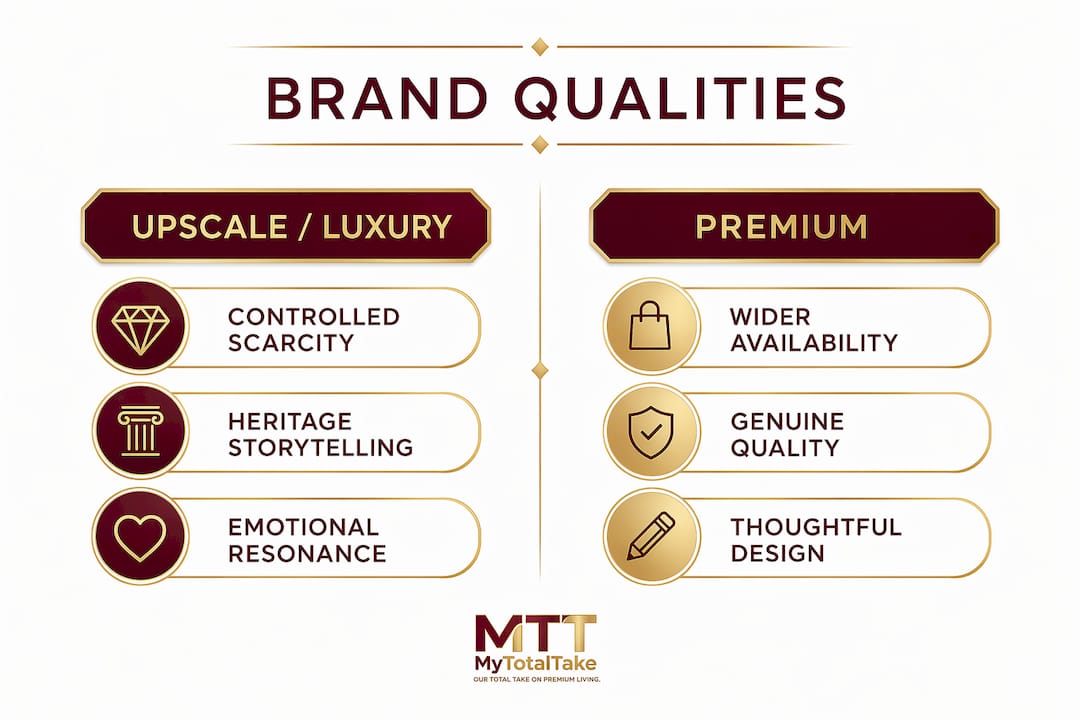
The terms luxury, upscale, premium, and high-end are often used interchangeably, but they sit at different points on the same spectrum. Understanding the distinction helps you recognize what you are actually buying into.
Price is often a result of strategic positioning, restraint, and long-term vision, not simply cost or markup. That principle separates a true upscale brand from a brand that is merely expensive.
| Attribute | Upscale / Luxury Brand | Premium Brand | High-End Brand |
|---|---|---|---|
| Production scale | Very limited, often artisanal | Moderate, quality-controlled | Larger, quality-focused |
| Price elasticity | Demand rises with price (Veblen effect) | Demand sensitive to price | Demand moderately price-sensitive |
| Heritage emphasis | Central to brand identity | Occasionally referenced | Rarely a core narrative |
| Emotional connection | Deep, identity-level | Moderate | Functional, aspirational |
| Distribution control | Tightly restricted | Selective | Broader selective |
| Hero product focus | Strong, limited catalog | Moderate | Wide product range |
True upscale brands focus on a small number of hero products rather than extensive catalogs. Chanel’s No. 5 perfume and the Classic Flap bag carry the brand’s entire identity. That focus strengthens brand equity in a way that a sprawling product line never can.
Premium brands like Bang and Olufsen or Aesop deliver genuine quality and thoughtful design, but they operate at a different scale and accessibility level. High-end brands occupy the tier just below, offering quality above the mass market without the heritage narrative or scarcity mechanics of true luxury. Knowing where a brand sits on this spectrum helps you evaluate whether its price reflects genuine upscale brand qualities or simply a premium markup.
How do these qualities show up across fashion, home decor, and technology?
The traits of upscale brands are universal, but the way they express themselves shifts by category. Each sector has its own signals, and knowing them makes you a sharper consumer.
Fashion
Hermès and Chanel are the clearest examples of upscale brand qualities in fashion. Both brands control distribution tightly, invest in artisanal production, and build their identities around heritage narratives that span generations. Chanel’s tweed jackets are still made in the same ateliers that Coco Chanel established. That continuity is not nostalgia. It is a brand asset. For premium home decor enthusiasts who also follow fashion, the parallels in how these brands manage scarcity and storytelling are direct.
Home Decor
In home decor, upscale brand qualities show up through artisanal production methods, provenance storytelling, and material integrity. A hand-thrown ceramic from a named studio carries more premium weight than a mass-produced equivalent at twice the price. Brands like Fornasetti and de Gournay build entire identities around craft and narrative, limiting production to protect the integrity of their work. The craftsmanship and style that define upscale home decor mirror the same principles at work in fashion: restraint, quality, and story.
Technology
Technology is the newest frontier for upscale brand positioning. Apple occupies the premium tier, but brands like Bang and Olufsen, Leica, and Devialet operate at the true luxury level. They combine superior materials, limited editions, and curated retail experiences to signal exclusivity. Smart home upgrades that feel genuinely premium share the same DNA: they prioritize material quality and considered design over feature quantity. A Devialet Phantom speaker does not compete on specs. It competes on the experience of owning it.
Cross-sector signals to watch for:
- Materials that age beautifully rather than degrade
- Named makers, artisans, or founding stories attached to the product
- Packaging that feels considered and reusable, not disposable
- Retail environments designed for experience, not transaction volume
- After-sale service that treats the relationship as ongoing
Key takeaways
Upscale brands earn their status through controlled scarcity, artisanal craftsmanship, heritage storytelling, and emotional resonance, not through price alone.
| Point | Details |
|---|---|
| Price is an outcome | Upscale pricing reflects strategic positioning and restraint, not just material cost. |
| Scarcity is deliberate | Production runs under 300 pieces per style protect prestige and drive desirability. |
| Hero products anchor identity | Limiting the catalog to key products strengthens brand equity across all categories. |
| Friction signals value | Waitlists and purchase requirements communicate exclusivity more powerfully than advertising. |
| Subtlety over logos | Inconspicuous consumption is the defining consumer preference among true luxury buyers today. |
Why most people read luxury brands wrong
I have spent years studying how upscale brands position themselves, and the single most common mistake I see is conflating price with prestige. People assume that if something costs enough, it qualifies as luxury. That thinking is exactly backward.
The brands that hold their value over decades, Hermès, Cartier, Chanel, do so because they have built systems of restraint. They say no more than they say yes. They protect their distribution, limit their collaborations, and invest in craft even when no one is watching. That discipline is what creates lasting elegance, not the price tag.
What I find most telling is the shift toward inconspicuous consumption. The most discerning buyers today are moving away from visible logos toward subtle signals: a particular weave, a specific shade, an object that only those who know will recognize. That shift tells you something about where luxury is heading. It is becoming more about knowledge and less about display.
My advice: before you buy into a brand’s premium claim, ask what it protects. Does it limit distribution? Does it have a craft story that holds up to scrutiny? Does it have products that have been central to its identity for decades? If the answers are yes, you are looking at a brand with genuine upscale qualities. If the brand is everywhere and discounting seasonally, the premium positioning is marketing, not substance.
— Lysander
Discover furniture that earns its premium status
Understanding what makes a brand truly upscale changes how you shop for your home. The same principles that define Hermès or Chanel apply to the furniture and decor you live with every day: craftsmanship, material integrity, and a design story that holds up over time.
At Mytotaltake, we curate pieces that meet those standards. Every item in our collection is selected for lasting quality, considered design, and the kind of craftsmanship that improves with age. If you are ready to invest in pieces that genuinely earn their place, start with our guide to luxury furniture worth owning. For those building a complete interior vision, our designer furniture guide covers everything you need to make confident, lasting choices.
FAQ
What defines upscale brands beyond their price?
Upscale brands are defined by controlled scarcity, artisanal craftsmanship, heritage storytelling, and emotional resonance. Price is a result of these qualities, not the cause of them.
How do upscale brands differ from premium brands?
Upscale and luxury brands operate with tighter distribution, stronger heritage narratives, and deeper emotional connections than premium brands. Premium brands offer genuine quality but at a broader scale and without the same scarcity mechanics.
Why do luxury brands use waitlists and limited production?
Friction in the buying process signals scarcity and deters mass-market access, which protects brand prestige and sustains desirability over time.
What is inconspicuous consumption in luxury?
Inconspicuous consumption describes the preference among upscale consumers for subtle brand signals, such as distinctive textures or colors, over overt logos. It reflects a shift toward knowledge-based luxury recognition rather than display.
How can i identify genuine upscale brand qualities in home decor?
Look for named makers or artisans, materials that age well, limited production runs, and a brand story rooted in craft. These are the same signals that define upscale brands in fashion and technology.
Recommended
How to Choose a Sectional Sofa That Fits
How to Review Smart Doorbell Camera Systems
Comments
[…] What Defines Upscale Brands: The Real Qualities […]







Leave a comment