
Exceptional Customer Service: Definition, Pillars, and Proven Tips

Exceptional customer service is the consistent delivery of experiences that exceed customer expectations through empathy, speed, personalization, and reliable problem resolution. It goes beyond answering questions correctly. The difference between adequate and exceptional lies in six core elements: empathy and genuine compassion, responsiveness and availability, first-contact resolution, personalization using customer context, consistency across every channel, and the occasional unexpected gesture that turns a transaction into a memory.
Quick reference for what exceptional service looks like in practice:
- Empathy: Agents acknowledge feelings before jumping to solutions
- Responsiveness: Issues resolved quickly, ideally in a single interaction (First Contact Resolution, or FCR)
- Personalization: Interactions draw on purchase history, preferences, and prior context
- Consistency: The same quality whether the customer calls, emails, or chats
- Proactive communication: Problems flagged to customers before they have to ask
- Unexpected generosity: A handwritten note, a goodwill credit, or a follow-up call that nobody required
Primary metrics to track: Customer Satisfaction Score (CSAT), Net Promoter Score (NPS), Customer Effort Score (CES), and FCR. At Mytotaltake, these principles shape every customer touchpoint, from premium accessory purchases to post-delivery follow-up.
Key Takeaways
Exceptional customer service is a measurable, repeatable system built on empathy, FCR, personalization, and consistency, not individual heroics or vague commitments.
| Point | Details |
|---|---|
| Define it precisely | Exceptional service exceeds expectations through empathy, speed, personalization, and first-contact resolution. |
| The business case is concrete | A 5% retention increase can raise profits by 25–95%, per Bain & Company research cited by Salesforce. |
| Six pillars drive it | Availability, empathy, FCR, personalization, consistency, and unexpected generosity work as a system, not in isolation. |
| Measure CSAT, CES, and FCR together | No single metric tells the full story; use all three to diagnose gaps and coach toward specific behaviors. |
| Culture precedes training | Agents need the authority and internal support to deliver exceptional service, not just the knowledge. |
Table of Contents
- Why exceptional customer service matters more than you think
- The core pillars that define great customer service
- How to deliver exceptional customer service starting this week
- Real-world examples of exceptional service you can learn from
- How to measure service quality and coach your team toward it
- Quick experiments your team can run in one to four weeks
- The one thing most service frameworks get wrong
- Sources
Why exceptional customer service matters more than you think
Poor service carries a measurable price tag. According to Salesforce, poor customer service costs U.S. Those numbers reframe service from a cost center into a growth lever.
Investopedia notes that strong service directly increases customer lifetime value, reduces churn, and builds brand reputation in ways that paid acquisition cannot replicate. A customer who stays costs far less to serve than a new one to acquire.
A 5% increase in customer retention can raise profits by 25–95%. (Bain & Company, via Salesforce)
The metrics that capture this impact:
| Metric | What it measures | Target benchmark | Business implication |
|---|---|---|---|
| CSAT | Post-interaction satisfaction | a generally strong target benchmark | Predicts repeat purchase and referral likelihood |
| NPS | Likelihood to recommend | considered an excellent level | Tracks brand advocacy and long-term loyalty |
| CES | Ease of resolving an issue | a higher score corresponds to lower effort | High effort predicts churn; low effort predicts retention |
| FCR | Issues resolved on first contact | a common industry target range | Directly reduces cost per contact and improves loyalty |
| Response SLA | Time to first meaningful response | a typical goal is a quick response, often within an hour for chat/email | Slow response is the top driver of negative reviews |
Movement in any single metric tells a partial story. The real signal comes from tracking all five together, so a drop in FCR that coincides with a CES spike points directly to a process gap rather than a training gap.
The core pillars that define great customer service
Exceptional service is a system, not a single gesture. DigitalMindsBPO frames it well: availability, empathy, solution focus, and consistency must work together or the whole structure weakens. Here are the six pillars that hold it up.
1. Availability and responsiveness. Customers expect to reach you on their terms, whether by phone, chat, email, or social. Speed matters at every stage: first response, resolution, and follow-up. Slow responses are the single most cited driver of negative reviews.
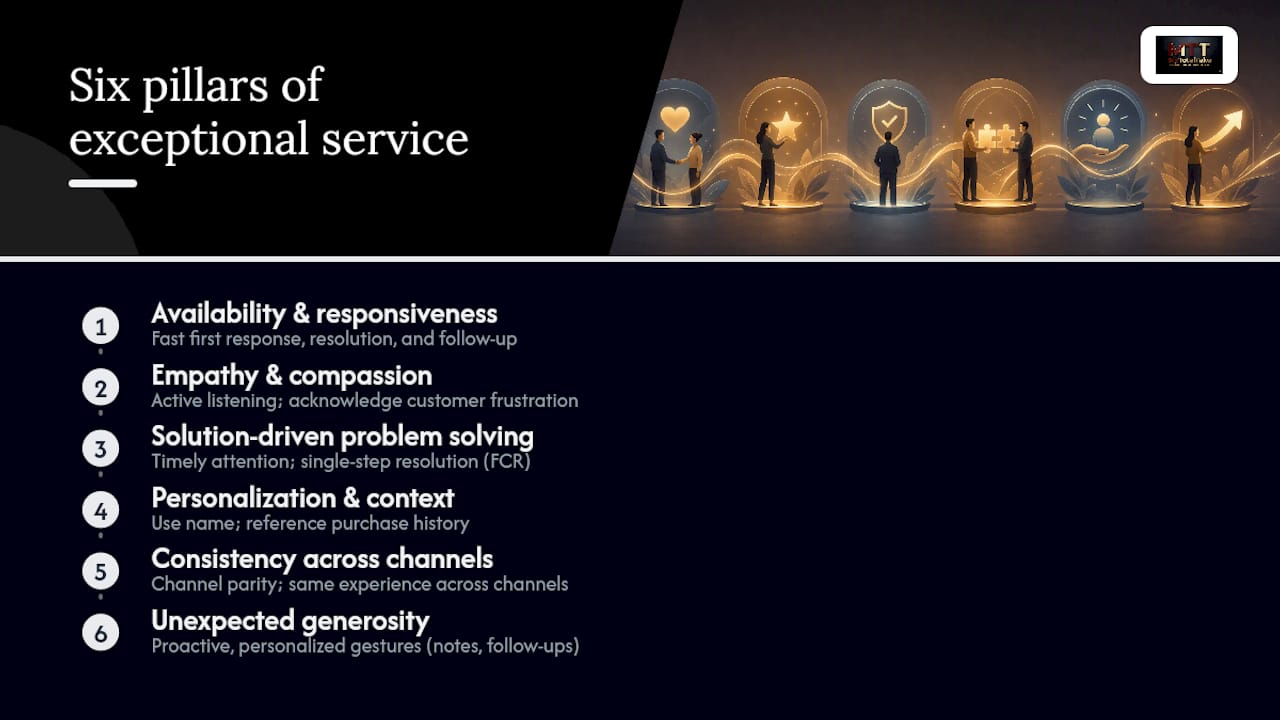
2. Empathy and compassion. Forbes contributors highlight that building meaningful connections and active listening drive word-of-mouth more reliably than any loyalty program. Agents who acknowledge a customer’s frustration before offering a solution consistently score higher on CSAT.
3. Solution-driven problem solving and FCR. Investopedia’s guidance on customer service stresses that timely attention and single-step resolution improve customer perception significantly. Every transfer to another agent or department is a friction point that erodes trust.
4. Personalization and context. Using a customer’s name, referencing their purchase history, or recalling a prior issue signals that they are known, not just a ticket number. CRM tools like Salesforce Service Cloud or Zendesk make this scalable.
5. Consistency across channels. A customer who gets a warm, efficient experience by phone and a cold, scripted one by email will not feel they are dealing with the same brand. Channel parity is non-negotiable for premium service.
6. Unexpected generosity. Indeed’s examples of exceptional service show that proactive, personalized gestures, such as handwritten notes or personalized follow-ups, convert ordinary transactions into loyalty-building moments. The gesture does not need to be expensive; it needs to feel genuine.
Pro Tip: Automate the routine. Use chatbots and response templates to handle order status, FAQs, and basic troubleshooting. That frees your human agents to focus entirely on the high-empathy, high-stakes interactions where a real person makes all the difference. Salesforce’s practitioner guidance confirms this is where technology delivers its highest ROI in service.
How to deliver exceptional customer service starting this week
Knowing the pillars is one thing. Translating them into daily team behavior is another. These are the highest-leverage actions, ordered by how quickly you can implement them.
Train for empathy, not just product knowledge. Role-play scenarios where agents practice acknowledging emotions before offering solutions. Indeed’s career resources confirm that empathy, active listening, and communication are trainable skills that improve measurably with rubric-based coaching and post-interaction feedback.

Set an FCR target and track it weekly. If you do not currently measure FCR, start. Aim for a solid target above average benchmarks. Review every escalated or transferred ticket to identify the root cause, whether it is a knowledge gap, a policy restriction, or a missing tool.
Empower agents to make on-the-spot decisions. A $10 goodwill credit or a free replacement authorized at the agent level resolves issues faster and costs less than a multi-step escalation. Define a clear dollar threshold and give agents the authority to use it without manager approval.
Use CRM context in every interaction. Before an agent responds, they should see the customer’s order history, prior contacts, and any open issues. This single change eliminates the most common frustration: customers repeating themselves.
Build proactive outreach rules. If a shipment is delayed, email the customer before they contact you. If a product has a known issue, reach out with a solution. Proactive communication reduces inbound volume and builds trust simultaneously.
Create a follow-up and recovery playbook. After a resolved complaint, a brief follow-up message, whether by email or text, confirms the issue is closed and signals that the brand cares beyond the transaction. Zendesk’s multi-channel guidance emphasizes that clarity and empathy at every stage of resolution are what separate good service from great service.
Dos and don’ts to prevent backslide:
- Do log every interaction in your CRM, even brief ones
- Do set response SLA alerts so no ticket ages past your target window
- Don’t hide escalation paths behind three or more transfers
- Don’t use scripts so rigid that agents cannot adapt to the customer’s actual situation
Real-world examples of exceptional service you can learn from
These four brands have built reputations on specific, repeatable behaviors, not vague commitments to “putting customers first.”
JetBlue. When weather or mechanical delays strand passengers, JetBlue’s social media team responds to individual complaints in real time, often within minutes, with specific updates and compensation offers. The behavior: proactive, channel-native communication at scale. The takeaway for your team: monitor your highest-volume complaint channel and assign a dedicated responder during peak periods.
Zappos. The online retailer built its entire culture around empowering agents to stay on a call as long as the customer needs, with no time-limit pressure. One customer service call famously lasted over ten hours. The behavior: removing artificial constraints that prioritize efficiency over connection. The takeaway: audit your average handle time policy and ask whether it is optimizing for speed or for resolution quality.
Chick-fil-A. The chain trains every team member to respond to “thank you” with “my pleasure” rather than “no problem,” a deliberate word choice that signals warmth and professionalism. More substantively, their staff is trained to anticipate needs, refilling drinks before customers ask and offering to carry trays for guests with young children. The takeaway: identify two or three proactive behaviors your team can standardize and train them until they are instinctive.

Trader Joe’s. The grocery chain empowers any employee to open a product on the spot for a customer who wants to try it before buying. No manager approval required. The behavior: frontline autonomy that eliminates friction and signals trust. The takeaway: map your most common customer hesitation points and give agents the authority to resolve them without escalation.
Each of these examples reflects a deliberate policy, not individual heroics. The Forbes guidance on exceptional service reinforces this: the teams that consistently win on service have built the behaviors into their processes, not left them to chance.
How to measure service quality and coach your team toward it
Metrics without coaching cycles are just scorecards. The goal is to close the loop between what the data shows and what the team does differently next week.
Which metrics to prioritize and why. CSAT and CES are the fastest feedback loops: they capture the customer’s immediate reaction to a specific interaction. NPS is a longer-term brand signal. FCR is the operational metric most directly tied to cost and loyalty. Average handle time and response SLA tell you about capacity and process, not quality. Use them together: a high CSAT with a low FCR means customers feel good about interactions that are not actually resolving their problems.
SurveyMonkey’s guidance on service quality recommends pairing CSAT and CES with skills-based coaching, using survey feedback to identify specific behaviors to reinforce or correct.
The improvement cycle:
- Plan: Set a target for one metric (e.g., raise FCR from 65% to 72% in 30 days)
- Measure: Pull weekly data; segment by agent, channel, and issue type
- Coach: Use specific interactions, not averages, to show agents what good looks like
- Iterate: Adjust the approach based on what moved the metric and what did not
| Common problem | Metric that detects it | Coaching action |
|---|---|---|
| Customers repeat their issue to multiple agents | Low FCR | Map transfer triggers; empower agents to resolve without escalation |
| Customers feel unheard | Low CSAT on empathy items | Role-play acknowledgment phrases; review recordings together |
| Customers find resolution difficult | High CES | Simplify the resolution path; reduce steps required to get an answer |
| Slow first response | Response SLA breach | Set queue alerts; redistribute workload during peak hours |
Quick experiments your team can run in one to four weeks
Small, single-variable tests are the fastest way to find out whether a change actually moves your metrics. Run these in sequence, not simultaneously, so you can isolate what worked.
-
Surprise-and-delight pilot. For 50 consecutive post-purchase interactions, add a handwritten note or a personalized follow-up email referencing the specific product purchased. Measure CSAT for this group against your baseline. Two weeks is enough to see a directional signal.
-
Proactive delay notification test. When a shipment is delayed, send a proactive email before the customer contacts you. Track inbound contact volume for delayed orders in the test group versus a control group. A meaningful reduction in inbound contacts confirms the behavior is worth scaling.
-
Transfer-reduction pilot. Identify your top three issue types that currently require a transfer. Give frontline agents the knowledge and authority to resolve them. Run for two weeks and measure FCR for those issue types specifically.
-
Agent empowerment credit test. Authorize agents to issue a small goodwill credit (define the dollar threshold in advance) without manager approval. Track resolution time and CSAT for interactions where the credit was used versus escalated cases.
-
Active listening script swap. Replace one standard acknowledgment phrase in your response templates with a more specific empathy statement (e.g., swap “I understand your concern” for “That sounds genuinely frustrating, and I want to fix it for you right now”). Measure CSAT on interactions using the new phrase over two weeks.
-
Follow-up message test. For resolved complaints, send a brief follow-up message 48 hours later confirming the issue is closed and asking if anything else is needed. Track whether this group shows higher NPS scores in the next survey cycle.
For each experiment, record the hypothesis, the sample size, the time window, and the result in a shared document. A test that moves a metric by even a few points is worth scaling. Indeed’s examples of exceptional service confirm that small, personalized gestures consistently produce outsized loyalty returns compared with expensive loyalty programs.
The one thing most service frameworks get wrong
Most frameworks treat exceptional service as a training problem. Hire the right people, teach them the right phrases, and the scores will follow. That logic is incomplete.
Exceptional service is a culture problem first. Salesforce’s practitioner guidance is direct on this: a reliable internal environment and aligned company culture are preconditions for consistent exceptional service. Unhappy employees rarely deliver warm, memorable interactions, regardless of how well they know the script.
For teams serving premium customers, the stakes are higher. Buyers of luxury furniture or high-end fashion arrive with elevated expectations. They are not comparing you to the average retailer; they are comparing you to every premium experience they have ever had. That means the first action is not a training session. It is an honest audit of whether your team has the tools, the authority, and the internal support to actually deliver what you are promising.
Set one FCR target, run a one-week transfer-reduction pilot on your highest-volume issue type, and review the results with your team. That single cycle will surface more actionable insight than a full-day training workshop.
Sources
- Salesforce
- Customer service definition and benefits – Investopedia
- 11 Examples of Exceptional Customer Service
- Six Tips For Exceptional Customer Service – Forbes
- 15 qualities of good customer service – SurveyMonkey
- 11 ways to deliver good customer service – Zendesk











Leave a comment