
Why Invest in Premium Goods: Quality That Pays Off

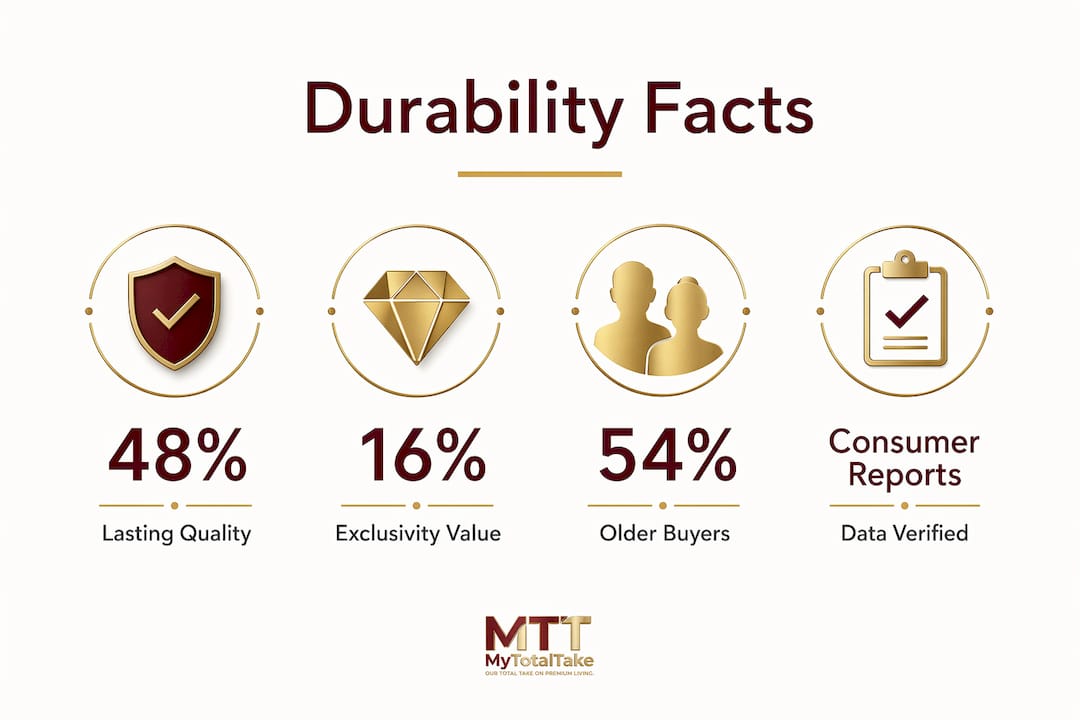
Investing in premium goods means choosing products built to last longer, perform better, and deliver more value per use than cheaper alternatives. The term “quality over quantity investment” captures the core idea: one well-made item outperforms three disposable ones over time. According to Ipsos February 2026 data, 48% of Americans cite longevity and 47% cite brand trust as their top reasons to spend more. That is not impulse buying. That is a deliberate economic decision backed by real consumer experience. The cost-per-use framework, used by analysts at organizations like Consumer Reports and ultracalculators.com, confirms that premium goods frequently cost less per use over their lifetime than budget alternatives.
Why invest in premium goods: what actually drives the decision
Most people do not buy premium goods for status. They buy them to avoid regret.
Ipsos data from February 2026 shows that only 16% of Americans cite exclusivity as a reason to spend more on a product. The dominant motivators are longevity at 48% and brand trust at 47%. That gap tells a clear story: consumers are paying for confidence, not prestige.

Age shapes how people weigh these factors. Older Americans prioritize longevity more strongly, with 54% of adults aged 55 and older citing it as their primary reason, compared to 41% of younger adults. Younger buyers lean slightly more toward image, but quality still ranks above style for that group. The generational difference is one of emphasis, not philosophy.
The core motivations behind premium purchases break down clearly:
- Longevity: Buyers expect the product to outlast cheaper alternatives by a meaningful margin.
- Brand reputation: Trusted brands signal consistent manufacturing standards and post-sale support.
- Avoiding waste: Most consumers pay more specifically to avoid the frustration of replacing a product too soon.
- Reliability over exclusivity: Status is a distant fourth. Performance is the real driver.
Pro Tip: Before buying, search the brand name alongside “reliability” or “owner reviews” on Consumer Reports or similar platforms. A brand’s reputation for standing behind its products is one of the clearest quality signals available.
Do premium goods actually last longer? the evidence
Durability claims are easy to make. Proving them requires rigorous testing, and that is exactly what Consumer Reports delivers.
Consumer Reports’ 2026 methodology combines independent lab tests with large-scale owner surveys covering hundreds of thousands of appliance owners. That combination matters because lab results show how a product performs under controlled stress, while owner surveys reveal how it holds up in real kitchens, laundry rooms, and living spaces over years of use. Neither source alone gives the full picture.
Nonstick cookware is a useful category for understanding how durability testing works in practice. Consumer Reports tests pans using abrasion and cooking simulations that replicate actual failure modes, specifically coating wear and adhesion loss. The results show meaningful variation: some pans demonstrate excellent durability across extended testing cycles, while others reach only mid-range performance. The key insight is that premium price alone does not guarantee top scores. The data does.
Reliability scores based on owner surveys give a more credible picture of long-term durability than any marketing claim. Brands that score consistently high across both lab tests and owner feedback are the ones worth the premium price. Brands that score well in only one dimension deserve more scrutiny.
| Product Category | Evaluation Method | What Premium Brands Typically Show |
|---|---|---|
| Kitchen appliances | Lab tests + owner surveys | Higher reliability scores, fewer repairs |
| Nonstick cookware | Abrasion and cooking tests | Better coating retention over time |
| Home furnishings | Material stress tests + longevity data | Structural integrity over years of use |
| Technology gadgets | Performance benchmarks + user feedback | Consistent output, lower failure rates |
Pro Tip: When evaluating any premium product, look for sources that combine controlled lab data with real owner feedback. Either source alone leaves gaps. Together, they give you a reliable durability picture.
How cost-per-use proves premium goods are worth the price
The sticker price is the least useful number when evaluating a premium purchase. The cost-per-use figure is what actually matters.
Cost-per-use calculation factors in the purchase price, maintenance costs, and the opportunity cost of capital tied up in the product. Divide total ownership cost by the number of times you use the item, and you get a true measure of value. A $300 pan used 500 times costs $0.60 per use. A $60 pan replaced three times over the same period costs $180 total, or $0.36 per use on paper, but that ignores the time, inconvenience, and environmental cost of repeated replacement.
Life-cycle cost modeling, used in scientific and industrial contexts, applies net present value discounting to long-term maintenance and replacement costs. The same logic applies to consumer goods. A product that requires frequent repairs or early replacement carries a higher true cost than its purchase price suggests.
Here is how to calculate cost-per-use for any purchase:
- Record the full purchase price including taxes and shipping.
- Estimate annual maintenance costs such as cleaning products, replacement parts, or servicing fees.
- Project realistic lifespan based on manufacturer data or independent reliability scores.
- Calculate total ownership cost by adding purchase price plus all maintenance over the projected lifespan.
- Divide by estimated total uses to get cost-per-use.
- Compare across options at the same use frequency to identify true value.
Applying this framework to home appliances, outdoor furniture, or premium home upgrades consistently favors the higher-quality option. Replacing a budget appliance twice costs more in total than buying one well-rated unit from the start. The math is straightforward once you run it.
Does a higher price actually signal better quality?
Price functions as a quality signal when direct quality assessment is difficult before purchase. Behavioral research confirms that premium prices shape buyer expectations and increase purchase confidence, particularly when backed by warranties and credible reliability evidence. The signal only holds when it is reinforced by real performance data.
A premium price without supporting evidence is just a number. A premium price backed by Consumer Reports scores, verified owner reviews, and a strong warranty is a genuine quality indicator. The difference matters because buyers who rely on price alone, without checking supporting evidence, are more likely to experience post-purchase regret and higher replacement frequency.
Premium pricing as a quality signal is a constructed relationship between brand reputation and consumer trust. Brands that invest in transparent testing, clear warranty terms, and consistent product performance earn the right to charge more. Brands that rely on packaging and marketing without substance do not.
Use these checkpoints when assessing quality signals before a premium purchase:
- Warranty length and coverage: Longer, more comprehensive warranties signal manufacturer confidence in the product.
- Third-party test results: Look for scores from Consumer Reports, Wirecutter, or category-specific testing organizations.
- Owner review volume and consistency: A high average score across thousands of reviews carries more weight than a perfect score from a handful.
- Brand track record: Brands with decades of consistent reliability data have earned their reputation. New entrants require more scrutiny.
- Return and service policies: Brands that offer generous return windows and accessible service networks stand behind their products in practice, not just in marketing copy.
Ignoring these signals and buying on price alone is the fastest route to the exact outcome premium buyers want to avoid: spending money twice. Exploring why premium home accessories deliver lasting value reinforces this point with specific home-focused examples.
Key takeaways
Premium goods deliver superior long-term value because their durability, lower cost-per-use, and trusted quality signals consistently outperform the cumulative cost of replacing cheaper alternatives.
| Point | Details |
|---|---|
| Longevity drives purchase decisions | 48% of Americans cite lasting quality as their top reason to spend more on a product. |
| Durability requires verified evidence | Combine lab test results with owner survey data for the most reliable durability picture. |
| Cost-per-use reveals true value | Divide total ownership cost by projected uses to compare premium and budget options accurately. |
| Price signals quality only with support | A premium price backed by warranties and test scores is a reliable quality indicator. |
| Exclusivity is rarely the real motivation | Only 16% of buyers cite exclusivity; most pay more to avoid regret and replacement costs. |
The uncomfortable truth about premium purchases
By Lysander
Most articles on this topic tell you to “invest wisely” and leave it there. That advice skips the harder question: which categories actually reward the premium investment, and which ones are just expensive?
My experience is clear on this. Premium goods pay off most reliably in categories where failure is frequent, inconvenient, or costly. Kitchen appliances, outdoor furniture, and home technology are the categories where I have seen the most consistent return on a higher upfront spend. A quality stand mixer or a well-built outdoor sofa outlasts three budget versions without question. The math is not even close once you account for replacement costs and the time spent dealing with failures.
Where premium spending disappoints is in categories where the product’s lifespan is limited by external factors rather than build quality. Trend-driven fashion, for example, can become obsolete before it wears out. In those cases, the premium price buys craftsmanship that never fully expresses itself.
The framework I use is simple: if the product touches your daily life and its failure would be genuinely disruptive, buy the best version you can verify with data. If the product is peripheral or trend-dependent, the premium case weakens considerably. Checking durable luxury furnishings before committing to a home purchase is exactly the kind of due diligence that separates a confident buy from an expensive mistake.
Trust the data. Trust the verified reviews. And be honest about how often you will actually use what you are buying.
— Lysander
Discover premium goods that earn their place in your home
Mytotaltake curates luxury furniture and home decor selected specifically for craftsmanship, durability, and timeless design. Every piece in the collection is chosen because it holds up under real use, not just in a showroom.
If you are ready to move from disposable purchases to heirloom-worthy investments, the luxury furniture collection at Mytotaltake is the right place to start. You will find pieces that justify every dollar through lasting quality and refined design. For broader inspiration, the premium home decor tips guide walks you through selecting items that deliver both style and long-term value. Fast delivery and free returns make the decision even easier.
FAQ
What makes a product qualify as a premium good?
A premium good is defined by superior materials, verified durability, and a brand reputation supported by independent testing and owner reliability data. Price alone does not qualify a product as premium without that supporting evidence.
Is premium worth the cost for everyday items?
Premium goods are worth the cost in categories where durability directly affects daily convenience and replacement frequency. Consumer Reports data shows premium appliances and cookware consistently score higher in reliability, reducing the total cost of ownership over time.
How do i calculate whether a premium purchase makes financial sense?
Divide the total ownership cost, including purchase price and maintenance, by the number of expected uses. Compare that figure against the cost-per-use of a budget alternative to determine which option delivers better long-term value.
Why do older consumers prioritize premium goods more than younger buyers?
Ipsos 2026 data shows 54% of adults aged 55 and older cite longevity as their primary reason to spend more, compared to 41% of younger adults. Older buyers have more experience with the cost of repeated replacements and prioritize avoiding that outcome.
What is the biggest mistake buyers make when investing in premium goods?
The most common mistake is relying on price as the only quality signal. A premium price backed by verified test results and strong warranties is a reliable indicator. A premium price without that supporting evidence is not.
Recommended
Best Portable Projector for Travel Guide
How to Choose a Sectional Sofa That Fits
Comments
[…] Why Invest in Premium Goods: Quality That Pays Off […]









Leave a comment