
Exclusive Customer Service: What It Means for Premium Brands

Exclusive customer service is a model where a brand delivers personalized, relationship-driven support combined with privileged access, reserved for a defined group of high-value customers rather than offered to everyone. Think of a luxury retailer assigning a named stylist to a top client, who then receives a private preview invitation before a collection goes live. As luxury service experts at Zendesk note, this approach centers on unique brand access and clienteling rather than generic help. The three defining elements are personalization depth, privileged access, and relationship-driven delivery.
Key Takeaways
Exclusive customer service delivers lasting loyalty because it combines personalization depth, privileged access, and relationship ownership at the brand level, not just faster response times.
| Point | Details |
|---|---|
| Core definition | Exclusive service pairs personalized, relationship-driven support with privileged access reserved for high-value customers. |
| Three defining elements | Personalization depth, privileged access (previews, events), and dedicated people or channels working together. |
| Primary measurement | Track retention rate, AOV, CLV, and NPS segmented for the VIP cohort separately from the general base. |
| First design step | Define your target segment and success metrics before selecting channels or assigning reps. |
| Relationship ownership | Clienteling profiles keep context at the brand level so the relationship survives staff changes and scales. |
Table of Contents
- What makes exclusive customer service different from standard support?
- How do luxury brands actually deliver exclusive service?
- How do brands build an exclusive service operation?
- When is exclusive service most appropriate?
- What are the risks of offering exclusive service?
- How do you measure whether exclusive service is working?
- A 6-step checklist to design and pilot an exclusive service offering
- How Mytotaltake delivers exclusive service for luxury shoppers
- Why exclusivity in customer service is shifting toward relationship depth
- Sources
What makes exclusive customer service different from standard support?
Standard support resolves problems. Exclusive customer service, by contrast, builds a relationship that makes problems feel almost incidental. The distinction insiders use is telling: exclusive access (who you can reach and when) versus exclusive understanding (whether the person you reach already knows your context and never asks you to repeat yourself).
Salesforce’s definition of personalized customer service frames it well: using customer data and history to tailor every interaction, which increases perceived value and loyalty when done with clear consent and genuine preference signals. In a luxury context, that tailoring goes several layers deeper.
The core components that together create an exclusive offering:
- Personalization depth. Clienteling goes beyond first-name recognition. A well-run program captures preferences, past purchases, life events, and even preferred communication style at the system level, so every interaction feels considered. BSPK’s research on luxury clienteling shows that effective systems record human context around transactions and use it to generate relevant follow-ups and invitations.
- Privileged access. Early product previews, limited-edition holds, invitation-only events, and members-only content create a sense of belonging that price alone cannot replicate.
- Dedicated people and channels. A named representative, a concierge line, or a direct messaging thread signals that the brand has reserved human attention specifically for you.
- Proactive service. White-glove programs reach out before a problem surfaces: anniversary reminders, curated replenishment suggestions, or a check-in after a high-value delivery.
- Relationship ownership at the brand level. Clienteling systematizes what once lived only in an associate’s memory, so the relationship survives staff turnover and scales across locations.
| Feature | Standard customer service | Exclusive customer service |
|---|---|---|
| Response routing | Queue-based, first available | Named rep or dedicated concierge |
| Context retention | Ticket history only | Full clienteling profile (preferences, life events) |
| Access | Public channels | Private lines, invite-only events |
| Outreach | Reactive | Proactive, anticipatory |
| Relationship owner | Individual associate | Brand-level profile |
Pro Tip: The most durable sign of an exclusive program is that a customer’s relationship with the brand does not reset when their favorite associate leaves. If context lives only in one person’s head, you have good service, not exclusive service.
How do luxury brands actually deliver exclusive service?
Channels vary by objective. Relationship-building calls for unhurried, high-touch formats. Urgent problem-solving needs a direct line with fast escalation. Curated commerce works best through private digital experiences that feel like a personal invitation rather than a broadcast.
Common delivery formats in premium and luxury contexts:
- Private in-person appointments. A reserved fitting room, a closed-door preview, or an at-home consultation. The physical setting signals that the customer’s time is valued.
- Dedicated phone or concierge lines. A number that rings a named rep or a small specialist team, with no hold queue. Google Cloud’s premium support model offers a useful analogy: dedicated account resources and priority response expectations convert exclusivity into measurable operations.
- Direct email or DM threads. A personal address rather than a support alias. The customer knows exactly who they are writing to.
- Invitation-only events. Private previews, trunk shows, or member dinners that combine commerce with genuine hospitality.
- Private microsites or in-app VIP experiences. A gated digital space with early access to new arrivals, member pricing, or curated edits. Smart home and technology integrations increasingly mirror this model, offering app-based concierge features for premium product owners.
A concrete example of how these channels combine: a member receives a personalized email with a private booking link for a 30-minute preview appointment. The email references their previous purchases and notes two pieces selected specifically for them. After the appointment, a follow-up arrives from their named rep with a delivery update and a curated recommendation for a complementary item.
How do brands build an exclusive service operation?
The gap between the idea of exclusivity and a repeatable operation comes down to three things: data, people, and decision rights.
Clienteling vs. CRM. A standard CRM records transactions. A clienteling layer adds context: preferred color palettes, upcoming life events, how the customer prefers to be contacted, and notes from prior conversations. Service personalization research confirms that genuine tailoring requires both provider capability and the customer’s clear desire for something different. Capturing that desire requires asking, not assuming.

Named reps and escalation paths. In enterprise settings, Google Cloud’s premium support assigns Technical Account Managers with defined responsibilities and real-time collaboration channels. The luxury retail equivalent is a personal stylist or client advisor with a clear escalation path to a senior manager for complex or sensitive requests.
Data plumbing. Unified customer profiles, loyalty-tier logic, and AI-enabled routing allow VIP customers to be identified automatically and routed to the right resource. Zendesk’s personalization guidance notes that AI-enabled tools can surface VIP customers and deliver tailored journeys, though true exclusivity still depends on human judgment and policy-backed empowerment.
Privacy and consent. Collecting contextual data is only defensible when customers understand what is captured and why. Opt-in preference centers, clear data policies, and data minimization practices are not optional extras; they are the foundation of trust in any premium relationship.
A practical build sequence:
- Audit existing customer data for completeness and consent status.
- Define VIP criteria (spend threshold, purchase frequency, product category, referral value).
- Select or configure a clienteling tool or CRM fields to capture contextual notes.
- Assign named reps and document their empowerment limits: what they can promise, what requires manager sign-off.
- Build escalation playbooks so reps know exactly when and how to involve senior support.
- Pilot with a small cohort before scaling.
When is exclusive service most appropriate?
Not every customer interaction warrants a white-glove approach, and trying to apply it universally dilutes the experience for everyone. Exclusivity adds the most value in specific, high-stakes moments.
- High-ticket and bespoke purchases. A customer spending significantly on a single order, or commissioning a custom piece, expects a level of attention proportional to the investment. Premium home enhancement projects are a clear example: the purchase decision is complex, the stakes are high, and a named advisor who understands the project context is worth more than any discount.
- High-net-worth and affinity customers. Individuals who purchase frequently, refer others, or carry significant social influence warrant proactive relationship management rather than reactive support.
- Major lifecycle events. A wedding, a home renovation, a relocation. These moments create concentrated buying activity and emotional significance. A brand that acknowledges the context, rather than treating the purchase as an isolated transaction, builds lasting loyalty.
- Privacy-sensitive requests. Celebrity or VIP logistics, gift purchases, or situations where discretion is expected. Named reps with clear confidentiality protocols handle these far better than a general support queue.
- Retention touchpoints. Anniversary outreach, curated replenishment offers tied to past purchases, and personalized recommendations for wellness products or seasonal refreshes keep the relationship active between purchases.
What are the risks of offering exclusive service?
Exclusivity creates real value, but it also creates real risks if the program is designed carelessly.
- Expectation creep. Once a customer receives exclusive treatment, they expect it consistently. Without documented service-level agreements and clear empowerment rules for reps, promises made informally become obligations the brand cannot always honor.
- Perceived unfairness. Customers outside the VIP tier notice when others receive preferential treatment. Transparent communication about how tiers work, and what any customer can do to qualify, reduces resentment considerably.
- Privacy exposure. Detailed contextual profiles are valuable precisely because they contain sensitive information. Inadequate security, over-collection, or unclear consent flows create legal and reputational risk. Data minimization and regular consent audits are non-negotiable.
- Operational cost. Named reps, private channels, and invitation-only events carry real costs. Scaling an exclusive program without a clear unit-economics model can erode the margin it was designed to protect.
- Pilot before scaling. A cohort of 50–100 customers is enough to test channel design, rep empowerment rules, and KPI baselines before committing to a full rollout.
Pro Tip: Write a service recovery playbook before you launch. The moment an exclusive customer has a bad experience is the moment your program’s credibility is tested. A rep who knows exactly what they can offer, and how fast, recovers trust far more effectively than one improvising under pressure.
How do you measure whether exclusive service is working?
Measurement starts with separating VIP cohort data from the general customer base. Without that segmentation, exclusivity’s impact is invisible in aggregate metrics.
Core KPIs to track:
- Retention rate for VIP cohort vs. control group
- Average order value (AOV) and year-over-year change for members
- Customer lifetime value (CLV) segmented by tier
- NPS and CSAT collected specifically after exclusive touchpoints (not blended with general surveys)
- First-contact resolution rate on premium channels
Process metrics that reveal operational health:
- Time-to-escalation for VIP tickets vs. standard queue
- Percentage of VIP tickets routed to a named rep on first contact
- Event RSVP-to-attendance rate for invitation-only experiences
- Clienteling profile completeness score (what percentage of VIP records have contextual notes beyond transaction history)
Setting benchmarks using an internal pilot-versus-control design is more reliable than industry averages, because exclusivity programs vary too much in scope and category to compare directly. Run the pilot cohort for a full purchase cycle before drawing conclusions.
A data hygiene note: VIP tags and tier logic must be consistent across every system (CRM, e-commerce platform, support tool) before reporting. A customer tagged as VIP in one system but not another will generate misleading metrics and frustrating service gaps.
A 6-step checklist to design and pilot an exclusive service offering
- Define your target segment and success metrics. Who qualifies, and what will you measure? Retention lift, AOV increase, and NPS delta for the cohort are the three most useful starting points.
- Select channels and assign ownership. Choose two or three formats (a named rep, a dedicated email address, one invitation-only event per quarter) and name the person or team responsible for each.
- Build data profiles and consent flows. Configure clienteling fields or CRM notes for preferences, life events, and communication style. Set up an opt-in preference center so customers control what you capture.
- Write service playbooks and empowerment limits. Document what a rep can promise without escalation (a complimentary delivery upgrade, a priority hold on a new arrival) and what requires manager sign-off. Operationalizing decision rights prevents expectation creep.
- Pilot with a limited cohort. Fifty to one hundred customers is sufficient to test the design. Collect both quantitative KPIs and qualitative feedback from reps and customers after the first full purchase cycle.
- Iterate, scale, and communicate transparently. Refine playbooks based on pilot findings, then scale the rules rather than just the headcount. Communicate program membership clearly to members, and explain tier criteria to the broader customer base to manage perception.
How Mytotaltake delivers exclusive service for luxury shoppers
A Mytotaltake member’s journey illustrates how these principles translate into a real e-commerce context.
A customer browsing premium accessories creates an account and, after a qualifying purchase, receives an invitation to the members-only program. Onboarding includes a short preference survey covering style categories, preferred delivery windows, and communication preferences. That data populates a clienteling-style profile that informs every subsequent interaction.
When a new curated collection arrives, the member receives a private preview email before the collection goes live publicly. The email references their stated preferences and highlights two or three pieces selected for them specifically, with a direct booking link for a priority hold. Their named contact handles any questions about fit, materials, or delivery logistics, with a clear escalation path to senior support for complex requests.

After delivery, a follow-up message confirms satisfaction and includes a curated recommendation for a complementary piece, drawing on purchase history. For members who have expressed interest in luxury furniture, white-glove delivery coordination is available, with real-time updates and a dedicated contact for any post-delivery questions.
Key features of this model:
- Private product previews tied to stated preferences, not generic new-arrival blasts
- Named contact for the full purchase journey, from discovery through delivery
- Curated replenishment and cross-category recommendations based on purchase history
- Express delivery with free returns, reinforcing the low-risk, high-trust dynamic
- Member-only content and early access to limited editions
KPIs Mytotaltake watches in this context include conversion lift from invite-only preview events compared to standard launches, AOV uplift among members versus non-members, and delivery satisfaction scores for white-glove orders.
Why exclusivity in customer service is shifting toward relationship depth
The conventional wisdom holds that exclusive service is primarily about speed: faster responses, shorter queues, priority routing, similar to how home renovation projects require coordinated delivery logistics for premium customers. Speed matters, but it is the floor, not the ceiling. The brands that will define premium service over the next decade are investing in context, not just velocity.
AI-enabled personalization and unified profiles are making parts of the luxury playbook accessible to brands that could not previously afford dedicated clienteling teams. Zendesk’s research on personalized service confirms this shift: digital tools are enabling deeper context and faster routing at scale, blurring the line between luxury and everyday service. What that means in practice is that the differentiator is moving. Any brand can now offer a fast response. Fewer can offer a response that demonstrates genuine knowledge of who the customer is and what they actually need.
The human element is not going away. AI-enabled routing can surface context and speed escalations, but a rep who lacks the empowerment to act on that context delivers nothing. The investment that matters is in training, playbooks, and decision rights, not only in technology.
My recommendation: treat exclusivity as a relationship architecture problem, not a channel problem. The question is not which platform to use. It is whether your organization captures the right context, empowers the right people, and communicates the right boundaries to sustain a relationship that a customer would genuinely miss if it disappeared.
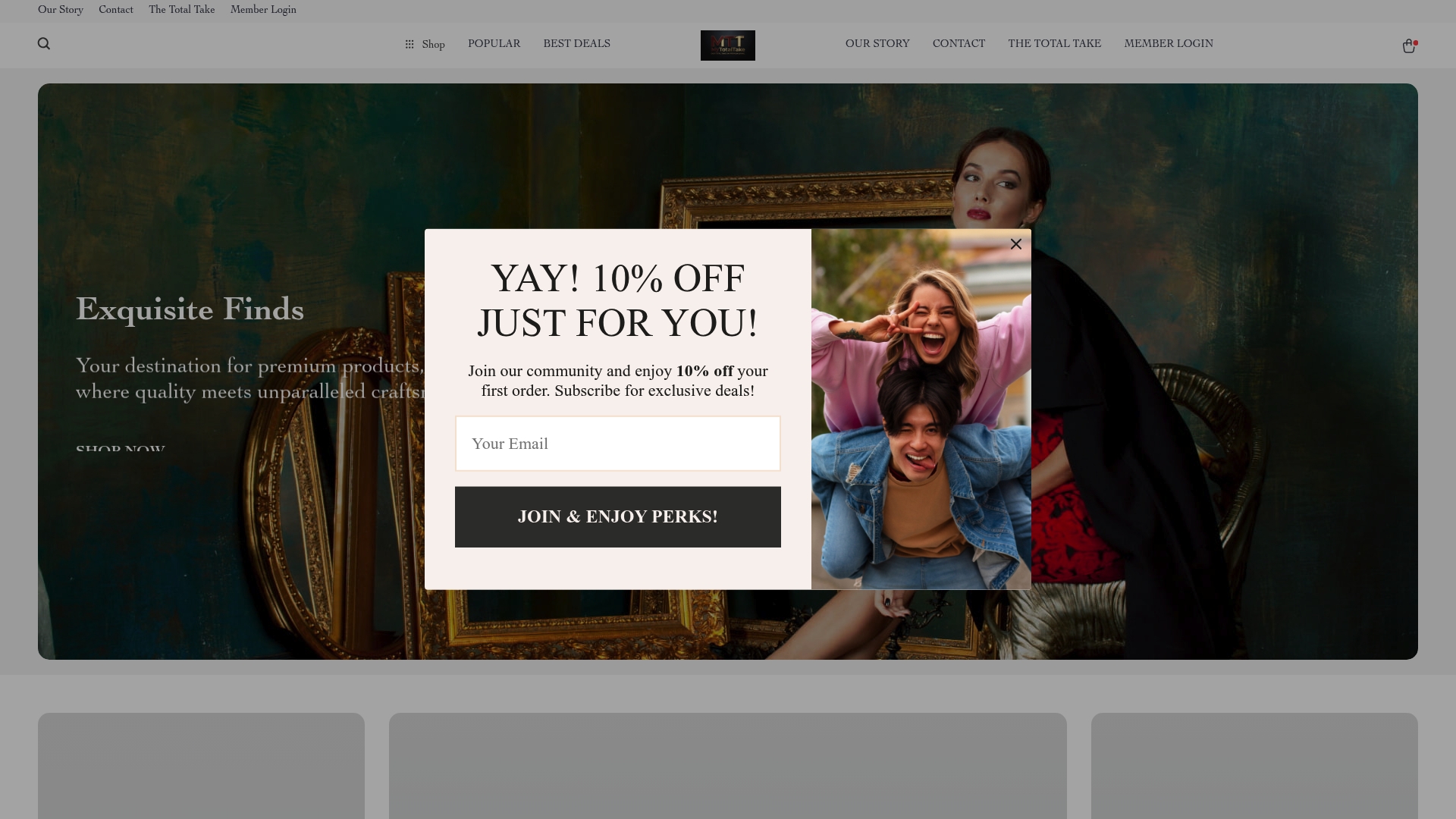
Mytotaltake brings this philosophy to life across every category it carries, from designer accessories to luxury furniture. Members receive curated previews, named support, and white-glove delivery as standard, not as an upgrade. If you value a shopping experience that knows what you care about before you have to explain it, explore the full collection at Mytotaltake.
Sources
- When luxury customer service is no longer a luxury, but the norm
- What is personalized customer service? — Salesforce
- How Luxury Brands Deliver VIP Service: Clienteling, Personalization, and Repeat-Customer Strategy — BSPK
- Premium support — Google Cloud











Leave a comment