Benefits of Advanced Home Technology for Homeowners

Advanced home technology delivers measurable gains across five areas that matter most to discerning homeowners: comfort and convenience, energy savings, security, accessibility, and long-term property value. As of 2026, the average U.S. household electric bill is about $150 per month. Smart devices can realistically reduce electricity costs by $25–45 per month. Here is what the full list covers:
- Comfort & convenience — learning thermostats, voice assistants, automated routines
- Energy savings — smart plugs, coordinated schedules, HVAC optimization
- Security & safety — verified alerts, smart locks, remote monitoring
- Accessibility — hands-free controls, automated lighting, aging-in-place support
- Home value — premium integrations that appeal to buyers and appraisers
Table of Contents
- The main benefits of advanced home technology, mapped to devices
- How sensors, algorithms, and integrations actually produce those benefits
- How modern energy management saves money without sacrificing comfort
- What advanced security tech actually adds, and where its limits are
- How smart tech supports aging-in-place and accessibility
- Privacy and data risks, and how to manage them
- Realistic costs, timelines, and a pilot plan
- How to choose and integrate luxury-grade home tech
- Your 4–8 week pilot: a clear action plan
- The environmental picture beyond energy savings
- Key Takeaways
- Why premium integration is worth getting right
- Curated luxury tech that pairs with a well-designed home
- Useful sources for further reading
The main benefits of advanced home technology, mapped to devices
Each benefit category connects directly to a device class that delivers it. Knowing that link helps you spend where it counts.
- Comfort & convenience: Smart thermostats like Ecobee learn your schedule and adjust automatically; voice assistants handle lighting, music, and climate without a single switch.
- Energy efficiency: Coordinated routines tying thermostats, smart plugs, and motorized shades can save $400–600 per year for a typical household.
- Security & safety: Smart locks, video doorbells, and motion-triggered cameras give you verified, real-time awareness of every entry point.
- Accessibility: Voice-driven climate control and automated lighting let older adults and people with mobility challenges manage their environment without physical effort.
- Home value: Well-integrated, premium smart home upgrades add buyer appeal and signal quality craftsmanship to appraisers.
How sensors, algorithms, and integrations actually produce those benefits
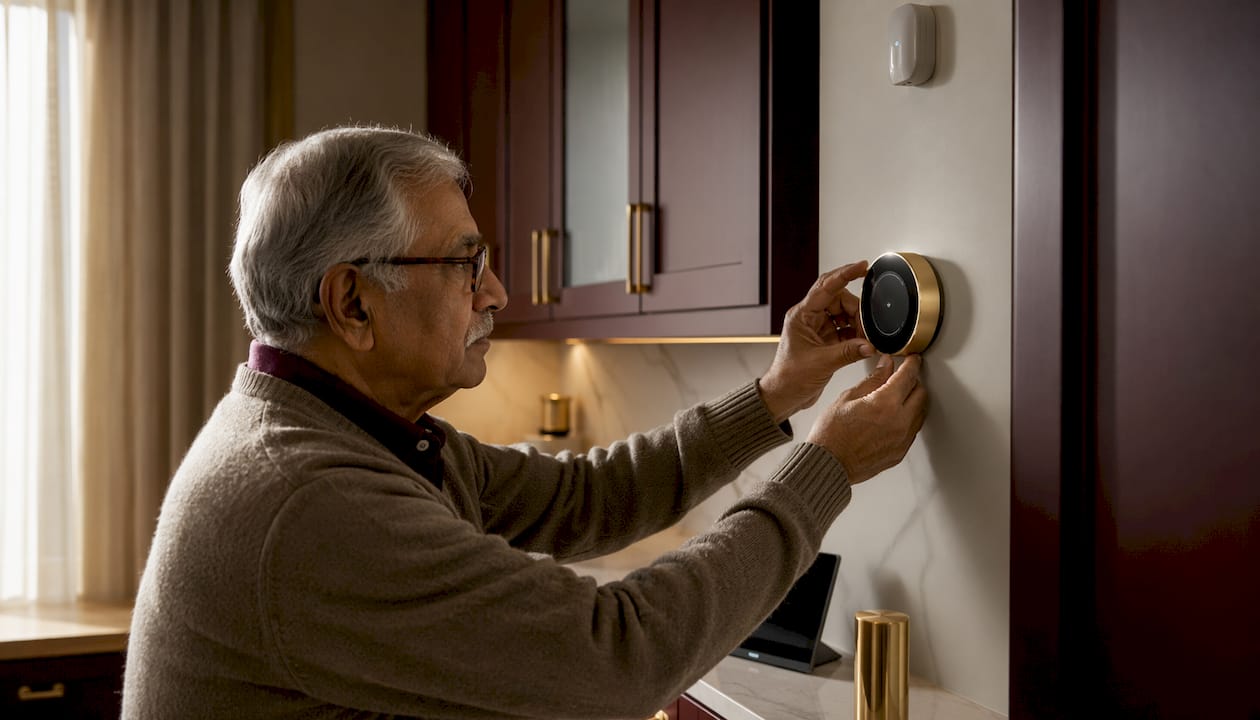
The benefits come from data flow and coordinated automation, not from individual gadgets sitting in isolation. A single smart bulb saves pennies. A unified control layer saves hundreds.
The chain works like this: occupancy sensors, temperature probes, and energy monitors feed data to a central hub (Google Home, Apple HomeKit, or a local controller like Home Assistant). The hub applies logic, either a hard schedule you set or an AI-driven routine that learns your patterns, and triggers devices accordingly. Industry experts frame this as a partnership model where the system offloads routine decisions and reduces mental load.
Learning algorithms add a second layer. They track when rooms are occupied, when you typically leave, and how long your HVAC takes to recover, then adjust pre-conditioning timing to avoid wasted energy. The key constraint: well-designed systems enforce comfort-first rules so the algorithm never sacrifices your preferred temperature to chase marginal savings.
Pro Tip: Before building any automations, run energy-monitoring plugs on your entertainment center, home office strip, and kitchen counter for two full weeks. Real usage data tells you exactly where to cut, and the role of AI in smart homes is most powerful when it has accurate baselines to learn from.
How modern energy management saves money without sacrificing comfort
Modern systems can cut HVAC and lighting waste while holding your preferred temperature, because they enforce user-defined comfort constraints before optimizing for savings. This is the core idea behind the Comfort Violation Penalty Index: advanced algorithms penalize any schedule adjustment that pushes the home outside an acceptable comfort band, so savings never come at the cost of a cold morning or a sweltering afternoon.
Smart thermostats deliver the single biggest impact, with conservatively 15% HVAC savings and payback often under 24 months. Energy-monitoring smart plugs are among the fastest financial wins, typically costing $12–15 each and saving $8–15 per month on high-standby loads, with payback period around 5–12 months. Motorized shades add passive thermal control, reducing solar heat gain in summer and retaining warmth in winter, though payback periods tend to be longer.
Pro Tip: Start with a thermostat plus three to four energy-monitoring plugs. That combination covers the two highest-impact categories and gives you measurable billing data within one cycle, before you commit to a larger installation.
What advanced security tech actually adds, and where its limits are
Integrated sensors, verified alerts, and automated responses lower risk and speed your reaction time. That is the real security gain, not the hardware itself.
- Smart locks let you grant and revoke access remotely, log every entry, and eliminate the risk of copied keys.
- Video doorbells and cameras provide verified visual confirmation before you respond to an alert, cutting false-alarm fatigue.
- Door and window sensors trigger instant notifications and can arm a siren or alert a monitoring service automatically.
- Advanced fire and smoke detectors, including interconnected systems with remote alerts, add a layer of protection that traditional detectors cannot match.
The limitations are real. Camera blind spots, notification fatigue from high-sensitivity motion alerts, and cloud-dependent systems that fail during an outage are all genuine trade-offs. On the financial side, some homeowners insurance carriers offer discounts for verified smart security systems, but those discounts often require a paid professional monitoring subscription, so net savings vary. Evaluate the subscription cost against the discount before committing. For a deeper look at security without monthly fees, there are well-integrated options that avoid that trade-off entirely.
How smart tech supports aging-in-place and accessibility
Voice control, automated lighting, and remote monitoring materially increase independence for older adults and people with mobility challenges. Industry guidance from CEDIA identifies hands-free controls and routine automation as the most important enablers for aging-in-place.
- Routine-based lighting turns on automatically at dusk and along nighttime paths, reducing fall risk without requiring any manual action.
- Voice-driven climate control lets residents adjust temperature without reaching for a panel or app.
- Remote monitoring integrations allow family members to check in passively, without intrusive check-up calls.
- Fall-detection and medical-alert integrations can connect to smart home hubs, triggering lights and unlocking doors for emergency responders automatically.
Pro Tip: Prioritize hands-free controls and predictable fail-safe routines above all else for accessibility installs. If the internet goes down, lights should default to on, not off. Local control options (Zigbee, Z-Wave, or a local hub) protect against cloud outages.
Privacy and data risks, and how to manage them
Privacy risks are real but manageable with straightforward settings and deliberate procurement decisions. The checklist below covers the actions that move the needle most.
- Choose local processing where possible. Devices that process data on-device or via a local hub (Home Assistant, Hubitat) expose less to cloud breaches than fully cloud-dependent systems.
- Segment your network. Put smart home devices on a dedicated IoT Wi-Fi network, separate from computers and phones.
- Enable multi-factor authentication on every platform account (Google Home, Amazon Alexa, Apple HomeKit).
- Update firmware promptly. Most smart home vulnerabilities are patched quickly; unpatched devices are the primary attack surface.
- Read vendor data policies before buying. Some manufacturers sell usage data to third parties; others offer explicit opt-outs.
- Plan for decommissioning. Factory-reset every device before disposal and remove it from your account to prevent data exposure.
On storage trade-offs: cloud-based video storage is convenient but creates a persistent record. Local NVR storage keeps footage off third-party servers, at the cost of managing the hardware yourself.
Realistic costs, timelines, and a pilot plan
Low-cost items, specifically smart plugs, LED bulbs, and a smart thermostat, deliver the fastest return. Whole-home installations take longer and cost significantly more. Automation setups range from roughly $500 for a basic package to $15,000 or more for a full professional installation, with whole-home payback averaging 3–6 years.
| Device | Typical Cost | Est. Annual Savings | Payback Period |
|---|---|---|---|
| Smart thermostat (e.g., Ecobee) | — | — | 8 months |
| Energy-monitoring smart plugs (×4) | — | — | 5 months |
| Smart LED lighting (whole home) | — | — | 2–4 years |
| Full professional install | $15,000 or more | $400–600 | 3–6 years |
Phased approach:
- Phase 1: Smart thermostat plus four energy-monitoring plugs. Baseline your bill, run routines for 4–8 weeks, measure savings.
- Phase 2: Smart lighting and automated shades for rooms with high sun exposure.
- Phase 3: Full hub integration, security layer, and voice assistant ecosystem.
How to choose and integrate luxury-grade home tech
Ask about interoperability, local-control options, repair terms, and how the hardware fits your existing finishes before signing any installation contract.
Buyer checklist:
- Does the system work with your existing ecosystem (Apple HomeKit, Google Home, Amazon Alexa)?
- What happens when the internet goes down? Does the system fail safe or fail dark?
- What is the firmware update policy, and for how long does the manufacturer commit to software support?
- Are repair parts and certified technicians available in your area?
- How does the hardware integrate with your current architecture, millwork, or wall finishes?
For luxury installations, unobtrusive hardware matters as much as performance. Keypads, sensors, and speakers that disappear into the design are worth the premium over bulky alternatives. Integrating tech with high-end decor requires the same curatorial eye you bring to furniture and art. Expect ongoing costs for firmware updates, periodic hardware replacements (smart bulbs every 3–5 years, batteries in sensors annually), and optional service contracts for professional monitoring or system maintenance.
Your 4–8 week pilot: a clear action plan
A focused pilot of a smart thermostat plus three to six energy-monitoring plugs will tell you whether to scale, within two billing cycles.
- Install the thermostat and set a hard schedule based on your actual daily routine.
- Place energy-monitoring plugs on your entertainment center, home office strip, and kitchen counter.
- Record your baseline electricity bill from the prior month.
- Run the thermostat schedule and plug automations for 4–8 weeks without changing other habits.
- Compare the new bill to baseline. Note any comfort issues (too warm, too cool, inconvenient override moments).
- Apply the decision rule: if you save more than $50 per month or comfort measurably improved, expand to Phase 2. If savings are minimal, iterate the schedule before adding hardware.
The ENERGY STAR SHEMS program validates packages that combine a certified thermostat, smart lighting, and plug-load monitors, giving you a recognized framework for verifying your own results.
The environmental picture beyond energy savings
Reduced energy consumption is the most visible environmental benefit, but the full picture includes device lifespan, manufacturing impact, and end-of-life disposal.
Smart home devices carry an embedded carbon cost from manufacturing. A device replaced every two years has a higher lifetime footprint than one that lasts a decade, even if the shorter-lived unit is slightly more efficient. Prioritize hardware with long manufacturer support windows and replaceable components (batteries, sensors) over sealed units with planned obsolescence.
E-waste is a growing concern. The EPA’s responsible electronics recycling guidance points to certified e-Stewards and R2-certified recyclers as the appropriate disposal path for smart home hardware. Factory-reset devices before recycling to protect your data. Some manufacturers, including Google and Amazon, offer take-back programs for their own hardware.
Behavioral rebound effects also deserve attention. Research shows that automation can increase device usage rather than reduce it, because easier operation lowers the psychological barrier to use. Pair automation with usage caps and periodic energy-report reviews to protect net savings over time.
Key Takeaways
Advanced home technology delivers its strongest returns when devices are coordinated into routines, not operated as isolated gadgets.
| Point | Details |
|---|---|
| Fastest ROI devices | Smart plugs and a smart thermostat pay back in 5–21 months; start there before scaling. |
| Comfort-preserving strategy | Use comfort-constraint algorithms and hybrid schedules so savings never override your preferred temperature. |
| Privacy basics | Segment your IoT network, enable MFA, choose local processing where available, and factory-reset before disposal. |
| Pilot before scaling | A 4–8 week pilot with baseline billing data tells you whether to expand or iterate before committing to a full install. |
| Mytotaltake curation | Mytotaltake curates premium, design-forward home tech and decor for homeowners who want verified quality alongside lasting elegance. |
Why premium integration is worth getting right
The conversation around smart home technology tends to fixate on payback periods and app ecosystems. Those matter, but they miss the more durable argument for investing in well-integrated, high-quality systems: the home itself becomes a more considered, more livable space.
Cheap smart devices installed without a coherent plan produce notification fatigue, compatibility headaches, and hardware that looks out of place in a well-appointed room. The homeowners who get the most from advanced technology are not the ones who bought the most gadgets. They are the ones who treated the system as a design decision, not just a technical one. Interoperability, aesthetic fit, and long-term software support are the criteria that separate a home that ages well from one that needs a full rip-and-replace in five years.
The energy and security gains are real and worth pursuing. But the deeper value is a home that quietly understands your routines, requires less daily management, and holds its quality over time. That is the standard Mytotaltake applies when curating premium home technology, and it is the standard worth holding any installation to.
Curated luxury tech that pairs with a well-designed home
Mytotaltake brings the same editorial rigor to home technology that it applies to furniture, decor, and design. For homeowners who want advanced systems that perform and look the part, the platform’s curated guides connect premium hardware to the spaces it belongs in.

Whether you are outfitting a primary residence or a second home, the selection at Mytotaltake is filtered for durability, design integrity, and long-term value. The luxury furniture and decor resources pair naturally with smart home integrations, because the best technology disappears into a room rather than dominating it. For homeowners ready to move from research to a curated shortlist, visit Mytotaltake’s premium home decor guides to find selections that hold their value as confidently as the technology they complement.
Useful sources for further reading
- ENERGY STAR Smart Home Tips — The official SHEMS framework for verified energy savings across thermostat, lighting, and plug-load monitors. Use this to validate your own setup against a recognized standard.
- CEDIA Home Automation Benefits — Industry guidance on accessibility, aging-in-place, and professional installation standards from the leading home technology trade association.
- HomeTechTested — Smart Home Savings (2026) — Sourced cost and payback data for common smart home devices, including thermostat and plug ROI ranges.
- Modern Home Compass — Energy Routines Guide — Detailed breakdown of coordinated routines using Ecobee, Lutron, and smart plugs, with real savings figures.
- IIASA / Energy and Buildings Study — Peer-reviewed research on behavioral rebound effects in home automation; essential reading before assuming automation always reduces consumption.
Recommended
The Premium Home Office Setup Process: 2026 Guide
Review Compact Espresso Machine for Small Kitchen
Comments
[…] carefully selected pet camera deserves the same consideration as any other home upgrade. Choose one that fits your space, respects your pet’s personality, and makes the moments apart […]











Leave a comment