
Home comfort unlocked: The essential role of ergonomics

That plush, oversized sofa might look like the pinnacle of relaxation, but spending a few hours working or reading on it can leave you with a stiff neck and an aching lower back. The assumption that expensive, visually luxurious furniture automatically delivers superior comfort is one of the most common and costly mistakes homeowners make. True, lasting comfort comes from ergonomic design, which means shaping your environment to fit you, not the other way around. This article walks you through the principles, the evidence, and the practical steps for bringing genuine ergonomic comfort into a high-end home.
Table of Contents
- What is ergonomics and why does it matter at home?
- How furniture and workspace setup affect your well-being
- Beyond the basics: Behavioral strategies for ergonomic comfort
- Making ergonomic design work for luxury living spaces
- Our perspective: Why true luxury means personalized ergonomic comfort
- Upgrade your space: Elegant solutions for ergonomic comfort
- Frequently asked questions
Key Takeaways
| Point | Details |
|---|---|
| Ergonomics boosts home comfort | Proper ergonomic design reduces pain, improves productivity, and enhances luxury living. |
| Furniture needs to fit you | Matching furnishings to your body and tasks prevents discomfort and supports wellness. |
| Behavior matters as much as furniture | Combining ergonomic setups with movement and training delivers the best results for home comfort. |
| Luxury requires ergonomic awareness | True high-end living blends aesthetics with personalized ergonomic solutions for sustained comfort. |
What is ergonomics and why does it matter at home?
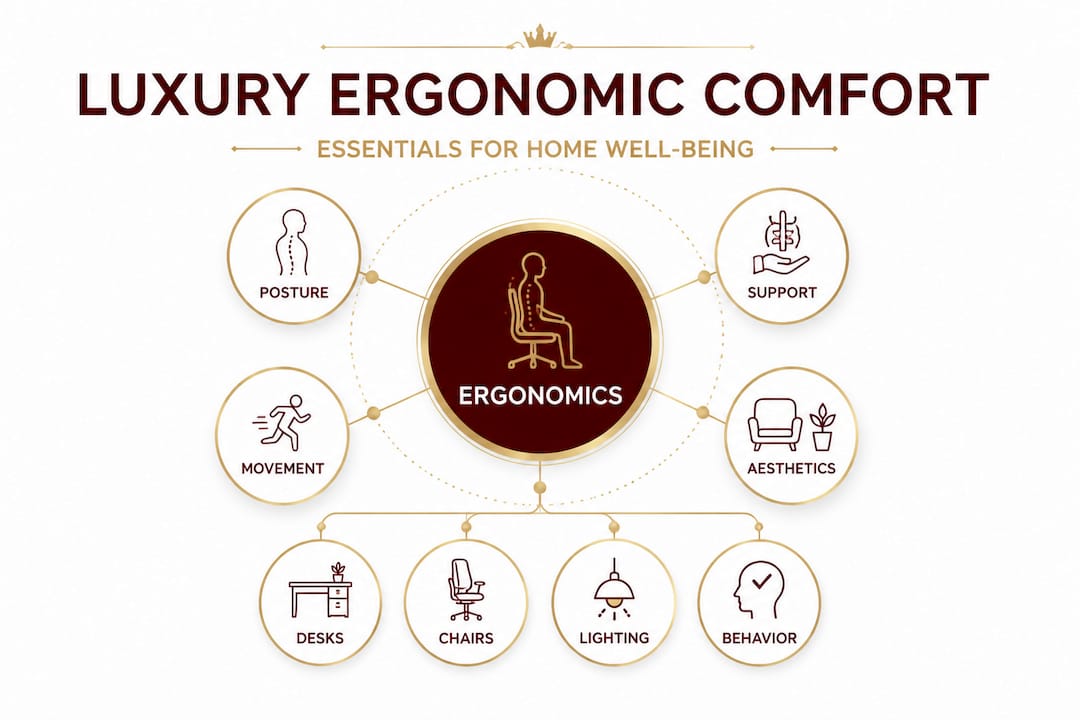
Ergonomics is the science of designing spaces, furniture, and tools so they work with the human body rather than against it. At home, that means everything from the height of your desk chair to the lumbar support of your sofa.
Most people associate ergonomics with corporate offices. But with remote work now a fixture of daily life, the home environment carries just as much weight for physical health and mental well-being. Research confirms that proper ergonomic equipment is empirically linked to reduced sedentary time and improved comfort during at-home work. That is not a small benefit. Hours spent in a poorly fitted space compound over time into chronic pain, fatigue, and reduced focus.
Here is what good home ergonomics actually delivers:
- Reduced musculoskeletal strain, especially in the neck, shoulders, and lower back
- Improved posture that protects your spine across long sessions
- Higher focus and productivity during work-from-home tasks
- Better sleep quality, since your body is not recovering from physical stress all day
- Longer-term wellness, reducing the risk of repetitive strain injuries
Luxury design is beautiful, but beauty alone does not protect your spine. Exploring luxury home wellness products that merge premium aesthetics with proven ergonomic principles is where the real value lives. When you invest in smart ergonomic furniture choices, you are not compromising style. You are adding a layer of intelligence to it.
Pro Tip: Before purchasing any high-end furniture piece, sit in it or simulate your typical use case for at least 15 minutes. A chair that feels amazing for 5 minutes may feel entirely different during a two-hour work session.
How furniture and workspace setup affect your well-being
With ergonomics defined, it is vital to see how your daily furniture choices affect real, measurable outcomes for your health and performance.
The furniture you use for work, leisure, and dining directly shapes your posture, muscle engagement, and overall physical load. Studies show that poorly matched workstation furniture, such as using sofas or floor cushions for desk work, is directly associated with higher rates of musculoskeletal complaints and worse performance. This is not about aesthetics. It is about alignment.

Consider the impact of screen height alone. When your monitor sits too low, you naturally tilt your head forward and down. Holding that position for a couple of hours places significant compressive force on the cervical spine. Multiply that across a five-day work week and you have a recipe for chronic neck pain, regardless of how luxurious your seating feels.
The cost of the wrong setup
| Setup type | Musculoskeletal risk | Performance impact |
|---|---|---|
| Sofa or floor cushion | High (neck, shoulder, back strain) | Reduced focus and slower output |
| Standard dining chair | Moderate (limited lumbar support) | Mild discomfort over long sessions |
| Ergonomic office chair | Low (supports natural spine curve) | Sustained focus and output |
| Adjustable sit-stand desk | Very low (redistributes postural load) | Highest sustained performance |
The data tells a clear story. Upgrading your setup is not vanity. It is investment in your body’s long-term performance.
Key furniture factors to evaluate:
- Seat depth and width that accommodates your build without pressure on the back of your thighs
- Armrest height that allows your shoulders to relax completely
- Desk or table height aligned with your natural elbow position when seated
- Monitor or screen distance set to roughly arm’s length to reduce eye strain
- Lumbar support that matches the curve of your lower back
For those designing a dedicated workspace, our best standing desk guide offers detailed guidance on selecting height-adjustable surfaces that combine clean, premium design with genuine postural support. Even your dining area plays a role. Getting dining table dimensions right means better seated posture during meals, which matters more than most people realize.
Pro Tip: Use the “90-90-90 rule” as a quick self-check. When seated, your hips, knees, and ankles should each form roughly 90-degree angles. If any joint feels compressed or awkward, your furniture setup needs adjustment.
A note on sofa seating for work: Sofas are brilliant for relaxation and social time. They are not designed for sustained task work. Using a sofa as a home office chair, even a very expensive one, increases neck and shoulder flexion beyond the thresholds associated with comfort and safety. Save your sofa for leisure, and invest in task-appropriate seating for work.
Beyond the basics: Behavioral strategies for ergonomic comfort
Understanding the impact of furnishing is just the first step. The strategies that actually multiply your ergonomic gains go beyond simply swapping one chair for another.
Here is a truth most interior designers will not tell you: even the most precisely fitted ergonomic furniture will not solve your comfort problems if you sit in it, motionless, for eight hours straight. The body is designed to move. Prolonged static posture, even in perfect alignment, increases muscle fatigue and compresses spinal discs.
Research confirms that combining adjustable furniture with behavioral strategies, including movement breaks, sit-stand alternation, and ergonomic training, outperforms any passive “set-and-forget” furniture approach. The hardware is the foundation. The behavior is the multiplier.
Passive setup vs. active ergonomic strategy
| Approach | Comfort level | Long-term benefit | Required effort |
|---|---|---|---|
| Passive: ergonomic chair only | Moderate improvement | Limited without movement | Low |
| Active: breaks + sit-stand use | High improvement | Significant pain reduction | Moderate |
| Combined: furniture + habits + training | Highest improvement | Sustainable wellness gains | Moderate to high |
The combined approach consistently wins. Here is how to put it into practice in your own home:
- Set a movement timer. Every 45 to 60 minutes, stand up, stretch, and take a short walk, even just to the kitchen and back. This resets your posture and restores circulation.
- Use your sit-stand desk deliberately. Alternate between sitting and standing across your work day rather than staying in one position. A practical rhythm is 45 minutes seated, 15 minutes standing.
- Practice task-based positioning. Match your posture to your task. Reading calls for different positioning than typing. Adjust as your activity shifts.
- Invest in short ergonomic education. Simply knowing how to adjust your own equipment, chair height, armrests, lumbar support, dramatically improves outcomes. Most people never read the adjustment guide for their chair.
- Create environmental cues. Position your water bottle across the room so you have to stand to hydrate. Small friction points build movement habits effortlessly.
Smart home upgrades can support this active approach in elegant ways. Programmable lighting scenes, for example, can signal a movement break or shift from work mode to relaxation mode. Explore smart home upgrades that integrate seamlessly into a premium living environment while reinforcing healthy behavioral rhythms throughout your day.
Making ergonomic design work for luxury living spaces
Having learned advanced strategies, it is time to apply ergonomic wisdom directly to the aesthetic demands of a luxury living space, without compromising either.
The good news is that ergonomics and high-end design are not in conflict. The best luxury furniture makers understand anatomy. Scandinavian and Italian design houses have spent decades perfecting pieces that are both visually striking and physically supportive. The challenge is knowing what to look for, and what to avoid.
The key principle is this: furniture must match the user and the specific task. Research is clear that comfort depends on task-furniture fit, not on how comfortable a piece looks in a photograph. A beautifully styled floor cushion in a reading nook can increase neck and shoulder flexion significantly during extended use, raising your risk of discomfort even in a thoughtfully designed space.
Here is how to integrate ergonomics into a luxury home without sacrificing aesthetic integrity:
- Prioritize adjustability in task furniture. Desks, chairs, and monitor stands should be adjustable for your specific body. Fixed-height luxury pieces are beautiful but often impractical for long-term daily use.
- Choose lounge seating that still supports. Deep cloud-style sofas are indulgent and visually striking. Look for pieces that include removable lumbar cushions or built-in back support to make extended lounging sustainable.
- Layer materials with purpose. Premium foam densities, high-resilience cushion fills, and supportive base frames deliver comfort you can feel over years, not just the first few weeks.
- Think in zones. Separate your home into task zones (work, dining) and recovery zones (lounge, reading). Apply strict ergonomic criteria to task zones, and softer ergonomic principles to recovery zones.
- Audit your space seasonally. Bodies change, tasks shift, and furniture wears. Reassessing your setup twice a year ensures your environment continues to serve you.
The cloud couch comfort experience is a perfect example of how plush, visually luxurious design can still be engineered for genuine physical support. Paired with the right luxury wellness upgrades, your home can look exceptional and feel exceptional at the same time.
Pro Tip: When evaluating a luxury sofa or lounge chair for long-term comfort, sit in it for at least 20 minutes and pay attention to where pressure builds. Genuine ergonomic support distributes weight evenly. If you feel concentrated pressure under your thighs or at your lower back, that piece is not serving your body well, regardless of its price tag.
Our perspective: Why true luxury means personalized ergonomic comfort
There is a difference between a space that looks luxurious and one that genuinely supports the life you live inside it. We have seen it repeatedly. Homeowners invest significantly in premium furnishings, only to find that back pain, fatigue, and restlessness follow them from their previous, less expensive home. The problem was never the budget. It was the assumption that luxury translates automatically to comfort.
Real comfort is not universal. Your body dimensions, your daily tasks, your health considerations, and even your preferred sleeping and sitting positions all influence what ergonomic fit actually means for you. A chair that is perfectly calibrated for one person can be subtly wrong for another, and that subtle wrongness accumulates into pain over months.
We believe the most important shift a discerning homeowner can make is moving from passive to active ergonomic engagement. This means not just buying the right furniture, but learning how to use it correctly, adjusting it regularly, and pairing it with smart behavioral habits. Furniture is the foundation. You are the architect of how it works for your body.
The homes that achieve true, lasting elegance are those designed around the people who live in them, not around a catalog page. Exploring how to approach designing luxury with ergonomic couches reveals how the finest pieces marry form and function without apology. That is the standard worth holding every purchase to.
Upgrade your space: Elegant solutions for ergonomic comfort
Understanding why personalized ergonomics is essential is the first step. Taking action with the right pieces is where transformation happens.

At mytotaltake.com, we curate premium ergonomic furnishings and wellness products selected for both their design excellence and their genuine physical support. Whether you are building a high-performance home office or refining your living room for lasting comfort, our collections are sourced with your well-being in mind. Browse luxury ergonomic furniture with fast delivery and free returns, so upgrading your space is as effortless as the comfort you gain. Discover curated wellness solutions for your home and explore our full range of luxury decor and style to find pieces that elevate every room. Your home should feel as refined as it looks.
Frequently asked questions
What is the best ergonomic furniture for a home office?
The best options are height-adjustable desks and supportive chairs matched to your body and specific tasks. Ergonomic equipment is directly linked to reduced sedentary time and improved comfort during at-home work.
Can sofas or floor cushions be ergonomic for home work?
No. Research shows sofa and floor seating increases neck and shoulder strain and reduces performance compared to proper desk and chair setups, regardless of how premium the materials are.
Does ergonomic design impact home luxury?
Yes, and significantly. Luxury design becomes truly comfortable only when ergonomic principles are matched to the user’s needs. Furniture-task fit determines comfort outcomes, not aesthetics or price alone.
What behavioral strategies help boost home ergonomics?
Movement breaks, deliberate sit-stand alternation, and learning how to properly adjust your furniture all enhance comfort well beyond what furniture alone achieves. Combining hardware with behavioral strategies produces the most sustainable wellness results.
Recommended
Comments
[…] is visible in joinery, weight, and how a piece feels after five years of use. The guide on ergonomics in home design explains how furniture geometry directly affects physical and emotional […]







Leave a comment