
Premium Home Organization Tips for Lasting Elegance

Premium home organization is defined as the practice of building storage systems tailored to your specific lifestyle, designed to maintain both function and beauty over the long term. The industry term for this approach is integrated storage design, and it goes well beyond buying matching bins or clearing a countertop. The best premium home organization tips share one principle: your system must fit your life, not an aspirational version of it. That means accounting for how you cook, entertain, travel, and live before a single shelf is installed. Mytotaltake curates products and insights for homeowners who want organization that looks as refined as it performs.
1. Start with micro-projects to build real decluttering momentum
The most effective decluttering method is not a weekend overhaul. Focusing on a single area for 10 to 15 minutes at a time is the recognized standard for building sustainable habits. That single statistic reframes the entire project: you are not reorganizing your home, you are reorganizing one drawer, then another, then a shelf.
The micro-project approach works because it sidesteps decision fatigue. When you limit the scope, your brain treats each session as a discrete, completable task rather than an open-ended burden. Experts at Time magazine confirm that sorting smaller categories first builds the decision-making muscle needed for higher-stakes choices later, like editing a wardrobe or a library.
Here is a practical sequence for your first week:
- Start with a single junk drawer. Remove everything, wipe the surface, and return only what you used in the last 90 days.
- Move to one pantry shelf. Group by category: grains, canned goods, snacks.
- Tackle a bathroom cabinet. Discard expired products and consolidate duplicates.
- Address one closet rod. Remove anything that does not fit or has not been worn in a year.
- Clear one surface, such as a nightstand or entryway console, and commit to keeping it clear for 30 days.
Pro Tip: Set a physical timer for 12 minutes. When it rings, stop. This trains your brain to associate decluttering with relief rather than exhaustion, which is the only way the habit sticks.
2. Apply the 90% capacity rule to every storage space
Leaving 10% empty space in every storage area is a key strategy for long-term maintenance. That buffer is not wasted space. It is the margin that lets your system absorb new purchases, seasonal shifts, and daily chaos without collapsing.
The 90% rule applies across every storage category in your home:
- Closets: One empty hanger per five occupied ones keeps the rod from becoming a compression zone.
- Kitchen cabinets: One clear shelf section per cabinet allows for easy retrieval and visual calm.
- Linen closets: One empty shelf per unit accommodates guest towels and seasonal bedding without overflow.
- Garage shelving: A 10% gap on each unit prevents the stacking that turns organized shelves into a hazard.
Visible buffer zones also prevent the reflex purchase of more containers. Most homeowners who feel perpetually disorganized are not short on storage. They are short on restraint. When a space looks full, the instinct is to buy another bin. The 90% rule breaks that cycle by making the limit visible and intentional.
Pro Tip: Use clear, labeled bins only if you will realistically maintain the labels. A mislabeled bin is worse than no label at all. Dymo LabelManager or Brother P-touch label makers make the process fast enough to actually sustain.
3. Invest in luxury built-ins and flexible millwork
Custom millwork, integrated lighting, and concealed cabinetry are the most requested luxury storage features among high-end residential clients. Storage has become a luxury amenity in its own right, designed to be timeless and flexible across decades of changing family needs.
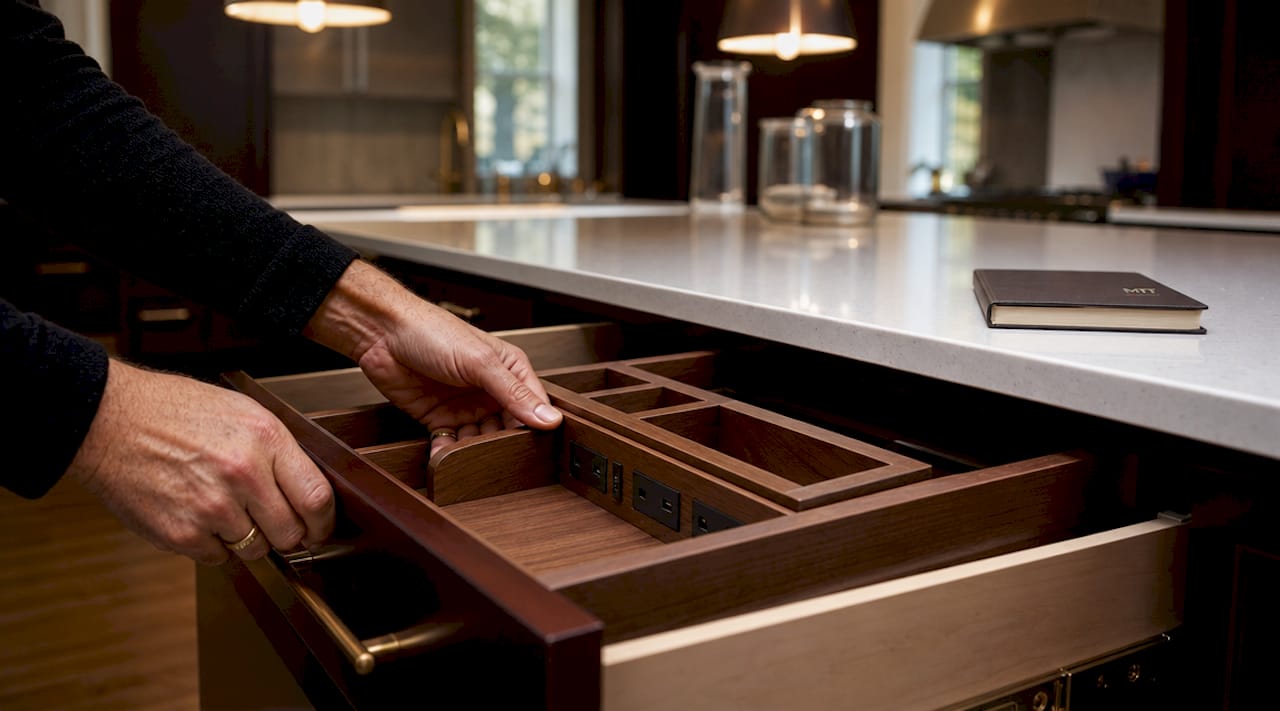
The reason built-ins outperform freestanding furniture is precision. Premium organization infrastructure is most effective when cabinetry is engineered to exact bin and item dimensions, creating a fitted look that freestanding shelves cannot replicate. A mudroom locker designed around your specific coat lengths, boot heights, and bag sizes will outperform a generic unit every time.
Flexibility is the other non-negotiable. Flexible mudroom and pantry systems that adapt over time maximize the lifespan and functional value of expensive custom millwork. A pantry designed for a family of four with young children should be reconfigurable as those children grow and habits change. Adjustable shelving, modular drawer inserts, and removable dividers are what separate a well-designed built-in from a beautiful but rigid one.
| Space | Recommended feature | Functional benefit |
|---|---|---|
| Mudroom | Locker-style cabinetry with integrated hooks | Conceals outerwear, bags, and shoes in one zone |
| Pantry | Adjustable shelving with pull-out drawers | Adapts to changing grocery and appliance needs |
| Home office | Built-in desk with concealed cable management | Maintains clean aesthetic while supporting technology |
| Primary closet | Island with soft-close drawers and integrated lighting | Combines display, storage, and daily-use access |
| Living room | Floor-to-ceiling built-ins with concealed cabinetry | Hides media equipment while framing the room |
Technology integration adds another layer of premium convenience. Charging stations built into drawer inserts, under-cabinet LED lighting on motion sensors, and app-controlled closet lighting are now standard requests in high-end builds. For a deeper look at how design choices shape the luxury experience, the Mytotaltake guide on luxury home decor covers the intersection of storage and aesthetic intent.
4. Treat your storage like an inventory system
Inventory management principles applied to home storage improve retrieval efficiency and reduce clutter liabilities. The practical translation: every item in storage should be findable in under two minutes without moving other items to reach it.
The most common failure in off-site or seasonal storage is the absence of indexing. Hidden off-site storage without indexing creates organizational liabilities, not solutions. A climate-controlled storage unit filled with unlabeled boxes is not organized. It is deferred clutter.
Apply these principles to manage storage with precision:
- Create a category-based index. List every stored item by category, box number, and location. A simple spreadsheet or an app like Sortly works well for this.
- Pack for retrieval, not just storage. Place the most frequently accessed items at the front and top of each unit. Seasonal items used twice a year go to the back.
- Label every container on three sides. One label faces out, one faces up, and one faces the wall. You will always be able to read it regardless of how the box is positioned.
- Schedule a quarterly review. Set a calendar reminder every 90 days to assess what has not been accessed and whether it still warrants the space it occupies.
- Photograph contents before sealing boxes. A quick photo stored in a labeled album on your phone eliminates the need to open boxes to confirm contents.
5. Compare premium storage solutions by room
Not every high-end organizing solution fits every space. The right product depends on the room’s function, traffic level, and aesthetic requirements.
| Room | Best storage solution | Key feature | Trade-off |
|---|---|---|---|
| Primary closet | Custom closet system (California Closets, Poliform) | Tailored to exact wardrobe dimensions | High upfront cost |
| Kitchen pantry | Pull-out drawer inserts with adjustable shelving | Maximizes depth and accessibility | Requires cabinet depth of at least 18 inches |
| Living room | Built-in media cabinetry with concealed doors | Hides electronics while maintaining clean lines | Fixed layout limits future reconfiguration |
| Home office | Modular wall storage (IKEA KALLAX, String System) | Scalable and reconfigurable | Less bespoke appearance than custom millwork |
| Garage | Heavy-duty steel shelving (Gladiator, Husky) | Supports weight and resists moisture | Industrial aesthetic may not suit interior-adjacent spaces |
| Bedroom | Under-bed storage with soft-close drawers | Uses dead space efficiently | Limits airflow under mattress |
Custom pantry designs based on family cooking and shopping habits improve both functionality and visual calm. The distinction between a premium pantry and a standard one is not the price of the shelving. It is whether the shelving was designed around how you actually shop and cook. A household that buys in bulk needs deep pull-out drawers. A household that prioritizes fresh produce needs open shelving near natural light.
For renters who cannot install built-ins, modular systems like the String System or freestanding units from Crate & Barrel offer a credible alternative. The key is choosing pieces with a consistent finish and hardware so the overall effect reads as intentional rather than assembled over time.
Pro Tip: Before purchasing any storage product, measure the items you plan to store, not just the space. A shelf sized to your actual cookware collection will always outperform a shelf sized to the cabinet.
Key takeaways
Premium home organization works because it is built around your actual lifestyle, not a generic template, making it the only approach that holds up over years rather than weeks.
| Point | Details |
|---|---|
| Start with micro-projects | Organize one area for 10 to 15 minutes at a time to build lasting habits without overwhelm. |
| Apply the 90% capacity rule | Leave 10% of every storage area empty to maintain flexibility and prevent system collapse. |
| Invest in flexible built-ins | Custom millwork with adjustable components adapts to changing family needs over decades. |
| Index your off-site storage | Label and catalog every stored item so retrieval takes under two minutes. |
| Match solutions to room function | Choose storage products based on how a space is actually used, not on aesthetics alone. |
Why I stopped chasing the perfect organized home
The most common mistake I see homeowners make is designing their storage for the life they want rather than the life they have. A beautiful linen closet with matching baskets and hand-lettered labels is aspirational. But if you are the kind of person who grabs a towel at 6 a.m. half-awake, that system will be destroyed within a week.
Sustainable systems tailored to real habits outperform aspirational perfection every time. The homes that stay organized are not the ones with the most beautiful storage. They are the ones where the storage requires the least effort to maintain. That means fewer categories, wider tolerances, and a willingness to accept that some areas will never be magazine-ready.
My honest recommendation: spend 80% of your organization budget on the two or three spaces you use every day, such as the kitchen, primary closet, and entryway. Get those right, and the rest of the house will follow. Incremental improvement over six months beats a single weekend overhaul that unravels by Tuesday.
Luxury organization planning begins months ahead, analyzing lifestyle habits to tailor storage infrastructure. That is the standard professionals hold themselves to. You should hold your own home to the same one.
— Lysander
Mytotaltake has the furniture your organization deserves
Organization at the premium level is inseparable from the furniture and cabinetry that houses it. A well-edited storage system built around pieces that are both beautiful and functional is the definition of elegant home organization.

Mytotaltake curates luxury furniture designed to earn its place in your home, from concealed cabinetry and modular storage units to heirloom-worthy pieces that anchor a room for decades. Every product in the collection is selected for craftsmanship, durability, and design integrity. If you are ready to build a home that looks as considered as it functions, explore the premium decor collection and find pieces that work as hard as they look good.
FAQ
What makes home organization “premium”?
Premium home organization combines custom storage solutions, high-quality materials, and systems tailored to your specific lifestyle habits. The result is a home that stays organized with minimal daily effort because the storage was designed around how you actually live.
How do I start decluttering without feeling overwhelmed?
Focus on one small area for 10 to 15 minutes at a time. Starting with micro-categories, such as a single drawer or one pantry shelf, builds decision-making confidence before you tackle larger spaces.
Is custom millwork worth the investment for renters?
Custom millwork is best suited to homeowners with long-term tenure. Renters get comparable results from modular systems like the String System or freestanding units with consistent hardware finishes, which can move with you and still read as intentional design.
What is the 90% capacity rule in home storage?
The 90% capacity rule means leaving 10% of every storage area empty at all times. That buffer prevents overflow, reduces the impulse to buy more containers, and keeps the system maintainable as your household’s needs shift.
How do I manage seasonal or off-site storage effectively?
Treat off-site storage like a warehouse inventory. Label every container on three sides, photograph contents before sealing, and maintain a category-based index so any item is retrievable in under two minutes without unpacking multiple boxes.
Recommended
A Guide to Smart Thermostats for Homes
How to Review Robot Vacuum and Mop Combo
Comments
[…] work. They can maintain a space beautifully, but they are not especially good at improvisation. If your home changes constantly or your expectations are very exacting, a robot vacuum may feel helpful but […]







Leave a comment