
How to choose premium home decor: a guide to timeless luxury

The luxury home decor market is flooded with products that look premium but fall apart within a few years. For discerning homeowners, the real challenge is not finding options — it is identifying pieces that deliver genuine craftsmanship, spatial intelligence, and enduring elegance. True quality is rarely loud. It reveals itself in weight, texture, provenance, and the way a room feels when everything is placed with intention. This guide gives you a clear, expert-backed framework for evaluating every purchase, from structural elements to finishing details, so your investment holds its value and its beauty for decades.
Table of Contents
- Essential criteria for premium home decor
- Applying the PICK method to material selection
- Authenticity and spatial intelligence: Beyond the visual
- Common mistakes and how to avoid them
- Our take: Rethinking luxury decor for 2026 and beyond
- Explore unrivaled collections and elevate your spaces
- Frequently asked questions
Key Takeaways
| Point | Details |
|---|---|
| Material quality matters | Premium decor relies on durability, authenticity, and performance-tested materials. |
| Heirloom value and sustainability | Choose items with lasting appeal and ethical sourcing for genuine luxury. |
| Spatial intelligence first | Design for elegant flow and utility, not just appearance. |
| Avoid trend-driven purchases | Focus on craftsmanship and holistic integration for timeless results. |
| Expert shopping shortcuts | Test textiles for feel, research brand provenance, and build decor hierarchically. |
Essential criteria for premium home decor
Before you buy a single piece, you need a clear definition of what “premium” actually means in a home decor context. Price alone is not the answer. Plenty of expensive items are overpriced, not over-engineered. True premium means exceptional craftsmanship, responsibly sourced materials, a degree of exclusivity, and the kind of heirloom potential and sustainability that makes a piece worth passing down.
Start with structure before anything else. Structural choices — flooring, built-ins, architectural molding — anchor everything that follows. From there, move to facades and surfaces, then palette, and finally the layered details like textiles and decorative objects. Jumping straight to accessories before resolving structural choices is one of the most common and costly errors affluent buyers make.
Here are the essential criteria every premium purchase should meet:
- Provenance and brand transparency: Can the maker explain where materials came from?
- FSC-certified or traceable sourcing: Especially for wood, stone, and natural textiles
- Customization availability: Genuinely high-end pieces can often be tailored to your exact specification
- Heirloom durability: Will this hold structural and aesthetic integrity after 20 years?
- Spatial intelligence: True luxury prioritizes spatial intelligence over surface aesthetics alone
- Exclusivity: Limited production runs or artisan-made pieces resist the mass-market sameness
Use the table below to quickly separate costly decor from genuinely premium decor:
| Feature | Costly but not premium | Genuinely premium |
|---|---|---|
| Materials | Looks refined, no provenance | Verified sourcing, traceable origin |
| Craftsmanship | Machine-finished uniformity | Hand-finished details, slight variation |
| Customization | Fixed catalog options | Bespoke or semi-bespoke available |
| Longevity | 3 to 7 years before wear | 20+ years with minimal care |
| Spatial suitability | Generic sizing | Scaled and planned for your space |
Exploring different luxury home decor styles will help you identify which aesthetic direction aligns with your space before committing to any investment. It also pays to study timeless design principles early — they act as guardrails against impulse purchases that age poorly.

Pro Tip: Before finalizing any significant purchase, handle the piece in person. The physical heft, the smoothness of joinery, and the feel of a surface tell you more in ten seconds than any product description.
Applying the PICK method to material selection
With your foundational criteria clear, the next step is a structured approach to evaluating individual materials. The PICK method for materials gives you exactly that: Performance, Intent, Coherence, and Keep maintenance honest.
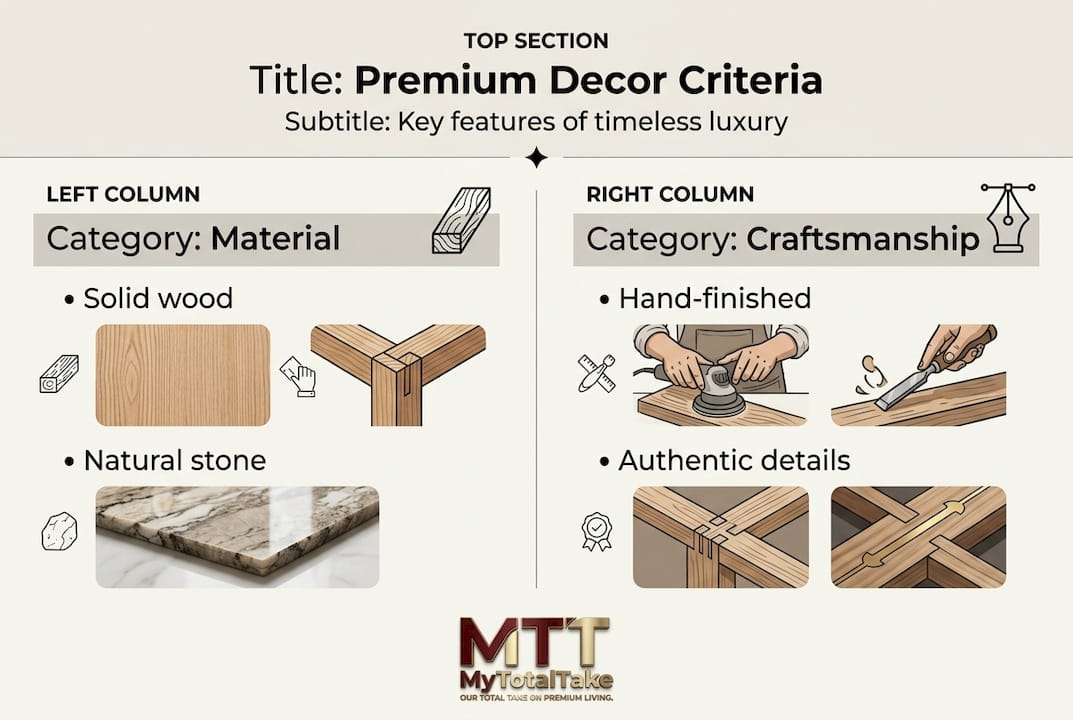
This framework turns a subjective “does this look good?” into an objective checklist that protects your investment.
Here is how to apply it step by step:
- Performance: How does the material behave under real conditions? Marble, for example, is stunning but porous. Engineered stone performs similarly with fewer vulnerabilities. Ask: will this material perform well in its specific location?
- Intent and context: What is the piece meant to do, and does the material support that purpose? A silk throw is appropriate in a formal sitting room. In a high-traffic family space, it is a liability.
- Coherence: Does this material sit harmoniously alongside the other finishes in the room? A brushed-brass fixture in a space filled with matte-black hardware creates visual noise, not refinement.
- Keep maintenance honest: What does caring for this material actually require? Some of the most luxurious finishes — hand-waxed wood, untreated leather — demand consistent upkeep. Know that before you buy.
Use this quick comparison to guide your material choices:
| Material | Durability | Authenticity marker | Ease of care | Relative cost |
|—|—|—|—|
|—|
| Solid hardwood | Very high | Grain variation, weight | Moderate | High |
| Engineered wood | High | Uniform surface layer | Easy | Medium |
| Genuine leather | Very high | Natural texture, scent | Low to moderate | High |
| Faux leather | Medium | Uniform, synthetic feel | Very easy | Low |
| Natural stone | Very high | Veining, weight | Low (sealing needed) | Very high |
| Artisan ceramic | High | Slight irregularity | Easy | Medium to high |
For outdoor spaces, the same logic applies. Pieces designed for outdoor premium decor must pass the performance and maintenance tests with even stricter standards given exposure to weather. And when evaluating technology integration, apply PICK just as rigorously to premium smart home upgrades — performance and coherence matter enormously in that category. You can also find premium material deals that hold up to this scrutiny without requiring a compromise on quality.
Pro Tip: Run your palm slowly across any textile before purchasing. Genuine luxury fabrics have a specific weight and resistance that synthetic alternatives simply cannot replicate. Trust your hands as much as your eyes.
Authenticity and spatial intelligence: Beyond the visual
Material quality alone does not guarantee a luxurious space. Authenticity and spatial intelligence are what separate a well-furnished room from a truly exceptional one. Test heft and run your palm over textiles to confirm authenticity at the physical level, but go further by evaluating provenance documentation, maker signatures, and finish consistency.
Spatial intelligence means planning decor to serve the flow, proportion, and function of a room — not just its visual impact. A soaring sculpture in a low-ceilinged room creates tension, not elegance. Oversized furniture in a narrow corridor blocks energy and movement. True authenticity in luxury decor demands that every element earns its place through both beauty and spatial logic.
Here are the core principles for integrating authenticity and spatial intelligence:
- Proportion first: Scale every piece to the actual dimensions of the room, not to catalog photography
- Negative space is intentional: Luxury spaces breathe; avoid filling every surface
- Provenance documentation: Authentic pieces come with verifiable origin — certificates, maker marks, or artisan notes
- Finish consistency: Run your eye across surfaces at an angle; uneven finishes or visible seams indicate lower quality
- Weight as a quality signal: Heavier pieces in stone, solid wood, or cast metal signal genuine material density
- Sensory coherence: Luxury is also tactile and olfactory — leather, cedar, and natural stone have distinct sensory signatures
“True luxury prioritizes spatial intelligence over aesthetics.”
Knowing how to frame and position art is equally critical. Understanding the rules around arranging wall art in high-end spaces helps you activate vertical space with intention rather than intuition. The same spatial thinking applies to furniture scale — a piece like the cloud couch comfort only works when the surrounding space allows it to breathe and anchor the room properly.
Common mistakes and how to avoid them
Even experienced buyers make avoidable errors in luxury decor. Knowing the most common pitfalls puts you well ahead of the market. The biggest mistake is treating a high price tag as a proxy for quality. It is not. Brand recognition and retail positioning inflate cost regularly without elevating actual craft.
The principle of building hierarchically: structure, facade, palette, details is one of the most effective guards against costly missteps. When you sequence purchases correctly, every subsequent layer reinforces the one before it.
Here are the 5 most common premium decor mistakes to avoid:
- Chasing trends over timeless value: Trend-driven pieces date quickly and rarely hold resale value
- Skipping material verification: Accepting visual impressions without testing heft, texture, or provenance
- Buying before planning spatially: Purchasing statement pieces without measuring flow, proportion, or sight lines
- Prioritizing brand name over craftsmanship: Some heritage brands coast on reputation; always evaluate the actual piece
- Neglecting holistic integration: Individual pieces may be exceptional but clash visually or functionally with the broader room
If you have already made a purchase that is not working, you have three practical options: return it if within the window, resell through a reputable consignment platform, or repurpose it in a different space where the scale and material make more sense. Do not force a piece to work where it does not belong.
Pro Tip: Always resolve structural changes — flooring, wall finishes, lighting architecture — before layering in palette choices or decorative details. Reversing that sequence costs time, money, and visual coherence.
Returning to a trusted luxury styles guide after any misstep helps you recalibrate your direction and make more intentional choices on the next round.
Our take: Rethinking luxury decor for 2026 and beyond
Here is an uncomfortable truth: most affluent buyers still shop for luxury decor the wrong way. They lead with aesthetics and end with regret. They follow what design accounts are showing right now, spend heavily, and find themselves restless again within two years.
The more lasting approach is also the less glamorous one: lead with spatial intelligence, verify materials physically, and invest in fewer pieces chosen with more rigor. As expert decor selection insights consistently reinforce, spatial intelligence over aesthetics is the actual luxury standard.
In 2026, the most sophisticated interiors we see are defined by restraint. They hold ten carefully chosen pieces instead of forty mediocre ones. Each item has weight, provenance, and a clear spatial role. That is the new signal of real wealth and taste. We believe strongly that the premium comfort experience that defines truly elevated living comes not from accumulation, but from intentional curation. Buy less. Choose better. That is lasting elegance.
Explore unrivaled collections and elevate your spaces
You now have the framework to evaluate, select, and invest in premium decor with confidence. The natural next step is finding collections that actually meet these standards. At mytotaltake.com, we curate only the pieces that pass the tests this guide describes: verified craftsmanship, traceable materials, heirloom-worthy construction, and timeless design that holds its relevance year after year.

Whether you are seeking a full refresh or one defining statement piece, our luxury decor styles collection gives you a curated starting point. For rooms that demand a dramatic focal point, our selection of crystal chandelier ambiance pieces delivers instant transformation. And for outdoor spaces that deserve the same standard of quality, explore our range of timeless patio furniture built to perform beautifully through every season.
Frequently asked questions
How can I tell if home decor is truly premium?
Handle the piece directly: run your palm over textiles and assess heft, then request provenance documentation and evaluate construction finish for genuine quality assurance.
What are the most important materials in luxury home decor?
Materials with performance and sustainability credentials — such as FSC-certified solid wood, genuine full-grain leather, and hand-loomed natural textiles — consistently deliver the authenticity and durability that define real luxury.
How do I avoid common mistakes when choosing luxury home decor?
Always build hierarchically — resolving structural elements before surface finishes and decorative layers — and research brands for actual craftsmanship rather than relying on name recognition alone.
Should I prioritize aesthetics or spatial intelligence in luxury decor?
Spatial intelligence over aesthetics is the more reliable standard; pieces that serve proportion, flow, and function in your specific space will always deliver more lasting satisfaction than visually striking items that disrupt spatial harmony.
Recommended
- Timeless Furniture Design: Lasting Elegance for Upscale Homes
- Best Deals on Premium Home Decor That Last
- Discover 7 home decor styles for luxury living spaces
- Smart Home Upgrades That Feel Truly Premium
- Explore interior decor styles: find your perfect home aesthetic – New Way Ref
- How to Choose Upholstered Fabrics for Your Home – Shop Designer Fabrics by the Yard | Curtains & Drapery
Comments
[…] They also hold value over time in ways that mass-produced sets simply do not. Understanding timeless luxury decor principles helps you invest in pieces built to endure. The concept of lasting elegance design […]
[…] you have identified why curation matters, you need a vision to steer every decision. Defining a vision is the foundation for creating a luxury living space, and without it, even the most beautiful […]
[…] premium home decor guide offers additional layering strategies for creating interiors that feel cohesive across multiple […]
[…] wisely from the start makes all the difference. Read more about choosing premium home decor to understand which investments hold their value over […]
[…] townhouse calls for different design choices than a minimalist concrete penthouse. When you’re choosing premium home decor, your selections should feel like a continuation of the building’s character, not a contradiction […]
[…] you are choosing premium handmade decor, understanding this distinction helps you select pieces with intention rather than impulse. […]
[…] does not require starting over. Most people already own pieces worth keeping. The work is in learning to choose premium pieces that anchor the rest, then editing everything else around […]







Leave a comment